
Higher education
Erasmus+ Education and Training
Erasmus+ is the European Programme for education, training, youth and sport.
In the Higher Education sector, the program aims to enhance the personal, academic, and professional development of students and teaching and non-teaching staff, promoting the modernization, quality, and internationalization of institutions, as well as social cohesion and employability.
It fosters transnational cooperation between higher education institutions and socioeconomic partners, promoting knowledge sharing, pedagogical innovation, and academic excellence.
Erasmus+ in Higher Education: A Program for the Entire Academic Community
Erasmus+ offers thousands of students and higher education professionals the opportunity to study, do internships, teach and receive training abroad.
The Higher Education Program is open to students of all study cycles (bachelor's, master's and doctoral degrees), as well as teachers, researchers and technical and administrative staff, in addition to partner institutions and organizations linked to the sector.
Erasmus+ is an open and inclusive program designed to allow the participation of all members of the academic community.
Organization of the Erasmus+ Education and Training Program





Participants and Countries
Individuals are the primary target audience of the Program. However, the Program reaches these people mainly through organizations, institutions, bodies, or groups that organize activities of this type.
All organizations operating in the fields of education and training or higher education institutions can, in various ways and to different degrees, benefit from the Program and transmit it to their audience.
Students, teachers, staff of higher education institutions, etc., can benefit from the Erasmus+ Program and undertake mobility for studies, internships, or training abroad; however, they cannot apply directly but must apply through their institution, provided that the institution participates in the Program.
To learn more, visit the European Commission website .
Many organizations can participate in the Erasmus+ Programme: associations, educational establishments, institutions, etc., applying for funding for mobility and exchange projects, as well as partnerships and cooperation between organizations. Consult the Programme Guide for eligible institutions.
The Erasmus+ Programme is focused on Europe, but has been open to the world since 2015, with 200 countries currently participating or partnering in the Programme.
The conditions for participation and the opportunities offered by the Program vary according to the countries and their geographical locations. The countries are classified into two main groups:
- Countries participating in the Program;
- Partner countries
Participating countries can take advantage of all the opportunities offered by the Erasmus+ Program, which are:
- Member states of the European Union;
- Iceland, Liechtenstein, North Macedonia, Norway, Serbia, and Türkiye.
Partner countries can only participate in certain Erasmus+ Programme activities. The possibilities available to them are specified in the Programme Guide.
These countries are classified by geographic area: those neighboring the European Union and those in the rest of the world.
A complete list of partner countries is available here.
Objectives
Erasmus+ is crucial for achieving these priorities by supporting cooperation between Member States and between higher education institutions in different countries. In this sense, through its various actions in the higher education sector, the program aims to:
- Support for the development of various types of cooperation models, including virtual and blended cooperation and the use of different digital tools and online platforms;
- Improving mobility through the automatic implementation of mutual recognition of qualifications and learning outcomes, also incorporating mobility into curricula;
- Support for Higher Education institutions in implementing the Bologna principles and tools to increase mobility for all;
- Support for higher education institutions to develop and implement education for environmental sustainability.
- The development of student-centered and oriented learning outcomes that better meet learning needs and reduce skills gaps relevant to the job market and society in general;
- The development, testing, and implementation of flexible learning pathways and the design of modular courses ( part-time, online , or blended ) and appropriate assessment methods, including the development of online assessment;
- Promoting lifelong learning in higher education, including the validation and recognition of short courses;
- The implementation of transdisciplinary approaches and innovative pedagogies;
- Promoting the participation and training of women in STEM fields of study, especially in the areas of engineering, ICT and advanced digital skills;
- The integration of content on sustainable development into all student curricula, including the protection and responsible use of resources within the framework of the Green Deal priorities.
- The development of strategies to reward and encourage excellence in teaching, including online teaching;
- Training in new and innovative teaching practices;
- Promoting learning and teaching partnerships.
- Increased access to, participation in, and completion rates of corresponding studies for people with fewer opportunities;
- Proactively supporting participants in the accommodation search process, including promoting suitable and affordable options;
- support for the development of flexible career paths between education and research;
- Promoting gender balance in higher education institutions, both in fields of study and in leadership positions;
- To foster civic engagement through the promotion and recognition of students' informal learning and extracurricular activities.
To support digital capabilities in higher education institutions, namely the implementation of appropriate tools for data management and the development of digital skills among students and teaching and non-teaching staff.
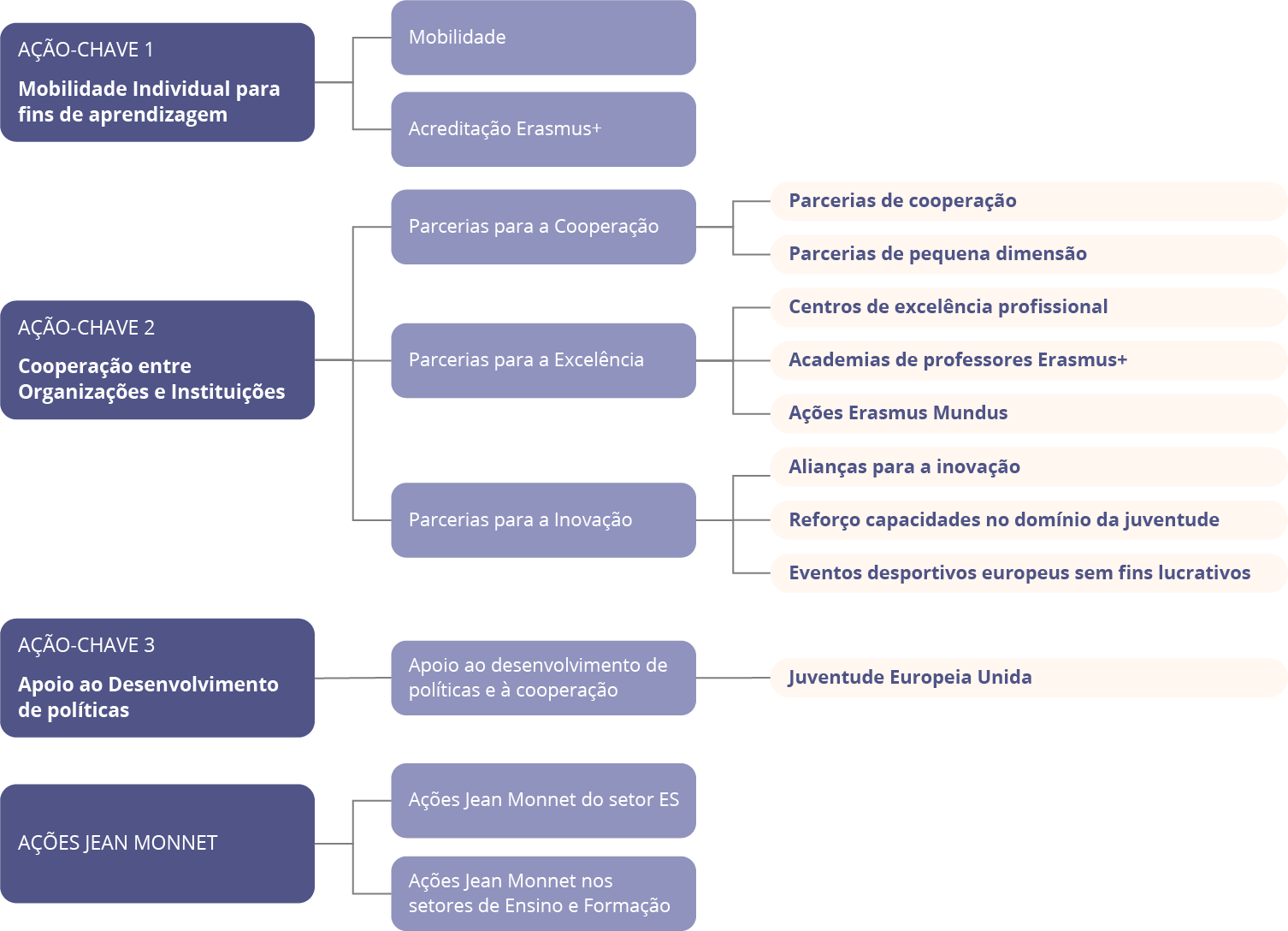
Program Structure
Priorities
THE The renewed European Union Agenda for Higher Education , adopted by the European Commission on May 30, 2017, aims to give new impetus to Higher Education and provides a set of support initiatives for its modernization. Four priorities are identified in this document:
- To ensure the alignment between the skills of graduates and the needs of the economy and the labor market, and to promote excellence in skills development;
- Develop inclusive higher education systems;
- To ensure that higher education institutions contribute to innovation, especially at the local and regional levels;
- To contribute to effective and efficient higher education systems.
Erasmus Charter (ECHE 21-27)
Applications
Applications must be submitted in accordance with the guidelines of the Education and Culture Executive Agency (EACEA).
Quality
The Erasmus Charter for Higher Education (CEES/ECHE) guarantees the quality of mobility and European and international cooperation activities that Higher Education Institutions (HEIs) can carry out within the Erasmus+ Programme. It implies the subscription to a set of fundamental principles and the public adoption of an institutional internationalization strategy through the Programme (DPE – Erasmus Policy Statement).
Mandatory requirement
The awarding of the Erasmus Charter for Higher Education (CEES/ECHE) is a requirement for all Higher Education Institutions (HEIs) located in Member States and third countries associated with the Erasmus+ Programme, that wish to apply for and participate in individual mobility activities for learning purposes and/or cooperation for innovation and exchange of good practices within the Programme.
International relations
The CEES/ECHE standard is not required for Higher Education Institutions (HEIs) in third countries not associated with the Erasmus+ Programme, with the quality framework being established through inter-institutional agreements between these institutions and HEIs in Member States and third countries associated with the Programme.
Duration
Once obtained, the accreditation granted by CEES/ECHE is valid for the entire duration of the current phase of the Erasmus+ Programme (2021-2027).
Monitoring
The implementation of the Charter will be monitored by the National Agency, and any violation of its principles and/or commitments undertaken by Higher Education Institutions (HEIs) may lead to its annulment by EACEA and/or the European Commission.
Updated on September 21, 2026