Saltar para o conteúdo principal

Organization responsible for coordinating and implementing public policies in the field of higher education.

  • BANNERS IES – resultados 3ª FASE

    Publication of the results of the 3rd Phase of the CNA.

    The Institute for Higher Education, IP (IES, IP) informs that the results of the 3rd phase of the National Competition for Access to Public Higher Education of 2026 are now available.

  • BANNERS IES – colocações_2 fase

    Publication of the Results of the 2nd Phase of the National Competition and Professional Competitions

    The results of the 2nd phase of the National Access Competition (CNA) will be published at 00:01 on September 30th, during the transition from Tuesday to Wednesday . Start of the 2nd phase of the special competition for graduates of vocational pathways.

National Access Competition

Find all the essential information to understand how access to higher education works, including applications, available places, quotas, and rankings.

Online application

Essential information for applying to higher education, from the calendar and priority quotas to online applications, entrance exams, and support services.

Other Competitions

All competitions except the National Access Competition.

Special Regimes Competition

Information regarding special admission schemes, including entry requirements, application process, deadlines, and other procedures.

Forms and Guides

This page provides, in electronic format, various forms used for access to higher education.

CNAES

The National Commission for Access to Higher Education has deliberative and advisory powers, and is therefore competent to issue decisions and opinions.

FAQs

Frequently Asked Questions

National Access Competition

General Information

  • How it Works

    Applications for public higher education are made annually through a national competition organized by the Institute for Higher Education (IES, IP).

    The national competition takes place at the end of the school year and is organized in three phases, according to the calendar approved annually.

    The National Commission for Access to Higher Education is responsible for directing the entire process related to assessing eligibility for higher education, as well as establishing the selection and ranking criteria for candidates applying for enrollment in higher education.

    To apply, you must:

    • To hold a secondary education qualification, or a legally equivalent qualification;
    • To have taken the national exams corresponding to the entrance exams required for the different courses and institutions you are applying to;
    • Perform the prerequisites if they are required by the institution for the course you are applying for;
    • Not being covered by the international student statute regulated by Decree-Law No. 36/2014, of March 10, altered and republished by Decree-Law No. 62/2018, of 6 August.

    For each institution/course pairing, a grade equal to or higher than the minimum established grade must be obtained in each entrance exam, as well as in the application grade.
    Minimum grades are set annually by each higher education institution for each of its courses and are published in the Application Guide.
    Candidates can compete in the various stages of the competition.

    However, for students who were placed in the 1st phase and then apply to and are placed in the 2nd phase, their placement in the 1st phase will be automatically cancelled, and consequently, their registration and enrollment will also be void.
    Similarly, for students placed in the 1st or 2nd phases who apply to and are placed in the 3rd phase, that placement is automatically cancelled, and consequently, so are their registration and enrollment.

  • National Final Exams for Higher Education Applications

    In applications to higher education, national final exams can be considered in two different ways:

    • Within the context of conducting entrance exams;
    • Within the context of calculating the final secondary school grade.
  • How to apply

    Applications for higher education through the national entrance exam are made via the portal of the Institute for Higher Education (IES, IP), and require an access password.
    To request a password, you must fill out the form. password assignment request and follow the instructions provided.
    After submitting your password request, you will receive a confirmation message at the email address you previously provided on the form.
    You must confirm the request by clicking on the link in the message you received. Confirmation will generate a password request receipt, which you must print and deliver to the location you indicated (secondary school or higher education access office) for certification.
    After certification, you will automatically receive the password at your email address.
    The password is only sent to the email address provided.
    After obtaining the password from the secondary school or GAES (Office for Access to Higher Education), Candidates may, if they so wish, start a session on online application platform with the digital mobile key.

    The Digital Mobile Key is a means of authentication and digital signature certified by the Portuguese State that allows the user to access various public or private portals and sign digital documents with a single login. This mechanism associates a mobile phone number with the civil identification number for a Portuguese citizen, and the passport number or residence permit/card for a foreign citizen.
    Activation of the digital mobile key is available at www.autenticacao.gov.pt/a-chave-movel-digital

  • Job openings

    Admission to public higher education is subject to quantitative limitations resulting from the number of places set annually by higher education institutions for each of their courses.
    The number of places available for each course at each higher education institution is published annually in the Application Guide.
    The designated positions are put up for competition right from the first phase of the process.
    Generally speaking, the remaining phases consist of vacancies that were not filled by candidates who were placed and enrolled in the previous phase(s).

  • Contingents

    In the first phase of the national competition, the places allocated for each course in each higher education institution are distributed between a general quota and priority quotas:

    • Candidates from the Azores
    • Candidates from Madeira
    • Portuguese emigrant candidates, their families, and people of Portuguese descent.
    • Military candidates on contract.
    • Candidates with disabilities
    • Candidates eligible for School Social Action benefits

    In the second phase of the national competition, the places allocated for each course in each higher education institution are distributed between a general quota and two priority quotas: candidates with disabilities and emigrant candidates, their families, and those of Portuguese descent. .
    In the 3rd phase of the national competition, the places allocated for each course in each higher education institution are distributed among a single quota.

  • Serialization

    In the national competition, up to six institution/course pairs can be submitted, that is, six different combinations of institutions and courses, indicated in order of preference.
    Placement in each institution/course is done according to the ranked lists of candidates until all available places are filled. This ranking is done in descending order of the application score for each institution/course pair.
    Thus, the placement process combines:

    • The order of preference indicated for each institution/course pair;
    • The position the candidate occupies in the ranked lists for each institution/course pair.

    In the national competition, only one placement is possible in each phase.

How it Works

Applications for public higher education are made annually through a national competition organized by the Institute for Higher Education (IES, IP).

The national competition takes place at the end of the school year and is organized in three phases, according to the calendar approved annually.

The National Commission for Access to Higher Education is responsible for directing the entire process related to assessing eligibility for higher education, as well as establishing the selection and ranking criteria for candidates applying for enrollment in higher education.

To apply, you must:

  • To hold a secondary education qualification, or a legally equivalent qualification;
  • To have taken the national exams corresponding to the entrance exams required for the different courses and institutions you are applying to;
  • Perform the prerequisites if they are required by the institution for the course you are applying for;
  • Not being covered by the international student statute regulated by Decree-Law No. 36/2014, of March 10, altered and republished by Decree-Law No. 62/2018, of 6 August.

For each institution/course pairing, a grade equal to or higher than the minimum established grade must be obtained in each entrance exam, as well as in the application grade.
Minimum grades are set annually by each higher education institution for each of its courses and are published in the Application Guide.
Candidates can compete in the various stages of the competition.

However, for students who were placed in the 1st phase and then apply to and are placed in the 2nd phase, their placement in the 1st phase will be automatically cancelled, and consequently, their registration and enrollment will also be void.
Similarly, for students placed in the 1st or 2nd phases who apply to and are placed in the 3rd phase, that placement is automatically cancelled, and consequently, so are their registration and enrollment.

National Final Exams for Higher Education Applications

In applications to higher education, national final exams can be considered in two different ways:

  • Within the context of conducting entrance exams;
  • Within the context of calculating the final secondary school grade.

How to apply

Applications for higher education through the national entrance exam are made via the portal of the Institute for Higher Education (IES, IP), and require an access password.
To request a password, you must fill out the form. password assignment request and follow the instructions provided.
After submitting your password request, you will receive a confirmation message at the email address you previously provided on the form.
You must confirm the request by clicking on the link in the message you received. Confirmation will generate a password request receipt, which you must print and deliver to the location you indicated (secondary school or higher education access office) for certification.
After certification, you will automatically receive the password at your email address.
The password is only sent to the email address provided.
After obtaining the password from the secondary school or GAES (Office for Access to Higher Education), Candidates may, if they so wish, start a session on online application platform with the digital mobile key.

The Digital Mobile Key is a means of authentication and digital signature certified by the Portuguese State that allows the user to access various public or private portals and sign digital documents with a single login. This mechanism associates a mobile phone number with the civil identification number for a Portuguese citizen, and the passport number or residence permit/card for a foreign citizen.
Activation of the digital mobile key is available at www.autenticacao.gov.pt/a-chave-movel-digital

Job openings

Admission to public higher education is subject to quantitative limitations resulting from the number of places set annually by higher education institutions for each of their courses.
The number of places available for each course at each higher education institution is published annually in the Application Guide.
The designated positions are put up for competition right from the first phase of the process.
Generally speaking, the remaining phases consist of vacancies that were not filled by candidates who were placed and enrolled in the previous phase(s).

Contingents

In the first phase of the national competition, the places allocated for each course in each higher education institution are distributed between a general quota and priority quotas:

  • Candidates from the Azores
  • Candidates from Madeira
  • Portuguese emigrant candidates, their families, and people of Portuguese descent.
  • Military candidates on contract.
  • Candidates with disabilities
  • Candidates eligible for School Social Action benefits

In the second phase of the national competition, the places allocated for each course in each higher education institution are distributed between a general quota and two priority quotas: candidates with disabilities and emigrant candidates, their families, and those of Portuguese descent. .
In the 3rd phase of the national competition, the places allocated for each course in each higher education institution are distributed among a single quota.

Serialization

In the national competition, up to six institution/course pairs can be submitted, that is, six different combinations of institutions and courses, indicated in order of preference.
Placement in each institution/course is done according to the ranked lists of candidates until all available places are filled. This ranking is done in descending order of the application score for each institution/course pair.
Thus, the placement process combines:

  • The order of preference indicated for each institution/course pair;
  • The position the candidate occupies in the ranked lists for each institution/course pair.

In the national competition, only one placement is possible in each phase.

Application

  • Calendar

    Approved by Order No. 9359-A/2026, of July 23 | Official Gazette No. 141/2026, Series II of 2026-07-23. (Order No. 6934/2026, of June 1, is hereby revoked)

    Ref.ª Action Home End
    1 Submission of applications for the 1st phase of the national competition for access to higher education – candidates for the priority quota for emigrants, family members residing with them and Portuguese descendants, and candidates requesting the substitution of entrance exams with foreign exams. July 20th July 29
    Submission of applications for the 1st phase of the national competition for access to higher education – remaining candidates July 20th August 6th
    2 Making the placement lists for the first phase of the national competition available electronically to higher education institutions. – August 22
    3 Announcement of the results of the 1st phase of the national competition. – August 23
    4 Registration and enrollment in higher education institutions for candidates admitted in the first phase of the national competition. August 24 August 27
    5 Submission of complaints regarding the results of the 1st phase of the national competition (1) August 24 August 28
    6 Submission of application for the 2nd phase of the national competition. August 24 September 20th
    7 Communication, by higher education institutions to the Institute for Higher Education, IP, of the information referred to in paragraph 4 of article 44 of the national competition regulations. – August 28
    8 Announcement of the vacancies referred to in paragraph 5 of article 44 of the national competition regulations. – September 1st
    9 Decision on complaints relating to the 1st phase of the national competition. (1) – September 28
    10 Making the placement lists for the second phase of the national competition available electronically to higher education institutions. – September 30th
    11 Announcement of the results of the 2nd phase of the national competition. – September 30th
    12 Registration and enrollment in higher education institutions for candidates admitted in the second phase of the national competition. October 1st October 3rd
    13 Presentation of complaints regarding the results of the 2nd phase of the national competition. (1) October 1st October 6th
    14 Communication, by higher education institutions to the Institute for Higher Education, IP, of the information referred to in paragraph 2 of article 47 and paragraph 5 of article 49 of the national competition regulations. – October 6th
    15 Announcement of the vacancies referred to in paragraph 3 of article 49 of the national competition regulations. – October 9th
    16 Submission of application for the 3rd phase of the national competition. October 10th October 12
    17 Decision on complaints relating to the 2nd phase of the national competition. (1) – October 30th
    18 Making the placement lists for the 3rd phase of the national competition available electronically to higher education institutions. – October 18
    19 Announcement of the results of the 3rd phase of the national competition. – October 18
    20 Registration and enrollment in higher education institutions for candidates admitted in the 3rd phase of the national competition. October 18 October 20th
    21 Presentation of complaints regarding the results of the 3rd phase of the national competition. (1) October 18 October 20th
    22 Communication, by higher education institutions to the Institute for Higher Education, IP, of information about candidates placed in the 3rd phase of the national competition who have actually enrolled. – October 23
    23 Decision on complaints relating to the 3rd phase of the national competition. (1) – November 16th
    (1). Complaints may still be submitted and decided upon until the end of the time limits set out in the Administrative Procedure Code.


    NOTE: Consult the publication of the Official Calendar in the Diário da República here.

  • Priority Contingents

    In the first phase of the national competition, there are several priority quotas, in addition to the general quota, to which certain percentages of vacancies are allocated, intended for candidates who meet the conditions of each quota.
    In the second phase, in addition to the general quota, there is also a priority quota for candidates with disabilities and a priority quota for emigrants, their family members residing with them, and people of Portuguese descent.
    In the 3rd phase there is only one single contingent – the general contingent.

    See here for all quotas and application requirements.

  • Application Guide 2026

    During the application period, students have access to all information regarding access to higher education in [location]. iesuperior.pt

    They can also contact the Higher Education Access Offices (GAES), which exist in higher education institutions on the mainland and in the Autonomous Regions of the Azores and Madeira.

    This publication contains the following elements and information:

    Practical guidelines for completing the application process;

    • Higher education training offer indicating the pairs of public higher education institutions/courses and the number of places allocated for the 2026 national access competition, specifying for each:
    1. Whether prerequisites are required, as well as how to prove them;
    2. The required entrance exams;
    3. The minimum required scores for the entrance exams and the application grade, as well as the formula for calculating the application grade;
    4. Assigning different weights to entrance exams, when applicable;
    5. The existence of regional preference in access to institution/course pairs in education.
      higher polytechnic and the respective percentage of reserved places;
    6. The existence of preferential qualifications for access to institution/course pairs in polytechnic higher education and the respective percentage of places reserved.

    The following information is also attached:

    • Equivalent prerequisite groups and information on prerequisite certification (Annex I);
    • A list of public higher education courses that are subject to local admission and an indication of where students should go to obtain additional information (Annex II);
    • Contact details for the Higher Education Access Offices (Annex III).

    Students wishing to apply to private higher education should consult the publication "Guide to Applications to Private Higher Education 2026" or contact their chosen institution.

    Consult the 2026 Application Guide

  • Course Selection Assistant

    The Course Selection Assistant allows you to find institution/course pairs that meet certain conditions.

    After fulfilling the relevant conditions, you can access the results page to obtain the list of institution/course pairs that meet them (cumulatively).

    To start a new search, you should use the "Clear Selections" button, which cancels all previously entered conditions.

    Available search conditions:

    1. Course
    2. Institution
    3. Other conditions

  • CANDIDATURA ONLINE

    Online Application

    PASSWORD ASSIGNMENT REQUEST

    Instructions

    Through this page you can request the password needed to apply to public higher education.

    In the following steps you will be able to fill in your identification, the email address through which you wish to receive the password, and the indication of the school or the Higher Education Access Office (GAES) where you will certify this request.

    After submitting this information, you will receive instructions to confirm your Password Assignment Request and print the corresponding receipt at the email address you provided. If, after submitting your Password Assignment Request, you do not receive the confirmation instructions, please access [link/resource]. Check Order Status.

    You must present the Password Assignment Request receipt and your identification at the school or Higher Education Access Office (GAES) you select, in order to certify your order.

    After confirming your request, your access password will be sent to your email address.

    You can then log in using the password sent to you or by authenticating with your citizen card or digital mobile key.

    If you do not have a valid identification number (citizen card or internal number assigned by your school), you must submit one instead. Request for Password and Identification Number Assignment, which, once confirmed, must be presented at an Office for Access to Higher Education.

    ONLINE APPLICATION

    Through this page you can start a session on the online application site, authenticating yourself using your identification number and access password.

    Students who are not yet registered on this site should request registration through the page. Password Request.

  • Replacing Entrance Exams with Foreign Language Exams

    Students with foreign secondary education

    It's important to know:

    • that your foreign secondary education course must be equivalent to Portuguese secondary education (How do you obtain the equivalence?);
    • who has to take national or foreign final exams;
    • that foreign final exams must be equivalent to the Portuguese entrance exams;
    • which can only replace entrance exams with equivalent foreign final exams, according to the CNAES Deliberations in effect;
    • who can also take the Portuguese national final exams;
    • If you wish to apply for a course that requires prerequisites, please consult the information here.

    Notice: O Order No. 7714/2020, of August 6, establishes procedures for simplifying the processing of equivalencies for foreign secondary education qualifications and for registration for national final exams for citizens residing outside the national territory.

    Foreign Secondary Education Course Equivalent to Portuguese Secondary Education

    To obtain equivalence between a foreign secondary education course and a Portuguese secondary education course, you must request a certificate of equivalence.

    • The certificate of equivalence is issued by secondary schools in Portugal or by the Directorate-General for Education, where applicable – https://area.dge.mec.pt/dsdccomext/
    • The equivalency certificate must identify the foreign secondary education course and its final grade, on a scale of 0 to 200 points.
    • You can find more information about foreign equivalencies. here

    FINAL NATIONAL AND FOREIGN EXAMS

    To replace entrance exams, foreign final exams must cumulatively meet the following conditions:

    • Having a national scope – these are tests required for admission to higher education in that country that constitute exams of national scope or,
    • have national recognition. If the country does not require entrance exams for higher education, final exams in foreign secondary education subjects that constitute national exams, or local exams in the foreign country, and have national recognition are considered.
    • to be homologous exams to the entrance exams.
    • to be valid as a substitute for entrance exams.
      Exams taken since 2022 are valid for five years, that is, the year they are taken and the following four years.

    HOMOLOGOUS FOREIGN EXAMS

    The homologation of foreign exams is determined by the National Commission for Access to Higher Education (CNAES).
    CNAES publishes annually, by May 31st of the application year, a resolution with the list of equivalent foreign final exams.

    For the application, please consult the information released by CNAES.

    Exam classification

    The grading of foreign exams, when used as entrance exams, is converted to the Portuguese scale of 0 to 200 points.

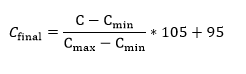
    a) For classifications expressed in whole or decimal form using numerals, the following formula applies:

    being Final The classification converted to the Portuguese scale, C; the classification obtained in the examination as stated on the diploma or certificate., Cmin the minimum foreign scale classification that allows the candidate access to higher education in that country and Cmax the highest rating on the foreign scale.

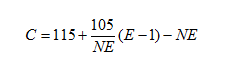
    b) In cases where the classification is presented in alphabetical order, the following formula applies:

    where C is the final classification to be assigned, on a scale of 0 to 200 points, E is the positive grade to be converted, and NE is the number of positive grades existing in the foreign classification system being converted.

    • The conversion of scales with a number of positive levels greater than 10 is subject to case-by-case assessment by the National Commission for Access to Higher Education;
    • In cases where the positive alphabetical levels include classifications expressed in decimals or hundredths, the maximum classification that can be awarded in the respective foreign secondary education system is assigned the maximum classification of 200 points;
    • In cases where an entrance exam is replaced by a combination of two exams from non-Portuguese courses that are legally equivalent to Portuguese secondary education, the verification of the minimum grade requirement for the entrance exam is done after calculating the average of the two exams;
    • In cases where an entrance exam is replaced by a combination of two exams from non-Portuguese courses legally equivalent to Portuguese secondary education, the calculation of the grade to be assigned to the entrance exam must be carried out by converting the grade of each exam to the Portuguese scale, and then calculating the average;
    • Situations not covered in the previous cases are subject to analysis and deliberation by the National Commission for Access to Higher Education, within the scope of the Higher Education Access Competitions;
    • When these distinctions exist in the respective foreign secondary education system, the National Commission for Access to Higher Education deems them justified to receive the maximum score of 200 points.

    Important to note

    • In cases where classifications are expressed to the tenths or hundredths place, conversions are performed before any rounding, which should only occur, if necessary, after the conversion process is complete.
    • The result of the calculation of the aforementioned values is rounded up to the nearest integer when the decimal part is greater than or equal to 0.5, and rounded down to the nearest integer if the decimal part is less than 0.5.
    • The result of the calculation of the aforementioned values is rounded up to the nearest tenth if it has a centesimal part greater than or equal to 0.05, and rounded down to the nearest tenth if it has a centesimal part less than 0.05.


    HOW TO SUBSTITUTE THE EVIDENCE / APPLICATION INSTRUCTIONS

    For the application:

    Access the online application platform

    • with your Portuguese identification number – citizen card or identity card. The identification number will be requested on the online application platform;
    • with an internal number – candidates who do not have a Portuguese identification number need an internal number to access the platform.

    The internal number is requested by the candidate from a Higher Education Access Office (GAES).
    When accessing the online application platform, you will be asked for your internal number.

    Request access password

    • The password request is made on the platform of online application;
    • The applicant indicates their identification number/internal number, name, the email address they wish to use, and the delivery location for the application (they can choose a secondary school or a...). GAES).

    Next, the system sends a message to the indicated email address, containing a confirmation link. By accessing this link The applicant must print the application confirmation receipt and deliver it in person to the secondary school or GAES indicated in the application for confirmation.

    If the applicant is a minor, the application receipt must be signed by their legal guardian or by someone who demonstrates parental or guardianship authority.

    After the request is validated, the password is sent to the candidate's email address.

    You should pay attention

    • The assigned access password is only valid for the year to which the application refers;
    • The access password can be used in all application phases of the same year.


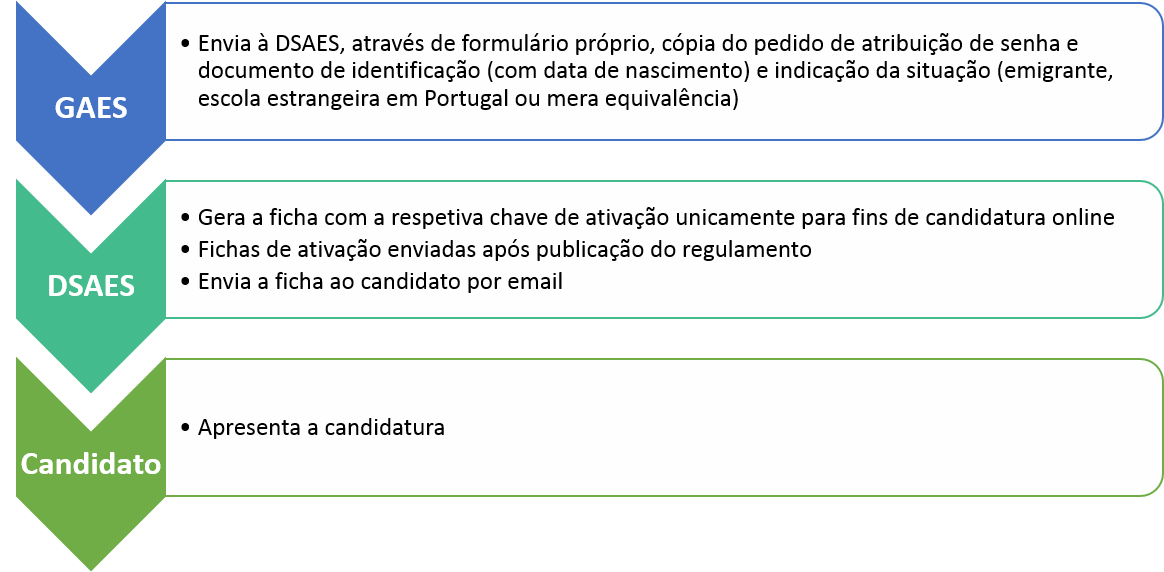
    Activation Form

    Candidates who do not take the Portuguese national final secondary school exams must request an Activation Form from a GAES (Student Support Office).
    The Activation Form contains a code that is requested in the online application and without which it is not possible to proceed with the application.

    Online form

    Once logged into the online application platform, the candidate must complete the application form. Candidates wishing to replace the entrance exams with foreign final exams must indicate this intention in the appropriate section of the online form, namely "Foreign Exam Selection Assistant".

    In case of omission or error in filling out the online form, the candidate will not benefit from the replacement of the entrance exams.

    You should pay attention

    • The online application form for substituting entrance exams with foreign exams must be completed for each phase the candidate applies to (1st phase and/or 2nd phase and/or 3rd phase).


    Upload documents

    The request to replace entrance exams with foreign final exams and the completion of the online form must include the upload of all documents required to support the request.

    Documents to upload:

    • Document proving completion of a foreign secondary education course, indicating the final grade of the course;
    • Proof of completion of foreign final exams, indicating the respective grade and the date on which they were taken;

    Note: These documents must be issued by the legally competent authority of the country to which the foreign secondary education qualification relates.

    • Certificate of equivalence of the foreign education course to Portuguese secondary education, indicating the final grade of the course, converted to a scale of 0 to 200 points;
    • other documents that candidates deem necessary.

    You should pay attention

    • Foreign documents must be authenticated by the Portuguese consular services or embassies in the country to which the qualification refers, or by the consular services or embassies of the foreign countries in Portugal, or with an Apostille of The Hague, for countries that have adhered to the Hague Convention;
    • Foreign documents in languages other than English, French, and Spanish must also be translated into Portuguese by an official translator.


    Conducting Portuguese National Final Exams

    Candidates holding a foreign secondary education qualification may choose to replace the entrance exams with foreign final exams or to take only the national final exams of Portuguese secondary education.

    If you wish to use your foreign secondary school exams and simultaneously take Portuguese national final exams, the following applies:

    • When requesting the replacement of one or more foreign exams, they cannot use the grade from the Portuguese secondary school exam, even if it is higher, when they have taken a corresponding foreign exam;
    • If they have not taken a foreign equivalent exam, they may use their Portuguese exam score to prove their eligibility for entry.

    Non-Portuguese courses equivalent to Portuguese secondary education.

    The system for granting equivalence of qualifications from foreign education systems to qualifications in the Portuguese education system at the secondary education level is defined by... Decree-Law No. 227/2005, of December 28.
    The following are defined by Decree of the Minister responsible for Education:

    • Comparative tables of the Portuguese education system and the education system of each country, and tables with the conversion of grading systems;
    • Comparative tables relating to years of schooling and courses, and conversion tables of grading systems, by educational institution, for foreign schools based in Portugal that offer courses with their own plans and programs;
    • Comparative tables relating to studies and diplomas from courses with their own programs certified by university institutions in third countries or by international non-governmental organizations;
    • Comparative tables relating to studies and diplomas from courses taught in European schools.

    With the publication of Decrees No. 224/2006, of March 8 e No. 699/2006, of July 12, Comparative tables between the Portuguese education system and certain foreign education systems, as well as conversion tables for the corresponding grading systems, have been approved for the following countries:

    • Decree No. 224/2006, of March 8 Germany, Angola, Cape Verde, Russian Federation, Greece, Mexico, Mozambique, United Kingdom, People's Republic of China, and Ukraine.
    • Decree No. 699/2006, of July 12 South Africa, Argentina, Australia, Belgium, Bolivia, Brazil, Bulgaria, Cuba, Denmark, Spain, United States of America, France, Guinea-Bissau, Indonesia, Ireland, Italy, Luxembourg, Morocco, Moldova, Netherlands, Pakistan, Romania, São Tomé and Príncipe, Senegal, Switzerland, East Timor, Tunisia, Turkey, Venezuela, and Zimbabwe.

    Under the terms of Decree-Law No. 227/2005, of December 28, The granting of equivalency is the responsibility of public and private secondary education establishments, which have pedagogical autonomy for the level of education in which equivalency is requested.
    However, requests for foreign equivalencies for which no comparative table has been defined by Order of the Minister responsible for Education must be sent to the Director-General of Education.
    Therefore, to find out if the non-Portuguese qualification held is equivalent to Portuguese secondary education, the student must submit a request for foreign equivalence to a Portuguese secondary school.
    If the institution finds that no comparative table has been defined for the foreign equivalency application submitted, as per the Ministerial Order of Education, the application must be forwarded to the Director-General of Education.
    Applications for equivalence/recognition of qualifications, studies and diplomas from foreign education systems, at the secondary education level.

    CLASSIFICATION OF THE EQUIVALENCE CERTIFICATE

    Under the terms of Article 3 of Decree-Law No. 227/2005, of December 28, In secondary education, equivalence is granted with the assignment of a grade, which may only refer to one complete academic year.

    For the purpose of calculating the classification, the following are approved by the Ministry of Education, through the Decrees No. 224/2006, of March 8 e No. 699/2006, of July 12, Comparative tables between the Portuguese education system and certain foreign education systems, as well as conversion tables for the corresponding grading systems.

    With respect to the provisions of Article 12 of Law No. 46/86, of October 14 – Basic Law of the Education System, in its updated version by Law No. 49/2005, of August 30, And in accordance with the principle of mandatory use of the final secondary school grade in the ranking process, the equivalence certificate required for access and admission to Portuguese higher education must contain a final grade corresponding to the final average of secondary education.

    Classification relating solely to one complete academic year.
    The equivalency certificate required for access and admission to Portuguese higher education must contain a final grade corresponding to the final average of the secondary education course.
    Students in Portuguese secondary education who attend a school year, or part of that schooling, as part of a foreign secondary education course, are considered integrated into the Portuguese education system, as it is their system of origin.

    Therefore, the presentation of an equivalency certificate, issued by the competent entities of the Ministry of Education, with a final grade identified as corresponding only to one academic year and not to the final average of secondary education, does not entitle students to replace entrance exams with foreign exams taken.

    Students who fall into this situation and intend to apply to Portuguese higher education must register to take the national final secondary school exams at a secondary school in order to validate the entrance exams required for access to the courses they wish to apply for.

    European Secondary School Diploma

    • Students holding qualifications from European Schools are subject to the same access rules for higher education in Portugal as students integrated into the Portuguese education system.
    • Decree No. 1/97, of January 3 Convention concerning the status of European schools

    LEGISLATION

    Decree-Law No. 64-A/2023, of July 31, 2023
    Decree-Law, No. 11/2020, of April 2, 2020
    Decree-Law No. 90/2008, of May 30
    Decree-Law No. 45/2007, of February 23
    Decree-Law No. 40/2007, of February 20
    Decree-Law No. 147-A/2006, of July 31
    Decree-Law No. 158/2004, of June 30
    Decree-Law No. 76/2004, of March 27
    Decree-Law No. 26/2003, of February 7
    Decree-Law, No. 99/99, of March 30
    Decree-Law No. 64-A/2023, of July 31, 2023
    Status: Active

  • Offices for Access to Higher Education (GAES)

    We kindly ask that you contact the Higher Education Access Office by phone or email before visiting in person to discuss matters related to your higher education application. Currently, some Higher Education Access Offices operate by appointment only.

    • Aveiro
      1. University of Aveiro. Academic Services Division, Santiago University Campus, 3810-193 Aveiro. Email: acesso@ua.pt. Telephone numbers: 234 370 200 and 234 370 347.
    • Beja
      1. Polytechnic Institute of Beja. Common Services II – IP Beja Campus, Rua Pedro Soares, 7800-295 Beja. Email: acesso@ipbeja.pt. Telephone: 284 314 400.
    • Braga
      1. University of Minho. Academic Management Service, Gualtar Campus, 4710-057 Braga. Email: acesso@usga.uminho.pt. Telephone: 253 604 593.
      2. Polytechnic Institute of Cávado and Ave. IPCA Campus, Rua do Aldão, 4750-810 Barcelos. Email: gabineteacesso@ipca.pt. Telephone: 253 802 509.
    • Bragança
      1. Polytechnic Institute of Bragança. Academic Services – Central Services, Santa Apolónia Campus, 5300-302 Bragança. Email: saipb@ipb.pt. Telephone: 273 330 850.
    • White Castle
      1. University of Beira Interior. Office for Access to Higher Education, Rua Marquês d'Ávila e Bolama, 6200-001 Covilhã. Email: acesso@ubi.pt. Telephone numbers: 275 242 014 and 275 319 700.
      2. Castelo Branco Polytechnic Institute. Avenida Pedro Álvares Cabral, No. 12, 6000-084 Castelo Branco. Email: acesso@ipcb.pt. Telephone numbers: 272 339 600 and 272 339 628.
    • Coimbra
      1. University of Coimbra. Student Hub, FMUC Building – Pólo I, Rua Larga, 3004-504 Coimbra. Email: acessoaoensinosuperior@uc.pt. Telephone: 239 247 195.
      2. Coimbra Polytechnic Institute. Rua da Misericórdia, Lagar dos Cortiços, São Martinho do Bispo, 3045-093 Coimbra. E-mail: gabinete.acesso@mail.ipc.pt. Telephone: 239 791 250.
    • Évora
      1. University of Évora. Santo Agostinho Building, Rua dos Duques de Cadaval, 7000-883 Évora. Email: gaes@uevora.pt. Telephone: 266 760 220.
    • Faro
      1. University of Algarve. Academic Services, Penha Campus, 8005-139 Faro. Email: gabineteacesso@ualg.pt. Telephone: 289 800 997.
    • Guard
      1. Polytechnic Institute of Guarda. IPG Campus, Avenida Dr. Francisco Sá Carneiro, No. 50, 6300-559 Guarda. Email: info.ipg@ipg.pt. Telephone numbers: 271 220 100 and 961 903 792.
    • Leiria
      1. Leiria Polytechnic Institute. General Norton de Matos Street, P.O. Box 4133, 2411-901 Leiria. Email: acesso@ipleiria.pt. Telephone: 244 830 013.
    • Lisbon
      1. University of Lisbon. Alameda da Universidade, Cidade Universitária, 1649-004 Lisboa. E-mail: acessoensinosuperior@ulisboa.pt. Telephone: 210 113 400.
      2. Nova University of Lisbon. Campus de Campolide, 1099-085 Lisbon. E-mail: gab-candidaturas@unl.pt. Telephone: 213 715 616.
      3. Lisbon Polytechnic Institute. Benfica Road, 529, 1549-020 Lisbon. Email: academica@sp.ipl.pt. Telephone: 217 101 200.
      4. ISCTE – University Institute of Lisbon. Sedas Nunes Building, Room 1S03, Avenida das Forças Armadas, 1649-026 Lisbon. Email: admissions@iscte-iul.pt. Telephone: 210 464 048.
    • Portalegre
      1. Polytechnic Institute of Portalegre. Municipal Square, 7300-100 Portalegre. E-mail: acesso.ipp@ipportalegre.pt. Telephone: 245 301 533.
    • Harbor
      1. University of Porto. Rectorate – Academic Training and Organization, Largo do Professor Abel Salazar, 24 (Abel Salazar Building), 4099-002 Porto. Email: acesso.es@reit.up.pt. Telephone: 220 408 237.
      2. Porto Polytechnic Institute. Dr. Roberto Frias Street, 712, 4200-465 Porto. Email: candidaturas@ipp.pt. Telephones: 225 571 039/40.
    • Santarém
      1. Polytechnic Institute of Santarém. Andaluz Complex, Moinho do Fau, P.O. Box 279, 2001-904 Santarém. Email: academicos@ipsantarem.pt. Telephone: 243 309 520.
      2. Polytechnic Institute of Tomar. Estrada da Serra, Quinta do Contador, 2300-313 Tomar. E-mail: acessoensinosuperior@ipt.pt. Telephone numbers: 249 328 107 and 249 328 216.
    • Setúbal
      1. Polytechnic Institute of Setúbal. School of Business Sciences, IPS Campus – Estefanilha, 2914-503 Setúbal. Email: divisao.academica@ips.pt. Telephone: 265 709 470.
    • Viana do Castelo
      1. Viana do Castelo Polytechnic Institute. Rua Escola Industrial e Comercial Nun'Álvares, n.º 34, 4900-347 Viana do Castelo. E-mail: gabineteacesso@ipvc.pt. Telephone: 258 819 797.
    • Vila Real
      1. University of Trás-os-Montes and Alto Douro. Student Space, Quinta dos Prados, 5001-801 Vila Real. Email: acesso@utad.pt. Telephone: 259 350 010.
    • Viseu
      1. Viseu Polytechnic Institute. Avenida Coronel José Maria Vale de Andrade, Campus Politécnico, 3504-510 Viseu. E-mail: gab.acesso.viseu@sc.ipv.pt. Telephone: 232 480 751.
    • Azores Autonomous Region
      1. Regional Secretariat of Education. Bettencourt Palace, Rua da Rosa, 49, 9700-171 Angra do Heroísmo. Email: dre.ingresso@azores.gov.pt. Telephone numbers: 295 401 100 and 295 401 186.
    • Autonomous Region of Madeira
      1. Regional Secretariat for Education, Science and Technology. Office of Higher Education, Regional Government Building, Avenida Arriaga, 9004-528 Funchal. Email: ensino.superior@madeira.gov.pt. Telephone: 291 145 515.

Calendar

Approved by Order No. 9359-A/2026, of July 23 | Official Gazette No. 141/2026, Series II of 2026-07-23. (Order No. 6934/2026, of June 1, is hereby revoked)

Ref.ª Action Home End
1 Submission of applications for the 1st phase of the national competition for access to higher education – candidates for the priority quota for emigrants, family members residing with them and Portuguese descendants, and candidates requesting the substitution of entrance exams with foreign exams. July 20th July 29
Submission of applications for the 1st phase of the national competition for access to higher education – remaining candidates July 20th August 6th
2 Making the placement lists for the first phase of the national competition available electronically to higher education institutions. – August 22
3 Announcement of the results of the 1st phase of the national competition. – August 23
4 Registration and enrollment in higher education institutions for candidates admitted in the first phase of the national competition. August 24 August 27
5 Submission of complaints regarding the results of the 1st phase of the national competition (1) August 24 August 28
6 Submission of application for the 2nd phase of the national competition. August 24 September 20th
7 Communication, by higher education institutions to the Institute for Higher Education, IP, of the information referred to in paragraph 4 of article 44 of the national competition regulations. – August 28
8 Announcement of the vacancies referred to in paragraph 5 of article 44 of the national competition regulations. – September 1st
9 Decision on complaints relating to the 1st phase of the national competition. (1) – September 28
10 Making the placement lists for the second phase of the national competition available electronically to higher education institutions. – September 30th
11 Announcement of the results of the 2nd phase of the national competition. – September 30th
12 Registration and enrollment in higher education institutions for candidates admitted in the second phase of the national competition. October 1st October 3rd
13 Presentation of complaints regarding the results of the 2nd phase of the national competition. (1) October 1st October 6th
14 Communication, by higher education institutions to the Institute for Higher Education, IP, of the information referred to in paragraph 2 of article 47 and paragraph 5 of article 49 of the national competition regulations. – October 6th
15 Announcement of the vacancies referred to in paragraph 3 of article 49 of the national competition regulations. – October 9th
16 Submission of application for the 3rd phase of the national competition. October 10th October 12
17 Decision on complaints relating to the 2nd phase of the national competition. (1) – October 30th
18 Making the placement lists for the 3rd phase of the national competition available electronically to higher education institutions. – October 18
19 Announcement of the results of the 3rd phase of the national competition. – October 18
20 Registration and enrollment in higher education institutions for candidates admitted in the 3rd phase of the national competition. October 18 October 20th
21 Presentation of complaints regarding the results of the 3rd phase of the national competition. (1) October 18 October 20th
22 Communication, by higher education institutions to the Institute for Higher Education, IP, of information about candidates placed in the 3rd phase of the national competition who have actually enrolled. – October 23
23 Decision on complaints relating to the 3rd phase of the national competition. (1) – November 16th
(1). Complaints may still be submitted and decided upon until the end of the time limits set out in the Administrative Procedure Code.


NOTE: Consult the publication of the Official Calendar in the Diário da República here.

Priority Contingents

In the first phase of the national competition, there are several priority quotas, in addition to the general quota, to which certain percentages of vacancies are allocated, intended for candidates who meet the conditions of each quota.
In the second phase, in addition to the general quota, there is also a priority quota for candidates with disabilities and a priority quota for emigrants, their family members residing with them, and people of Portuguese descent.
In the 3rd phase there is only one single contingent – the general contingent.

See here for all quotas and application requirements.

Application Guide 2026

During the application period, students have access to all information regarding access to higher education in [location]. iesuperior.pt

They can also contact the Higher Education Access Offices (GAES), which exist in higher education institutions on the mainland and in the Autonomous Regions of the Azores and Madeira.

This publication contains the following elements and information:

Practical guidelines for completing the application process;

  • Higher education training offer indicating the pairs of public higher education institutions/courses and the number of places allocated for the 2026 national access competition, specifying for each:
  1. Whether prerequisites are required, as well as how to prove them;
  2. The required entrance exams;
  3. The minimum required scores for the entrance exams and the application grade, as well as the formula for calculating the application grade;
  4. Assigning different weights to entrance exams, when applicable;
  5. The existence of regional preference in access to institution/course pairs in education.
    higher polytechnic and the respective percentage of reserved places;
  6. The existence of preferential qualifications for access to institution/course pairs in polytechnic higher education and the respective percentage of places reserved.

The following information is also attached:

  • Equivalent prerequisite groups and information on prerequisite certification (Annex I);
  • A list of public higher education courses that are subject to local admission and an indication of where students should go to obtain additional information (Annex II);
  • Contact details for the Higher Education Access Offices (Annex III).

Students wishing to apply to private higher education should consult the publication "Guide to Applications to Private Higher Education 2026" or contact their chosen institution.

Consult the 2026 Application Guide

Course Selection Assistant

The Course Selection Assistant allows you to find institution/course pairs that meet certain conditions.

After fulfilling the relevant conditions, you can access the results page to obtain the list of institution/course pairs that meet them (cumulatively).

To start a new search, you should use the "Clear Selections" button, which cancels all previously entered conditions.

Available search conditions:

1. Course
2. Institution
3. Other conditions

CANDIDATURA ONLINE

Online Application

PASSWORD ASSIGNMENT REQUEST

Instructions

Through this page you can request the password needed to apply to public higher education.

In the following steps you will be able to fill in your identification, the email address through which you wish to receive the password, and the indication of the school or the Higher Education Access Office (GAES) where you will certify this request.

After submitting this information, you will receive instructions to confirm your Password Assignment Request and print the corresponding receipt at the email address you provided. If, after submitting your Password Assignment Request, you do not receive the confirmation instructions, please access [link/resource]. Check Order Status.

You must present the Password Assignment Request receipt and your identification at the school or Higher Education Access Office (GAES) you select, in order to certify your order.

After confirming your request, your access password will be sent to your email address.

You can then log in using the password sent to you or by authenticating with your citizen card or digital mobile key.

If you do not have a valid identification number (citizen card or internal number assigned by your school), you must submit one instead. Request for Password and Identification Number Assignment, which, once confirmed, must be presented at an Office for Access to Higher Education.

ONLINE APPLICATION

Through this page you can start a session on the online application site, authenticating yourself using your identification number and access password.

Students who are not yet registered on this site should request registration through the page. Password Request.

Replacing Entrance Exams with Foreign Language Exams

Students with foreign secondary education

It's important to know:

  • that your foreign secondary education course must be equivalent to Portuguese secondary education (How do you obtain the equivalence?);
  • who has to take national or foreign final exams;
  • that foreign final exams must be equivalent to the Portuguese entrance exams;
  • which can only replace entrance exams with equivalent foreign final exams, according to the CNAES Deliberations in effect;
  • who can also take the Portuguese national final exams;
  • If you wish to apply for a course that requires prerequisites, please consult the information here.

Notice: O Order No. 7714/2020, of August 6, establishes procedures for simplifying the processing of equivalencies for foreign secondary education qualifications and for registration for national final exams for citizens residing outside the national territory.

Foreign Secondary Education Course Equivalent to Portuguese Secondary Education

To obtain equivalence between a foreign secondary education course and a Portuguese secondary education course, you must request a certificate of equivalence.

  • The certificate of equivalence is issued by secondary schools in Portugal or by the Directorate-General for Education, where applicable – https://area.dge.mec.pt/dsdccomext/
  • The equivalency certificate must identify the foreign secondary education course and its final grade, on a scale of 0 to 200 points.
  • You can find more information about foreign equivalencies. here

FINAL NATIONAL AND FOREIGN EXAMS

To replace entrance exams, foreign final exams must cumulatively meet the following conditions:

  • Having a national scope – these are tests required for admission to higher education in that country that constitute exams of national scope or,
  • have national recognition. If the country does not require entrance exams for higher education, final exams in foreign secondary education subjects that constitute national exams, or local exams in the foreign country, and have national recognition are considered.
  • to be homologous exams to the entrance exams.
  • to be valid as a substitute for entrance exams.
    Exams taken since 2022 are valid for five years, that is, the year they are taken and the following four years.

HOMOLOGOUS FOREIGN EXAMS

The homologation of foreign exams is determined by the National Commission for Access to Higher Education (CNAES).
CNAES publishes annually, by May 31st of the application year, a resolution with the list of equivalent foreign final exams.

For the application, please consult the information released by CNAES.

Exam classification

The grading of foreign exams, when used as entrance exams, is converted to the Portuguese scale of 0 to 200 points.

a) For classifications expressed in whole or decimal form using numerals, the following formula applies:

being Final The classification converted to the Portuguese scale, C; the classification obtained in the examination as stated on the diploma or certificate., Cmin the minimum foreign scale classification that allows the candidate access to higher education in that country and Cmax the highest rating on the foreign scale.

b) In cases where the classification is presented in alphabetical order, the following formula applies:

where C is the final classification to be assigned, on a scale of 0 to 200 points, E is the positive grade to be converted, and NE is the number of positive grades existing in the foreign classification system being converted.

  • The conversion of scales with a number of positive levels greater than 10 is subject to case-by-case assessment by the National Commission for Access to Higher Education;
  • In cases where the positive alphabetical levels include classifications expressed in decimals or hundredths, the maximum classification that can be awarded in the respective foreign secondary education system is assigned the maximum classification of 200 points;
  • In cases where an entrance exam is replaced by a combination of two exams from non-Portuguese courses that are legally equivalent to Portuguese secondary education, the verification of the minimum grade requirement for the entrance exam is done after calculating the average of the two exams;
  • In cases where an entrance exam is replaced by a combination of two exams from non-Portuguese courses legally equivalent to Portuguese secondary education, the calculation of the grade to be assigned to the entrance exam must be carried out by converting the grade of each exam to the Portuguese scale, and then calculating the average;
  • Situations not covered in the previous cases are subject to analysis and deliberation by the National Commission for Access to Higher Education, within the scope of the Higher Education Access Competitions;
  • When these distinctions exist in the respective foreign secondary education system, the National Commission for Access to Higher Education deems them justified to receive the maximum score of 200 points.

Important to note

  • In cases where classifications are expressed to the tenths or hundredths place, conversions are performed before any rounding, which should only occur, if necessary, after the conversion process is complete.
  • The result of the calculation of the aforementioned values is rounded up to the nearest integer when the decimal part is greater than or equal to 0.5, and rounded down to the nearest integer if the decimal part is less than 0.5.
  • The result of the calculation of the aforementioned values is rounded up to the nearest tenth if it has a centesimal part greater than or equal to 0.05, and rounded down to the nearest tenth if it has a centesimal part less than 0.05.


HOW TO SUBSTITUTE THE EVIDENCE / APPLICATION INSTRUCTIONS

For the application:

Access the online application platform

  • with your Portuguese identification number – citizen card or identity card. The identification number will be requested on the online application platform;
  • with an internal number – candidates who do not have a Portuguese identification number need an internal number to access the platform.

The internal number is requested by the candidate from a Higher Education Access Office (GAES).
When accessing the online application platform, you will be asked for your internal number.

Request access password

  • The password request is made on the platform of online application;
  • The applicant indicates their identification number/internal number, name, the email address they wish to use, and the delivery location for the application (they can choose a secondary school or a...). GAES).

Next, the system sends a message to the indicated email address, containing a confirmation link. By accessing this link The applicant must print the application confirmation receipt and deliver it in person to the secondary school or GAES indicated in the application for confirmation.

If the applicant is a minor, the application receipt must be signed by their legal guardian or by someone who demonstrates parental or guardianship authority.

After the request is validated, the password is sent to the candidate's email address.

You should pay attention

  • The assigned access password is only valid for the year to which the application refers;
  • The access password can be used in all application phases of the same year.


Activation Form

Candidates who do not take the Portuguese national final secondary school exams must request an Activation Form from a GAES (Student Support Office).
The Activation Form contains a code that is requested in the online application and without which it is not possible to proceed with the application.

Online form

Once logged into the online application platform, the candidate must complete the application form. Candidates wishing to replace the entrance exams with foreign final exams must indicate this intention in the appropriate section of the online form, namely "Foreign Exam Selection Assistant".

In case of omission or error in filling out the online form, the candidate will not benefit from the replacement of the entrance exams.

You should pay attention

  • The online application form for substituting entrance exams with foreign exams must be completed for each phase the candidate applies to (1st phase and/or 2nd phase and/or 3rd phase).


Upload documents

The request to replace entrance exams with foreign final exams and the completion of the online form must include the upload of all documents required to support the request.

Documents to upload:

  • Document proving completion of a foreign secondary education course, indicating the final grade of the course;
  • Proof of completion of foreign final exams, indicating the respective grade and the date on which they were taken;

Note: These documents must be issued by the legally competent authority of the country to which the foreign secondary education qualification relates.

  • Certificate of equivalence of the foreign education course to Portuguese secondary education, indicating the final grade of the course, converted to a scale of 0 to 200 points;
  • other documents that candidates deem necessary.

You should pay attention

  • Foreign documents must be authenticated by the Portuguese consular services or embassies in the country to which the qualification refers, or by the consular services or embassies of the foreign countries in Portugal, or with an Apostille of The Hague, for countries that have adhered to the Hague Convention;
  • Foreign documents in languages other than English, French, and Spanish must also be translated into Portuguese by an official translator.


Conducting Portuguese National Final Exams

Candidates holding a foreign secondary education qualification may choose to replace the entrance exams with foreign final exams or to take only the national final exams of Portuguese secondary education.

If you wish to use your foreign secondary school exams and simultaneously take Portuguese national final exams, the following applies:

  • When requesting the replacement of one or more foreign exams, they cannot use the grade from the Portuguese secondary school exam, even if it is higher, when they have taken a corresponding foreign exam;
  • If they have not taken a foreign equivalent exam, they may use their Portuguese exam score to prove their eligibility for entry.

Non-Portuguese courses equivalent to Portuguese secondary education.

The system for granting equivalence of qualifications from foreign education systems to qualifications in the Portuguese education system at the secondary education level is defined by... Decree-Law No. 227/2005, of December 28.
The following are defined by Decree of the Minister responsible for Education:

  • Comparative tables of the Portuguese education system and the education system of each country, and tables with the conversion of grading systems;
  • Comparative tables relating to years of schooling and courses, and conversion tables of grading systems, by educational institution, for foreign schools based in Portugal that offer courses with their own plans and programs;
  • Comparative tables relating to studies and diplomas from courses with their own programs certified by university institutions in third countries or by international non-governmental organizations;
  • Comparative tables relating to studies and diplomas from courses taught in European schools.

With the publication of Decrees No. 224/2006, of March 8 e No. 699/2006, of July 12, Comparative tables between the Portuguese education system and certain foreign education systems, as well as conversion tables for the corresponding grading systems, have been approved for the following countries:

  • Decree No. 224/2006, of March 8 Germany, Angola, Cape Verde, Russian Federation, Greece, Mexico, Mozambique, United Kingdom, People's Republic of China, and Ukraine.
  • Decree No. 699/2006, of July 12 South Africa, Argentina, Australia, Belgium, Bolivia, Brazil, Bulgaria, Cuba, Denmark, Spain, United States of America, France, Guinea-Bissau, Indonesia, Ireland, Italy, Luxembourg, Morocco, Moldova, Netherlands, Pakistan, Romania, São Tomé and Príncipe, Senegal, Switzerland, East Timor, Tunisia, Turkey, Venezuela, and Zimbabwe.

Under the terms of Decree-Law No. 227/2005, of December 28, The granting of equivalency is the responsibility of public and private secondary education establishments, which have pedagogical autonomy for the level of education in which equivalency is requested.
However, requests for foreign equivalencies for which no comparative table has been defined by Order of the Minister responsible for Education must be sent to the Director-General of Education.
Therefore, to find out if the non-Portuguese qualification held is equivalent to Portuguese secondary education, the student must submit a request for foreign equivalence to a Portuguese secondary school.
If the institution finds that no comparative table has been defined for the foreign equivalency application submitted, as per the Ministerial Order of Education, the application must be forwarded to the Director-General of Education.
Applications for equivalence/recognition of qualifications, studies and diplomas from foreign education systems, at the secondary education level.

CLASSIFICATION OF THE EQUIVALENCE CERTIFICATE

Under the terms of Article 3 of Decree-Law No. 227/2005, of December 28, In secondary education, equivalence is granted with the assignment of a grade, which may only refer to one complete academic year.

For the purpose of calculating the classification, the following are approved by the Ministry of Education, through the Decrees No. 224/2006, of March 8 e No. 699/2006, of July 12, Comparative tables between the Portuguese education system and certain foreign education systems, as well as conversion tables for the corresponding grading systems.

With respect to the provisions of Article 12 of Law No. 46/86, of October 14 – Basic Law of the Education System, in its updated version by Law No. 49/2005, of August 30, And in accordance with the principle of mandatory use of the final secondary school grade in the ranking process, the equivalence certificate required for access and admission to Portuguese higher education must contain a final grade corresponding to the final average of secondary education.

Classification relating solely to one complete academic year.
The equivalency certificate required for access and admission to Portuguese higher education must contain a final grade corresponding to the final average of the secondary education course.
Students in Portuguese secondary education who attend a school year, or part of that schooling, as part of a foreign secondary education course, are considered integrated into the Portuguese education system, as it is their system of origin.

Therefore, the presentation of an equivalency certificate, issued by the competent entities of the Ministry of Education, with a final grade identified as corresponding only to one academic year and not to the final average of secondary education, does not entitle students to replace entrance exams with foreign exams taken.

Students who fall into this situation and intend to apply to Portuguese higher education must register to take the national final secondary school exams at a secondary school in order to validate the entrance exams required for access to the courses they wish to apply for.

European Secondary School Diploma

  • Students holding qualifications from European Schools are subject to the same access rules for higher education in Portugal as students integrated into the Portuguese education system.
  • Decree No. 1/97, of January 3 Convention concerning the status of European schools

LEGISLATION

Decree-Law No. 64-A/2023, of July 31, 2023
Decree-Law, No. 11/2020, of April 2, 2020
Decree-Law No. 90/2008, of May 30
Decree-Law No. 45/2007, of February 23
Decree-Law No. 40/2007, of February 20
Decree-Law No. 147-A/2006, of July 31
Decree-Law No. 158/2004, of June 30
Decree-Law No. 76/2004, of March 27
Decree-Law No. 26/2003, of February 7
Decree-Law, No. 99/99, of March 30
Decree-Law No. 64-A/2023, of July 31, 2023
Status: Active

Offices for Access to Higher Education (GAES)

We kindly ask that you contact the Higher Education Access Office by phone or email before visiting in person to discuss matters related to your higher education application. Currently, some Higher Education Access Offices operate by appointment only.

  • Aveiro
    1. University of Aveiro. Academic Services Division, Santiago University Campus, 3810-193 Aveiro. Email: acesso@ua.pt. Telephone numbers: 234 370 200 and 234 370 347.
  • Beja
    1. Polytechnic Institute of Beja. Common Services II – IP Beja Campus, Rua Pedro Soares, 7800-295 Beja. Email: acesso@ipbeja.pt. Telephone: 284 314 400.
  • Braga
    1. University of Minho. Academic Management Service, Gualtar Campus, 4710-057 Braga. Email: acesso@usga.uminho.pt. Telephone: 253 604 593.
    2. Polytechnic Institute of Cávado and Ave. IPCA Campus, Rua do Aldão, 4750-810 Barcelos. Email: gabineteacesso@ipca.pt. Telephone: 253 802 509.
  • Bragança
    1. Polytechnic Institute of Bragança. Academic Services – Central Services, Santa Apolónia Campus, 5300-302 Bragança. Email: saipb@ipb.pt. Telephone: 273 330 850.
  • White Castle
    1. University of Beira Interior. Office for Access to Higher Education, Rua Marquês d'Ávila e Bolama, 6200-001 Covilhã. Email: acesso@ubi.pt. Telephone numbers: 275 242 014 and 275 319 700.
    2. Castelo Branco Polytechnic Institute. Avenida Pedro Álvares Cabral, No. 12, 6000-084 Castelo Branco. Email: acesso@ipcb.pt. Telephone numbers: 272 339 600 and 272 339 628.
  • Coimbra
    1. University of Coimbra. Student Hub, FMUC Building – Pólo I, Rua Larga, 3004-504 Coimbra. Email: acessoaoensinosuperior@uc.pt. Telephone: 239 247 195.
    2. Coimbra Polytechnic Institute. Rua da Misericórdia, Lagar dos Cortiços, São Martinho do Bispo, 3045-093 Coimbra. E-mail: gabinete.acesso@mail.ipc.pt. Telephone: 239 791 250.
  • Évora
    1. University of Évora. Santo Agostinho Building, Rua dos Duques de Cadaval, 7000-883 Évora. Email: gaes@uevora.pt. Telephone: 266 760 220.
  • Faro
    1. University of Algarve. Academic Services, Penha Campus, 8005-139 Faro. Email: gabineteacesso@ualg.pt. Telephone: 289 800 997.
  • Guard
    1. Polytechnic Institute of Guarda. IPG Campus, Avenida Dr. Francisco Sá Carneiro, No. 50, 6300-559 Guarda. Email: info.ipg@ipg.pt. Telephone numbers: 271 220 100 and 961 903 792.
  • Leiria
    1. Leiria Polytechnic Institute. General Norton de Matos Street, P.O. Box 4133, 2411-901 Leiria. Email: acesso@ipleiria.pt. Telephone: 244 830 013.
  • Lisbon
    1. University of Lisbon. Alameda da Universidade, Cidade Universitária, 1649-004 Lisboa. E-mail: acessoensinosuperior@ulisboa.pt. Telephone: 210 113 400.
    2. Nova University of Lisbon. Campus de Campolide, 1099-085 Lisbon. E-mail: gab-candidaturas@unl.pt. Telephone: 213 715 616.
    3. Lisbon Polytechnic Institute. Benfica Road, 529, 1549-020 Lisbon. Email: academica@sp.ipl.pt. Telephone: 217 101 200.
    4. ISCTE – University Institute of Lisbon. Sedas Nunes Building, Room 1S03, Avenida das Forças Armadas, 1649-026 Lisbon. Email: admissions@iscte-iul.pt. Telephone: 210 464 048.
  • Portalegre
    1. Polytechnic Institute of Portalegre. Municipal Square, 7300-100 Portalegre. E-mail: acesso.ipp@ipportalegre.pt. Telephone: 245 301 533.
  • Harbor
    1. University of Porto. Rectorate – Academic Training and Organization, Largo do Professor Abel Salazar, 24 (Abel Salazar Building), 4099-002 Porto. Email: acesso.es@reit.up.pt. Telephone: 220 408 237.
    2. Porto Polytechnic Institute. Dr. Roberto Frias Street, 712, 4200-465 Porto. Email: candidaturas@ipp.pt. Telephones: 225 571 039/40.
  • Santarém
    1. Polytechnic Institute of Santarém. Andaluz Complex, Moinho do Fau, P.O. Box 279, 2001-904 Santarém. Email: academicos@ipsantarem.pt. Telephone: 243 309 520.
    2. Polytechnic Institute of Tomar. Estrada da Serra, Quinta do Contador, 2300-313 Tomar. E-mail: acessoensinosuperior@ipt.pt. Telephone numbers: 249 328 107 and 249 328 216.
  • Setúbal
    1. Polytechnic Institute of Setúbal. School of Business Sciences, IPS Campus – Estefanilha, 2914-503 Setúbal. Email: divisao.academica@ips.pt. Telephone: 265 709 470.
  • Viana do Castelo
    1. Viana do Castelo Polytechnic Institute. Rua Escola Industrial e Comercial Nun'Álvares, n.º 34, 4900-347 Viana do Castelo. E-mail: gabineteacesso@ipvc.pt. Telephone: 258 819 797.
  • Vila Real
    1. University of Trás-os-Montes and Alto Douro. Student Space, Quinta dos Prados, 5001-801 Vila Real. Email: acesso@utad.pt. Telephone: 259 350 010.
  • Viseu
    1. Viseu Polytechnic Institute. Avenida Coronel José Maria Vale de Andrade, Campus Politécnico, 3504-510 Viseu. E-mail: gab.acesso.viseu@sc.ipv.pt. Telephone: 232 480 751.
  • Azores Autonomous Region
    1. Regional Secretariat of Education. Bettencourt Palace, Rua da Rosa, 49, 9700-171 Angra do Heroísmo. Email: dre.ingresso@azores.gov.pt. Telephone numbers: 295 401 100 and 295 401 186.
  • Autonomous Region of Madeira
    1. Regional Secretariat for Education, Science and Technology. Office of Higher Education, Regional Government Building, Avenida Arriaga, 9004-528 Funchal. Email: ensino.superior@madeira.gov.pt. Telephone: 291 145 515.

Other Competitions


  • Local Competitions – Public

    Local entrance exams apply to courses with specific characteristics that determine their own access and admission process.
    Its implementation depends on authorization by decree from the member of the Government responsible for higher education.
    The regulation establishes the criteria for evaluating capacity for attendance, selection, and ranking of candidates.
    The application is submitted directly to the higher education institution responsible for the course.
    Requirements, deadlines, available positions, and application procedures should be checked with the respective institution.

    See here for more information.

  • Institutional Competitions – Private

    Institutional entrance exams are the method of access to courses offered by private higher education institutions. They are organized directly by each institution, which defines and publicizes the available places, deadlines, and application procedures, in accordance with the applicable legal framework. Candidates must meet the general conditions for access to higher education and the specific requirements for the respective course, with placement being carried out by the institution itself.

    See here for more information.

  • Special Competitions – General Information

    Special admission and entry competitions for higher education are intended for students who meet specific eligibility requirements, identified in each competition modality. This is an autonomous form of access, distinct from the National Competition (application to public higher education), Institutional Competitions (application to private higher education), and Special Regimes (application to public and private higher education for students with specific eligibility and personal requirements).

    Within the scope of special admission processes, Higher Education Institutions (HEIs) are responsible for preparing and developing actions related to access and admission to their courses, in accordance with the legislation, establishing, in particular, which admission processes they will carry out, the number of places available per process for each of their institution/course pairs, and the respective ranking and tie-breaking criteria.

    The deadlines for completing the procedures for access and admission to higher education, in each academic year, through special admission processes, are also set by the higher education institutions.

    In the special admission process for medical school holders, the deadlines for completing all required actions are set by the organizational units of the higher education institutions that offer the medical course, in their own regulations.

    In the special admission process for international students, the deadlines for completing all required actions are set by the higher education institutions (HEIs).

    See here for more information.

  • Change of Institution/Course and Re-entry

    General Information

    Within the framework of the institution/course change and readmission regimes, Higher Education Institutions (HEIs) are responsible for preparing and developing actions related to admission to their courses, in accordance with the legislation, establishing, in particular, the eligibility requirements to be met for each of their institution/course pairs, the ranking and tie-breaking criteria, and defining, for this purpose, their own regulations.

    The deadlines for completing the procedures for changing institution/course and for readmission each academic year are also set by the higher education institutions and published on the institution's website.

    Changing institutions/courses is subject to quantitative limitations, which are set by the higher education institution where the student intends to enroll.
    Re-entry is not subject to quantitative limitations.


    The option to change institution/course may be requested:
    In public higher education institutions, with the exception of military and police educational institutions;
    In private educational establishments;
    Regarding study cycles leading to a higher professional technician diploma, a bachelor's degree, and a master's degree through an integrated master's study cycle.

    See additional information below.

  • TESP Courses

    The Higher Professional Technical Courses (CTeSP), regulated by Decree-Law No. 74/2006, of March 24, in its current wording, namely by the amendments introduced by Decree-Law No. 63/2016 , of September 13, and by Decree-Law No. 65/2018 , of August 16, are study cycles of higher polytechnic education, lasting four semesters and totaling 120 ECTS credits, which confer the diploma of higher professional technician, without awarding an academic degree.

    These courses integrate general and scientific training components, technical training, and work-based learning through internships, aiming to meet professional qualification needs. Holders of this diploma can pursue higher education through special access and admission competitions for bachelor's and integrated master's degree programs.

    See here for more information.

  • Master's and Doctoral Degrees

    Access to the 2nd Cycle

    The following may apply for admission to master's degree programs:

    • Holders of a bachelor's degree or equivalent legal qualification;
    • Holders of a foreign higher academic degree awarded following a first cycle of studies organised in accordance with the principles of the Bologna Process by a State adhering to this Process;
    • Holders of a foreign higher academic degree that is recognized as fulfilling the objectives of a bachelor's degree by the statutorily competent scientific body of the higher education institution where they intend to be admitted;
    • Holders of an academic, scientific or professional curriculum that is recognized as demonstrating the capacity to undertake this cycle of studies by the statutorily competent scientific body of the higher education institution where they intend to be admitted.

    In the case of institutional admission processes, organized by each higher education institution, specific information regarding access and admission to these study programs, as well as the number of places available for each academic year, can be obtained directly from the institution itself.

  • Distance Learning


Local Competitions – Public

Local entrance exams apply to courses with specific characteristics that determine their own access and admission process.
Its implementation depends on authorization by decree from the member of the Government responsible for higher education.
The regulation establishes the criteria for evaluating capacity for attendance, selection, and ranking of candidates.
The application is submitted directly to the higher education institution responsible for the course.
Requirements, deadlines, available positions, and application procedures should be checked with the respective institution.

See here for more information.

Institutional Competitions – Private

Institutional entrance exams are the method of access to courses offered by private higher education institutions. They are organized directly by each institution, which defines and publicizes the available places, deadlines, and application procedures, in accordance with the applicable legal framework. Candidates must meet the general conditions for access to higher education and the specific requirements for the respective course, with placement being carried out by the institution itself.

See here for more information.

Special Competitions – General Information

Special admission and entry competitions for higher education are intended for students who meet specific eligibility requirements, identified in each competition modality. This is an autonomous form of access, distinct from the National Competition (application to public higher education), Institutional Competitions (application to private higher education), and Special Regimes (application to public and private higher education for students with specific eligibility and personal requirements).

Within the scope of special admission processes, Higher Education Institutions (HEIs) are responsible for preparing and developing actions related to access and admission to their courses, in accordance with the legislation, establishing, in particular, which admission processes they will carry out, the number of places available per process for each of their institution/course pairs, and the respective ranking and tie-breaking criteria.

The deadlines for completing the procedures for access and admission to higher education, in each academic year, through special admission processes, are also set by the higher education institutions.

In the special admission process for medical school holders, the deadlines for completing all required actions are set by the organizational units of the higher education institutions that offer the medical course, in their own regulations.

In the special admission process for international students, the deadlines for completing all required actions are set by the higher education institutions (HEIs).

See here for more information.

Change of Institution/Course and Re-entry

General Information

Within the framework of the institution/course change and readmission regimes, Higher Education Institutions (HEIs) are responsible for preparing and developing actions related to admission to their courses, in accordance with the legislation, establishing, in particular, the eligibility requirements to be met for each of their institution/course pairs, the ranking and tie-breaking criteria, and defining, for this purpose, their own regulations.

The deadlines for completing the procedures for changing institution/course and for readmission each academic year are also set by the higher education institutions and published on the institution's website.

Changing institutions/courses is subject to quantitative limitations, which are set by the higher education institution where the student intends to enroll.
Re-entry is not subject to quantitative limitations.


The option to change institution/course may be requested:
In public higher education institutions, with the exception of military and police educational institutions;
In private educational establishments;
Regarding study cycles leading to a higher professional technician diploma, a bachelor's degree, and a master's degree through an integrated master's study cycle.

See additional information below.

TESP Courses

The Higher Professional Technical Courses (CTeSP), regulated by Decree-Law No. 74/2006, of March 24, in its current wording, namely by the amendments introduced by Decree-Law No. 63/2016 , of September 13, and by Decree-Law No. 65/2018 , of August 16, are study cycles of higher polytechnic education, lasting four semesters and totaling 120 ECTS credits, which confer the diploma of higher professional technician, without awarding an academic degree.

These courses integrate general and scientific training components, technical training, and work-based learning through internships, aiming to meet professional qualification needs. Holders of this diploma can pursue higher education through special access and admission competitions for bachelor's and integrated master's degree programs.

See here for more information.

Master's and Doctoral Degrees

Access to the 2nd Cycle

The following may apply for admission to master's degree programs:

  • Holders of a bachelor's degree or equivalent legal qualification;
  • Holders of a foreign higher academic degree awarded following a first cycle of studies organised in accordance with the principles of the Bologna Process by a State adhering to this Process;
  • Holders of a foreign higher academic degree that is recognized as fulfilling the objectives of a bachelor's degree by the statutorily competent scientific body of the higher education institution where they intend to be admitted;
  • Holders of an academic, scientific or professional curriculum that is recognized as demonstrating the capacity to undertake this cycle of studies by the statutorily competent scientific body of the higher education institution where they intend to be admitted.

In the case of institutional admission processes, organized by each higher education institution, specific information regarding access and admission to these study programs, as well as the number of places available for each academic year, can be obtained directly from the institution itself.

Distance Learning


Special Regimes

Special admission schemes for higher education are designed for candidates with specific educational and personal requirements, responding to situations arising from the performance of specific professions and activities or international commitments.

  • Application

    Applications for Special Schemes A, B, C, E, and F are submitted by candidates on the online platform for these special schemes.

    HERE

    Upon accessing the platform, the candidate registers, provides an email address, and specifies the employment status they are applying for, creating a password for access.
    You will automatically receive a registration confirmation email with the application form appropriate to the program you are applying for (application form).

    The application form (xlsx file) must be completed/edited using Microsoft Office Excel (recommended) or alternatively LibreOffice.

    Consult the guide on how to fill out the Bulletin here .

    Note: Using other programs, such as Google Sheets, will corrupt the xlsx file, preventing it from being imported into the database.

    Subsequently, the user logs into the platform using the credentials created during registration and submits the completed form and the single PDF file containing the required documents for the application to the program they are applying for.

    You can consult the application submission guide here.

    Applications for Special Regimes D and G must be submitted to the Embassy of the respective country in Portugal.

    Requirements for submitting an application to the competition:

    A candidate may apply for the position if they cumulatively meet the following conditions:

    • To hold the qualification for access to higher education foreseen for the applicable special regime;
    • To have a final secondary school grade that is at least identical to the minimum application grade set annually, under the general access regime, for each institution/study cycle to which the applicant is applying;
    • The specific conditions of each special regime;
    • Proof of completion and passing of the subjects or final exams corresponding to the entrance exams set for the institution/study cycle to which you are applying;
    • Having met the prerequisites, when established, for admission to the institution/study cycle to which one is applying;
    • Having met the special requirements subject to evaluation, when applying to a pair of institution/study program that is the subject of a local competition.

    Order No. 14616-D/2025, of December 9

    It establishes the guidelines and limits for setting the number of places available for access and admission to public higher education in the 2026-2027 academic year.

    Despacho n.º 14616-B/2025, de 9 de dezembro

    Establishes the deadlines for setting the quotas for access and admission to private higher education and the Catholic University of Portugal in the academic year 2026-2027.

    Course Index

  • General Information

    Job openings:

    The allocation of places for student admission under special schemes for access and entry into higher education is defined by order of the member of the Government responsible for higher education, up to a limit of 5% as the maximum number of admissions for each study cycle.

    Order No. 14616-D/2025, of December 9

    It establishes the guidelines and limits for setting the number of places available for access and admission to public higher education in the 2026-2027 academic year.

    Order No. 14616-B/2025, of December 9

    Establishes the deadlines for setting the quotas for access and admission to private higher education and the Catholic University of Portugal in the academic year 2026-2027.

    Restrictions:

    In any given academic year, each student may only apply through one of the special schemes provided for in the legislation in force.

    Holders of a Portuguese or foreign academic degree are not eligible to apply through the special admission schemes.

    Concept of Familiar:

    In some cases, special regimes are granted not only to the holder of the legal status, but also to their family member, where "family member" is understood to mean:
    – the spouse,
    – relatives by blood or marriage up to the second degree of consanguinity or affinity who are not older than 25 years of age on December 31st of the year in which they apply. This includes, in particular, spouses, children, stepchildren, grandchildren, and siblings.

    Application Process:

    Applications for Special Schemes A, B, C, E and F are submitted by candidates on the online platform for special schemes.

    The link to access this platform will be provided on the application date.

    The applicant accesses and registers on the platform, indicating an email address and the program they are applying for, and creating a password for access. They automatically receive a registration confirmation email with the application form appropriate to their chosen program (application form). Subsequently, they log into the platform using the credentials created during registration and submit the completed form and the single PDF file containing the required documents for the application to the program they are applying for.

    You can consult the application submission guide here.

    Applications for Special Regimes D and G must be submitted to the Embassy of the respective country in Portugal.

    Registration and Enrollment:

    Students who have been accepted must register and enroll at the higher education institution where they have been placed, according to the schedule.

    With the exception of candidates covered by regimes D and G, and those covered by the situations foreseen in points b) and c) of article 24 of Decree-Law no. 64-A/2023, of July 31, the placement only takes effect for the academic year in which the competition is held, and the right to enrollment and registration at the institution and study cycle in which the candidate is placed expires if this right is not exercised within the established timeframe.

    Candidates who do not register and enroll within the defined timeframe and are not covered by the situations foreseen in points b) and c) of article 24 of Decree-Law no. 64-A/2023, of July 31, cannot, in the academic year following the year in which they are due to enroll, apply through the general regime or the special regimes for access and admission to higher education.

    Results RE 2025 – Regimes A, B, E, F

    Consult HERE the total number of placements per Institution/study cycle pair and the application grade of the last placement in the 2025 Competition – Regimes A, B, E and F.

  • Calendar

    Calendar of actions for special access and admission schemes to higher education for enrollment and registration in the 2026-2027 academic year ( Order No. 7343/2026, of June 11, 2026 )


    Reference Action Home End
    1   Submission of applications through special schemes 03.08.2026 10.08.2026
    2   Announcement of application results – 10.09.2026
    3  Making placement lists available electronically to higher education institutions.   10.09.2026
    4   Registration and enrollment in higher education institutions for admitted candidates (a) 11.09.2026 18.09.2026
    5   Submission of complaints regarding application results (b) 11.09.2026 18.09.2026
    6   Decision on the complaints submitted (b) – 08.10.2026
    7  Making placement lists available electronically to higher education institutions, following the decision on appeals.   08.10.2026
    8  Enrollment and registration in higher education institutions of candidates admitted after appeals have been granted (b) 09.10.2026 16.10.2026

    (a) Those admitted through the special schemes provided for in points d) and g) of Article 3 of Decree-Law No. 64-A/2023, of 31 July, may register until 31 December 2026.

    (b) Complaints may be submitted and decided upon until the end of the time limits set out in the Code of Administrative Procedure.

  • Regime A – Diplomatic mission abroad

    A – Portuguese officials serving on Portuguese diplomatic missions abroad and their accompanying family members.

    The following are covered by special regime A: Portuguese officials who, at the time of application, are on a Portuguese diplomatic mission abroad, as well as their accompanying family members, provided they hold one of the following qualifications:

    1. A foreign secondary education course, legally equivalent to Portuguese secondary education, completed in a foreign country while on a mission or accompanying a family member on a mission;
    2. A foreign secondary education course, completed in a foreign country while on a mission or accompanying a family member on a mission, and which constitutes, in that country, sufficient academic qualification for admission to official higher education;
    3. Portuguese secondary education course completed in a foreign country while on a mission or accompanying a family member on a mission.

    Documents to be submitted with the application

    General documents:

    a) Supporting documents required for the program you are applying for;

    b) Identification document, namely citizen card or foreign identity card;

    c) Power of attorney, when the application is submitted by a proxy;

    d) Declaration from the legal representative authorizing the candidacy and identification document, in the case of a candidate under the age of 18;

    e) Document proving fulfillment of prerequisites for the institution/study program that requires it;

    f) Document proving that the applicant meets the special requirements being evaluated in the case of an institution/study program that is the subject of a local competition;

    g) Proof of consent issued by the educational institution in the case of a private higher education institution/study cycle pair.

    Supporting documents required for the program you are applying for:

    a) Document proving the status of an employee on a Portuguese diplomatic mission abroad, issued by the diplomatic entity, stating the start date of the mission and whether it continues at the time of application;

    b) When competing with the qualification of a foreign secondary education course:

    i) Document proving completion of secondary education, indicating the final grade and approval in the subjects or final exams corresponding to the entrance exams established for the institution/study cycle to which the applicant is applying;

    ii) Certificate of equivalence of the foreign education course to Portuguese secondary education, indicating the final grade of the course, converted to a scale of 0 to 200 points, or a declaration issued by the official education services of that country certifying that the foreign qualification is sufficient to enter a higher education course equivalent to the one you intend to apply for in Portugal (If you submit the certificate of equivalence of the foreign education course to Portuguese secondary education, the declaration of equivalence is not necessary. The certificate of equivalence of the foreign education course to Portuguese secondary education can be issued by a Portuguese Secondary School or by the DGE - Directorate-General for Education - you can consult information available at: https://www.dge.mec.pt/equivalencias-estrangeiras).

    c) When competing with the qualification of a Portuguese secondary education course:

    i) Document proving completion of a Portuguese secondary education course, indicating the final grade and approval in the subjects corresponding to the entrance exams established for the institution/study cycle to which the applicant is applying.

    The applicant, a family member of a Portuguese official on a Portuguese diplomatic mission abroad, must also submit the following documents:

    1. Document proving the degree of kinship;
    2. Document proving that you are accompanying the employee on assignment and residing with them at the time of application – Template

    When submitting applications for documents in Portuguese, the applicant must submit the original document certified by the issuing entity.

    In the application process involving foreign documents, the candidate must submit documents authenticated by the official education services of the respective country and recognized by the Portuguese diplomatic or consular authority, or containing the apostille of the Hague Convention. The same applies to translations of documents whose original language is not Spanish, French, or English.

  • Regime B – Portuguese citizens on official mission abroad, holders of a higher professional technician diploma.

    B – Portuguese scholarship holders abroad, Portuguese civil servants on official assignment abroad, and Portuguese officials from European Union institutions and their accompanying family members.

    The following Portuguese citizens are covered by special regime B: those who, at the time of application, have been in a foreign country for more than two years in the capacity of:

    1. Holders of scholarships from the Portuguese government, or equivalent;
    2. Civil servants on official assignments abroad;
    3. Portuguese employees of EU institutions.

    Family members of the citizens mentioned in the previous paragraph who accompany them are also covered by special regime B.

    Special regime B applies to the aforementioned candidates who hold one of the following qualifications:

    In the case of scholarship holders from the Portuguese Government, or equivalent, and their accompanying family members:

    1. A foreign secondary education course, legally equivalent to Portuguese secondary education, completed in a foreign country by a scholarship holder or equivalent, or accompanied by a family member under those conditions;
    2. A foreign secondary education course, completed in a foreign country by a scholarship holder or equivalent, or accompanied by a family member under these conditions, which constitutes, in that country, sufficient academic qualification for admission to official higher education;
    3. Portuguese secondary education course completed in a foreign country by a scholarship holder or equivalent, or accompanied by a family member under those conditions.

    In the case of civil servants on official assignment abroad or Portuguese officials from EU institutions and their accompanying family members:

    1. A foreign secondary education course, legally equivalent to Portuguese secondary education, completed in a foreign country while on a mission or accompanying a family member on a mission;
    2. A foreign secondary education course, completed in a foreign country while on a mission or accompanying a family member on a mission, which constitutes sufficient academic qualification in that country for admission to official higher education;
    3. Portuguese secondary education course completed in a foreign country, while on a mission or accompanying a family member on a mission.

    Documents to be submitted with the application:

    General documents:

    a) Supporting documents required for the program you are applying for;

    b) Identification document, namely citizen card or foreign identity card;

    c) Power of attorney, when the application is submitted by a proxy;

    d) Declaration from the legal representative authorizing the candidacy and identification document, in the case of a candidate under the age of 18;

    e) Document proving fulfillment of prerequisites for the institution/study program that requires it;

    f) Document proving that the applicant meets the special requirements being evaluated in the case of an institution/study program that is the subject of a local competition;

    g) Proof of consent issued by the educational institution in the case of a private higher education institution/study cycle pair.

    Supporting documents required for the program you are applying for:

    a) Document proving the status of scholarship holder, Portuguese civil servant on official assignment abroad, or Portuguese employee of European Union institutions, issued by the legally competent entity, stating the start date of duties and whether this status remains the same at the time of application;

    b) When competing with the holding of a foreign secondary education qualification obtained in that country:

    1. Document proving completion of secondary education, indicating the final grade and approval in the subjects or final exams corresponding to the entrance exams established for the institution/study cycle to which the applicant is applying;
    2. Certificate of equivalence of the foreign education course to Portuguese secondary education, indicating the final grade of the course, converted to a scale of 0 to 200 points, or a declaration issued by the official education services of that country certifying that the foreign qualification is sufficient to enter a higher education course equivalent to the one you intend to apply for in Portugal. (If you submit the certificate of equivalence of the foreign education course to Portuguese secondary education, the declaration of equivalence is not necessary. The certificate of equivalence of the foreign education course to Portuguese secondary education can be issued by a Portuguese Secondary School or by the DGE – Directorate-General for Education; you can consult information available on the Directorate-General for Education's website.)


    c) When competing with a Portuguese secondary education qualification obtained in that country:

    i) Document proving completion of a Portuguese secondary education course, indicating the final grade and approval in the subjects corresponding to the entrance exams established for the institution/study cycle to which the applicant is applying.


    The applicant who is a family member of a scholarship recipient, a Portuguese civil servant on official assignment abroad, or a Portuguese employee of European Union institutions, must also submit the following documents:

    a) Document proving the degree of kinship;

    b) Document proving that you are accompanying and residing with your family member permanently in that foreign country for more than two years, indicating the start date of residence and whether it continues at the time of application – Template


    When submitting applications for documents in Portuguese, the applicant must submit the original document certified by the issuing entity.

    In the application process involving foreign documents, the candidate must submit documents authenticated by the official education services of the respective country and recognized by the Portuguese diplomatic or consular authority, or containing the apostille of the Hague Convention. The same applies to translations of documents whose original language is not Spanish, French, or English.

  • Regime C – Officers of the Portuguese Armed Forces

    C – Military personnel of the Armed Forces on active duty in permanent positions and under special contract.

    The regime provided for in subparagraph c) of Article 3 covers members of the Armed Forces on active duty in permanent positions, and those under special contracts with a minimum duration of 10 years, in accordance with specific training agreements established between the Armed Forces and higher education institutions, to meet the specific training needs of the former.

    Documents to be submitted with the application:

    General documents:

    a) Supporting documents required for the program you are applying for;

    b) Identification document, namely citizen card;

    c) Power of attorney, when the application is submitted by a proxy;


    Supporting documents required for the program you are applying for:

    1. Military identification document;
    2. Document proving effective service in permanent positions and under a special contract with a minimum expected duration of 10 years;
    3. A declaration confirming the nomination to attend the study program, issued by the Portuguese Armed Forces;
    4. Document proving the reservation of a place, issued by the higher education institution.


    When submitting applications for documents in Portuguese, the applicant must submit the original document certified by the issuing entity.

  • Regime D – PALOP Scholarship Holders

    D – National scholarship holders from Portuguese-speaking African countries

    Nationals of Portuguese-speaking African countries who cumulatively meet the following conditions are covered by special regime D:

    1. Whether they are scholarship holders from their respective Governments, the Portuguese Government, or whose scholarship status is certified by the competent authorities of their respective country;
    2. They must hold a Portuguese secondary education qualification or a legally equivalent qualification, provided that it was completed in a Portuguese-speaking African country;
    3. Submit your application through diplomatic channels, via the embassy of your respective country in Portugal, or through Portuguese government entities or other official entities that award the scholarship, as recognized under point a) ;
    4. They must be 25 years of age or younger on December 31st of the year in which they submit their application.

    Documents to be submitted with the application:

    General documents:

    a) Supporting documents required for the program you are applying for;

    b) Identification document, namely citizen card or foreign identity card;

    c) Power of attorney, when the application is submitted by a proxy;

    d) Declaration from the legal representative authorizing the candidacy and identification document, in the case of a candidate under the age of 18;

    e) Document proving fulfillment of prerequisites for the institution/study program that requires it;

    f) Document proving that the applicant meets the special requirements being evaluated in the case of an institution/study program that is the subject of a local competition;

    g) Proof of consent issued by the educational institution in the case of a private higher education institution/study cycle pair.

    Supporting documents required for the program you are applying for:

    a) A statement proving responsibility for the payment of the scholarship, issued by the government of the respective country, the Portuguese government, or other officially recognized entities for this purpose, indicating the respective amount;

    b) When competing with the qualification of a foreign secondary education course:

    i) Document proving attendance and completion, in the country of origin, of the three years corresponding to the 10th, 11th and 12th years of Portuguese secondary education, indicating the respective final grade, to the nearest tenth, without rounding, and approval in the subjects corresponding to the entrance exams established for the institution/study cycle to which the student is applying;

    ii) Certificate of equivalence of the foreign education course to Portuguese secondary education, indicating the final course grade, converted to a scale of 0 to 200 points, to be issued by the DGE – Directorate-General for Education.

    c) When competing with a Portuguese secondary education qualification obtained in that country:

    i) Document proving completion of a Portuguese secondary education course, indicating the final grade and approval in the subjects corresponding to the entrance exams established for the institution/study cycle to which the applicant is applying.

    When submitting applications for documents in Portuguese, the applicant must submit the original document certified by the issuing entity.

    In the application process involving foreign documents, the candidate must submit documents authenticated by the official education services of the respective country and recognized by the Portuguese diplomatic or consular authority, or containing the apostille of the Hague Convention. The same applies to translations of documents whose original language is not Spanish, French, or English.


  • Regime E – Diplomatic mission accredited in Portugal

    E – Foreign officials from diplomatic missions accredited in Portugal and their family members residing here, on a reciprocal basis.

    The following are covered by the special regime: foreign officials from diplomatic missions accredited in Portugal and their family members residing here, who hold one of the following qualifications:

    1. A foreign secondary education course that is legally equivalent to Portuguese secondary education.;
    2. A foreign secondary education course, completed in a foreign country while on a mission or accompanying a family member on a mission, and which constitutes, in that country, sufficient academic qualification for admission to official higher education;
    3. Portuguese secondary education course.

    The application of this special regime is also conditional upon demonstrating reciprocal treatment towards Portuguese citizens.


    NOTE: Foreign officials on diplomatic missions must be listed on the Diplomatic Corps List of their country's Embassy accredited in Portugal.

    Documents to be submitted with the application

    General documents:

    a) Supporting documents required for the program you are applying for;

    b) Identification document, namely citizen card or foreign identity card;

    c) Power of attorney, when the application is submitted by a proxy;

    d) Declaration from the legal representative authorizing the candidacy and identification document, in the case of a candidate under the age of 18;

    e) Document proving fulfillment of prerequisites for the institution/study program that requires it;

    f) Document proving that the applicant meets the special requirements being evaluated in the case of an institution/study program that is the subject of a local competition;

    g) Proof of consent issued by the educational institution in the case of a private higher education institution/study cycle pair.

    Supporting documents required for the program you are applying for:

    a) Document proving the status of a foreign employee of a diplomatic mission accredited in Portugal, issued by the diplomatic entity, stating the start date of the mission and whether it continues at the time of application;

    b) When competing with the qualification of a foreign secondary education course:

    i) Document proving completion of secondary education, indicating the final grade and approval in the subjects or final exams corresponding to the entrance exams established for the institution/study cycle to which the applicant is applying;

    ii) Certificate of equivalence of the foreign education course to Portuguese secondary education, indicating the final grade of the course, converted to a scale of 0 to 200 points, or a declaration issued by the official education services of that country certifying that the foreign qualification is sufficient to enter a higher education course equivalent to the one you intend to apply for in Portugal. (If you submit the certificate of equivalence of the foreign education course to Portuguese secondary education, the declaration of equivalence is not necessary. The certificate of equivalence of the foreign education course to Portuguese secondary education can be issued by a Portuguese Secondary School by the DGE – Directorate-General for Education; you can consult information available on the Directorate-General for Education (DGE) website.)

    c) When competing with the qualification of a Portuguese secondary education course:

    i) Document proving completion of a Portuguese secondary education course, indicating the final grade and approval in the subjects corresponding to the entrance exams established for the institution/study cycle to which the applicant is applying;

    ii) Document proving reciprocal treatment towards Portuguese citizens.

    The applicant, a family member of a foreign official from a diplomatic mission accredited in Portugal, must also submit the following documents:

    a) Document proving the degree of kinship;

    b) Document proving that you are accompanying and residing with the family member at the time of application – Template


    When submitting applications for documents in Portuguese, the applicant must submit the original document certified by the issuing entity.

    In the application process involving foreign documents, the candidate must submit documents authenticated by the official education services of the respective country and recognized by the Portuguese diplomatic or consular authority, or containing the apostille of the Hague Convention. The same applies to translations of documents whose original language is not Spanish, French, or English.

  • Regime F – High-Performance Athletes

    F – High-Performance Athletes


    Special regime F covers high-performance athletes who cumulatively meet the following conditions:

    1. They must be registered in the register of high-performance sports agents, as provided for in Article 4 of Decree-Law No. 272/2009 of October 1, at the time of submitting their application to higher education;
    2. They must be registered in the register referred to in the previous paragraph in the calendar year in which the application is submitted or at any time during the previous calendar year, provided that, during this period, they have maintained their registration in the register of participation in national selections or other representations as provided for in paragraph 1 of Article 4 of Decree-Law No. 45/2013, of April 5;
    3. They must hold a Portuguese secondary education qualification or a legally equivalent qualification;
    4. They must have taken the required entrance exams, in the year of the competition, for the institution/study program they are applying to;
    5. They must have obtained the minimum grades set by higher education institutions for entrance exams and application scores under the general access regime.

    For candidates holding non-Portuguese qualifications that are legally equivalent to Portuguese secondary education, the entrance exams may be replaced under the terms of Article 20-A of Decree-Law No. 296-A/98 of September 25, as amended.

    High-performance athletes, for at least five consecutive or intermittent years, as referred to in paragraph 1 of Article 27 of Decree-Law No. 272/2009 of October 1, who have not used the option provided therein, may, within three years from the end of their respective career, benefit from the special regime for access to higher education.

    Whenever the result of a review or appeal of a national final secondary school exam grade is only known after the application deadline and results in a grade change, high-performance athletes are granted a period of up to three consecutive days, after its publication, to:

    1. Submit your application, in the case of candidates who have not yet submitted it;
    2. Change the application, in the case of candidates who have already submitted it.

    NOTICE:

    Throughout their sporting career, high-performance athletes can benefit from the special regime, provided they meet the necessary conditions, and there is no limit to its use.
    If you benefited from the special regime during your high-performance sporting career, you can no longer do so after ending your career.
    Students admitted through special admission schemes who fail to enroll and register at their respective higher education institution within the deadline set in the calendar, except for justified and documented reasons, MAY NOT apply for enrollment and registration through the national admission process or request it through special admission schemes in the following academic year.

    Documents to be submitted with the application:

    General documents:

    a) Supporting documents required for the program you are applying for;

    b) Identification document, namely citizen card or foreign identity card;

    c) Power of attorney, when the application is submitted by a proxy;

    d) Declaration from the legal representative authorizing the candidacy and identification document, in the case of a candidate under the age of 18;

    e) Document proving fulfillment of prerequisites for the institution/study program that requires it;

    f) Document proving that the applicant meets the special requirements being evaluated in the case of an institution/study program that is the subject of a local competition;

    g) Proof of consent issued by the educational institution in the case of a private higher education institution/study cycle pair.

    Supporting documents required for the program you are applying for:

    a) Document proving the status of a high-performance athlete, issued by the Portuguese Institute of Sport and Youth (IPDJ), indicating the start of registration and its validity, or document proving the date of termination of the career, issued by the IPDJ, indicating the start of the post-career status;

    b) ENES form from the year of application, proving the holder's possession of a Portuguese secondary education qualification and the completion of the entrance exams required for the institution/study cycle to which the applicant is applying, with grades equal to or higher than the minimum grades set by the higher education institution for the entrance exams and for the application grade under the general access regime;

    c) For candidates with foreign secondary education:

    i) Document proving completion of secondary education, indicating the final grade;

    ii) Document proving completion of foreign final exams, indicating the respective grade and the date the exams were taken;

    iii) Certificate of equivalence of the foreign education course to Portuguese secondary education, indicating the final grade of the course, converted to a scale of 0 to 200 points.

    When submitting applications for documents in Portuguese, the applicant must submit the original document certified by the issuing entity.

    In the application process involving foreign documents, the candidate must submit documents authenticated by the official education services of the respective country and recognized by the Portuguese diplomatic or consular authority, or containing the apostille of the Hague Convention. The same applies to translations of documents whose original language is not Spanish, French, or English.

  • Regime G – Nationals of Timor-Leste

    G – Nationals of Timor-Leste

    Candidates from Timor-Leste who cumulatively meet the following conditions are covered by special regime G:

    1. They must hold a Portuguese secondary education qualification or a legally equivalent qualification, provided it was completed in Timor-Leste;
    2. Submit your application through diplomatic channels, via the embassy of your respective country in Portugal;
    3. They must be 25 years of age or younger on December 31st of the year in which they submit their application.


    Documents to be submitted with the application:

    General documents:

    a) Supporting documents required for the program you are applying for;

    b) Identification document, namely citizen card or foreign identity card;

    c) Power of attorney, when the application is submitted by a proxy;

    d) Declaration from the legal representative authorizing the candidacy and identification document, in the case of a candidate under the age of 18;

    e) Document proving fulfillment of prerequisites for the institution/study program that requires it;

    f) Document proving that the applicant meets the special requirements being evaluated in the case of an institution/study program that is the subject of a local competition;

    g) Proof of consent issued by the educational institution in the case of a private higher education institution/study cycle pair.

    Supporting documents required for the program you are applying for:

    a) Document proving Timorese nationality;

    b) When competing with the qualification of a foreign secondary education course:

    i) Document proving attendance and completion, in the country of origin, of the three years corresponding to the 10th, 11th and 12th years of Portuguese secondary education, indicating the respective final grade, to the nearest tenth, without rounding, and converted to a scale of 0 to 200, and proof of passing the subjects corresponding to the entrance exams established for the institution/study cycle to which the student is applying;

    ii) Certificate of equivalence of the foreign education course to Portuguese secondary education, indicating the final course grade, converted to a scale of 0 to 200 points, to be issued by the Directorate-General for Education – DGE;

    c) When competing with a Portuguese secondary education qualification obtained in that country:

    i) Document proving completion of a Portuguese secondary education course, indicating the final grade and approval in the subjects corresponding to the entrance exams established for the institution/study cycle to which the applicant is applying.

    When submitting applications for documents in Portuguese, the applicant must submit the original document certified by the issuing entity.

    In the application process involving foreign documents, the candidate must submit documents authenticated by the official education services of the respective country and recognized by the Portuguese diplomatic or consular authority, or containing the apostille of the Hague Convention. The same applies to translations of documents whose original language is not Spanish, French, or English.

  • Legislation

    Decree-Law No. 64-A/2023 of July 31 – Establishes the special regimes for access and admission to higher education.
    Decree No. 248-A/2023 of August 1 – Approves the Regulations for the Competition for Special Access and Admission Schemes to Higher Education.
    Ratified on December 9, 1996 – Convention concerning the Statute of European Schools – Convention concerning the Statute of European Schools
    Decree-Law No. 272/2009, of October 1 – Establishes specific measures to support the development of high-performance sport and makes the first amendment to Decree-Law No. 393-A/99, of October 2.

Application

Applications for Special Schemes A, B, C, E, and F are submitted by candidates on the online platform for these special schemes.

HERE

Upon accessing the platform, the candidate registers, provides an email address, and specifies the employment status they are applying for, creating a password for access.
You will automatically receive a registration confirmation email with the application form appropriate to the program you are applying for (application form).

The application form (xlsx file) must be completed/edited using Microsoft Office Excel (recommended) or alternatively LibreOffice.

Consult the guide on how to fill out the Bulletin here .

Note: Using other programs, such as Google Sheets, will corrupt the xlsx file, preventing it from being imported into the database.

Subsequently, the user logs into the platform using the credentials created during registration and submits the completed form and the single PDF file containing the required documents for the application to the program they are applying for.

You can consult the application submission guide here.

Applications for Special Regimes D and G must be submitted to the Embassy of the respective country in Portugal.

Requirements for submitting an application to the competition:

A candidate may apply for the position if they cumulatively meet the following conditions:

  • To hold the qualification for access to higher education foreseen for the applicable special regime;
  • To have a final secondary school grade that is at least identical to the minimum application grade set annually, under the general access regime, for each institution/study cycle to which the applicant is applying;
  • The specific conditions of each special regime;
  • Proof of completion and passing of the subjects or final exams corresponding to the entrance exams set for the institution/study cycle to which you are applying;
  • Having met the prerequisites, when established, for admission to the institution/study cycle to which one is applying;
  • Having met the special requirements subject to evaluation, when applying to a pair of institution/study program that is the subject of a local competition.

Order No. 14616-D/2025, of December 9

It establishes the guidelines and limits for setting the number of places available for access and admission to public higher education in the 2026-2027 academic year.

Despacho n.º 14616-B/2025, de 9 de dezembro

Establishes the deadlines for setting the quotas for access and admission to private higher education and the Catholic University of Portugal in the academic year 2026-2027.

Course Index

General Information

Job openings:

The allocation of places for student admission under special schemes for access and entry into higher education is defined by order of the member of the Government responsible for higher education, up to a limit of 5% as the maximum number of admissions for each study cycle.

Order No. 14616-D/2025, of December 9

It establishes the guidelines and limits for setting the number of places available for access and admission to public higher education in the 2026-2027 academic year.

Order No. 14616-B/2025, of December 9

Establishes the deadlines for setting the quotas for access and admission to private higher education and the Catholic University of Portugal in the academic year 2026-2027.

Restrictions:

In any given academic year, each student may only apply through one of the special schemes provided for in the legislation in force.

Holders of a Portuguese or foreign academic degree are not eligible to apply through the special admission schemes.

Concept of Familiar:

In some cases, special regimes are granted not only to the holder of the legal status, but also to their family member, where "family member" is understood to mean:
– the spouse,
– relatives by blood or marriage up to the second degree of consanguinity or affinity who are not older than 25 years of age on December 31st of the year in which they apply. This includes, in particular, spouses, children, stepchildren, grandchildren, and siblings.

Application Process:

Applications for Special Schemes A, B, C, E and F are submitted by candidates on the online platform for special schemes.

The link to access this platform will be provided on the application date.

The applicant accesses and registers on the platform, indicating an email address and the program they are applying for, and creating a password for access. They automatically receive a registration confirmation email with the application form appropriate to their chosen program (application form). Subsequently, they log into the platform using the credentials created during registration and submit the completed form and the single PDF file containing the required documents for the application to the program they are applying for.

You can consult the application submission guide here.

Applications for Special Regimes D and G must be submitted to the Embassy of the respective country in Portugal.

Registration and Enrollment:

Students who have been accepted must register and enroll at the higher education institution where they have been placed, according to the schedule.

With the exception of candidates covered by regimes D and G, and those covered by the situations foreseen in points b) and c) of article 24 of Decree-Law no. 64-A/2023, of July 31, the placement only takes effect for the academic year in which the competition is held, and the right to enrollment and registration at the institution and study cycle in which the candidate is placed expires if this right is not exercised within the established timeframe.

Candidates who do not register and enroll within the defined timeframe and are not covered by the situations foreseen in points b) and c) of article 24 of Decree-Law no. 64-A/2023, of July 31, cannot, in the academic year following the year in which they are due to enroll, apply through the general regime or the special regimes for access and admission to higher education.

Results RE 2025 – Regimes A, B, E, F

Consult HERE the total number of placements per Institution/study cycle pair and the application grade of the last placement in the 2025 Competition – Regimes A, B, E and F.

Calendar

Calendar of actions for special access and admission schemes to higher education for enrollment and registration in the 2026-2027 academic year ( Order No. 7343/2026, of June 11, 2026 )


Reference Action Home End
1   Submission of applications through special schemes 03.08.2026 10.08.2026
2   Announcement of application results – 10.09.2026
3  Making placement lists available electronically to higher education institutions.   10.09.2026
4   Registration and enrollment in higher education institutions for admitted candidates (a) 11.09.2026 18.09.2026
5   Submission of complaints regarding application results (b) 11.09.2026 18.09.2026
6   Decision on the complaints submitted (b) – 08.10.2026
7  Making placement lists available electronically to higher education institutions, following the decision on appeals.   08.10.2026
8  Enrollment and registration in higher education institutions of candidates admitted after appeals have been granted (b) 09.10.2026 16.10.2026

(a) Those admitted through the special schemes provided for in points d) and g) of Article 3 of Decree-Law No. 64-A/2023, of 31 July, may register until 31 December 2026.

(b) Complaints may be submitted and decided upon until the end of the time limits set out in the Code of Administrative Procedure.

Regime A – Diplomatic mission abroad

A – Portuguese officials serving on Portuguese diplomatic missions abroad and their accompanying family members.

The following are covered by special regime A: Portuguese officials who, at the time of application, are on a Portuguese diplomatic mission abroad, as well as their accompanying family members, provided they hold one of the following qualifications:

  1. A foreign secondary education course, legally equivalent to Portuguese secondary education, completed in a foreign country while on a mission or accompanying a family member on a mission;
  2. A foreign secondary education course, completed in a foreign country while on a mission or accompanying a family member on a mission, and which constitutes, in that country, sufficient academic qualification for admission to official higher education;
  3. Portuguese secondary education course completed in a foreign country while on a mission or accompanying a family member on a mission.

Documents to be submitted with the application

General documents:

a) Supporting documents required for the program you are applying for;

b) Identification document, namely citizen card or foreign identity card;

c) Power of attorney, when the application is submitted by a proxy;

d) Declaration from the legal representative authorizing the candidacy and identification document, in the case of a candidate under the age of 18;

e) Document proving fulfillment of prerequisites for the institution/study program that requires it;

f) Document proving that the applicant meets the special requirements being evaluated in the case of an institution/study program that is the subject of a local competition;

g) Proof of consent issued by the educational institution in the case of a private higher education institution/study cycle pair.

Supporting documents required for the program you are applying for:

a) Document proving the status of an employee on a Portuguese diplomatic mission abroad, issued by the diplomatic entity, stating the start date of the mission and whether it continues at the time of application;

b) When competing with the qualification of a foreign secondary education course:

i) Document proving completion of secondary education, indicating the final grade and approval in the subjects or final exams corresponding to the entrance exams established for the institution/study cycle to which the applicant is applying;

ii) Certificate of equivalence of the foreign education course to Portuguese secondary education, indicating the final grade of the course, converted to a scale of 0 to 200 points, or a declaration issued by the official education services of that country certifying that the foreign qualification is sufficient to enter a higher education course equivalent to the one you intend to apply for in Portugal (If you submit the certificate of equivalence of the foreign education course to Portuguese secondary education, the declaration of equivalence is not necessary. The certificate of equivalence of the foreign education course to Portuguese secondary education can be issued by a Portuguese Secondary School or by the DGE - Directorate-General for Education - you can consult information available at: https://www.dge.mec.pt/equivalencias-estrangeiras).

c) When competing with the qualification of a Portuguese secondary education course:

i) Document proving completion of a Portuguese secondary education course, indicating the final grade and approval in the subjects corresponding to the entrance exams established for the institution/study cycle to which the applicant is applying.

The applicant, a family member of a Portuguese official on a Portuguese diplomatic mission abroad, must also submit the following documents:

  1. Document proving the degree of kinship;
  2. Document proving that you are accompanying the employee on assignment and residing with them at the time of application – Template

When submitting applications for documents in Portuguese, the applicant must submit the original document certified by the issuing entity.

In the application process involving foreign documents, the candidate must submit documents authenticated by the official education services of the respective country and recognized by the Portuguese diplomatic or consular authority, or containing the apostille of the Hague Convention. The same applies to translations of documents whose original language is not Spanish, French, or English.

Regime B – Portuguese citizens on official mission abroad, holders of a higher professional technician diploma.

B – Portuguese scholarship holders abroad, Portuguese civil servants on official assignment abroad, and Portuguese officials from European Union institutions and their accompanying family members.

The following Portuguese citizens are covered by special regime B: those who, at the time of application, have been in a foreign country for more than two years in the capacity of:

  1. Holders of scholarships from the Portuguese government, or equivalent;
  2. Civil servants on official assignments abroad;
  3. Portuguese employees of EU institutions.

Family members of the citizens mentioned in the previous paragraph who accompany them are also covered by special regime B.

Special regime B applies to the aforementioned candidates who hold one of the following qualifications:

In the case of scholarship holders from the Portuguese Government, or equivalent, and their accompanying family members:

  1. A foreign secondary education course, legally equivalent to Portuguese secondary education, completed in a foreign country by a scholarship holder or equivalent, or accompanied by a family member under those conditions;
  2. A foreign secondary education course, completed in a foreign country by a scholarship holder or equivalent, or accompanied by a family member under these conditions, which constitutes, in that country, sufficient academic qualification for admission to official higher education;
  3. Portuguese secondary education course completed in a foreign country by a scholarship holder or equivalent, or accompanied by a family member under those conditions.

In the case of civil servants on official assignment abroad or Portuguese officials from EU institutions and their accompanying family members:

  1. A foreign secondary education course, legally equivalent to Portuguese secondary education, completed in a foreign country while on a mission or accompanying a family member on a mission;
  2. A foreign secondary education course, completed in a foreign country while on a mission or accompanying a family member on a mission, which constitutes sufficient academic qualification in that country for admission to official higher education;
  3. Portuguese secondary education course completed in a foreign country, while on a mission or accompanying a family member on a mission.

Documents to be submitted with the application:

General documents:

a) Supporting documents required for the program you are applying for;

b) Identification document, namely citizen card or foreign identity card;

c) Power of attorney, when the application is submitted by a proxy;

d) Declaration from the legal representative authorizing the candidacy and identification document, in the case of a candidate under the age of 18;

e) Document proving fulfillment of prerequisites for the institution/study program that requires it;

f) Document proving that the applicant meets the special requirements being evaluated in the case of an institution/study program that is the subject of a local competition;

g) Proof of consent issued by the educational institution in the case of a private higher education institution/study cycle pair.

Supporting documents required for the program you are applying for:

a) Document proving the status of scholarship holder, Portuguese civil servant on official assignment abroad, or Portuguese employee of European Union institutions, issued by the legally competent entity, stating the start date of duties and whether this status remains the same at the time of application;

b) When competing with the holding of a foreign secondary education qualification obtained in that country:

  1. Document proving completion of secondary education, indicating the final grade and approval in the subjects or final exams corresponding to the entrance exams established for the institution/study cycle to which the applicant is applying;
  2. Certificate of equivalence of the foreign education course to Portuguese secondary education, indicating the final grade of the course, converted to a scale of 0 to 200 points, or a declaration issued by the official education services of that country certifying that the foreign qualification is sufficient to enter a higher education course equivalent to the one you intend to apply for in Portugal. (If you submit the certificate of equivalence of the foreign education course to Portuguese secondary education, the declaration of equivalence is not necessary. The certificate of equivalence of the foreign education course to Portuguese secondary education can be issued by a Portuguese Secondary School or by the DGE – Directorate-General for Education; you can consult information available on the Directorate-General for Education's website.)


c) When competing with a Portuguese secondary education qualification obtained in that country:

i) Document proving completion of a Portuguese secondary education course, indicating the final grade and approval in the subjects corresponding to the entrance exams established for the institution/study cycle to which the applicant is applying.


The applicant who is a family member of a scholarship recipient, a Portuguese civil servant on official assignment abroad, or a Portuguese employee of European Union institutions, must also submit the following documents:

a) Document proving the degree of kinship;

b) Document proving that you are accompanying and residing with your family member permanently in that foreign country for more than two years, indicating the start date of residence and whether it continues at the time of application – Template


When submitting applications for documents in Portuguese, the applicant must submit the original document certified by the issuing entity.

In the application process involving foreign documents, the candidate must submit documents authenticated by the official education services of the respective country and recognized by the Portuguese diplomatic or consular authority, or containing the apostille of the Hague Convention. The same applies to translations of documents whose original language is not Spanish, French, or English.

Regime C – Officers of the Portuguese Armed Forces

C – Military personnel of the Armed Forces on active duty in permanent positions and under special contract.

The regime provided for in subparagraph c) of Article 3 covers members of the Armed Forces on active duty in permanent positions, and those under special contracts with a minimum duration of 10 years, in accordance with specific training agreements established between the Armed Forces and higher education institutions, to meet the specific training needs of the former.

Documents to be submitted with the application:

General documents:

a) Supporting documents required for the program you are applying for;

b) Identification document, namely citizen card;

c) Power of attorney, when the application is submitted by a proxy;


Supporting documents required for the program you are applying for:

  1. Military identification document;
  2. Document proving effective service in permanent positions and under a special contract with a minimum expected duration of 10 years;
  3. A declaration confirming the nomination to attend the study program, issued by the Portuguese Armed Forces;
  4. Document proving the reservation of a place, issued by the higher education institution.


When submitting applications for documents in Portuguese, the applicant must submit the original document certified by the issuing entity.

Regime D – PALOP Scholarship Holders

D – National scholarship holders from Portuguese-speaking African countries

Nationals of Portuguese-speaking African countries who cumulatively meet the following conditions are covered by special regime D:

  1. Whether they are scholarship holders from their respective Governments, the Portuguese Government, or whose scholarship status is certified by the competent authorities of their respective country;
  2. They must hold a Portuguese secondary education qualification or a legally equivalent qualification, provided that it was completed in a Portuguese-speaking African country;
  3. Submit your application through diplomatic channels, via the embassy of your respective country in Portugal, or through Portuguese government entities or other official entities that award the scholarship, as recognized under point a) ;
  4. They must be 25 years of age or younger on December 31st of the year in which they submit their application.

Documents to be submitted with the application:

General documents:

a) Supporting documents required for the program you are applying for;

b) Identification document, namely citizen card or foreign identity card;

c) Power of attorney, when the application is submitted by a proxy;

d) Declaration from the legal representative authorizing the candidacy and identification document, in the case of a candidate under the age of 18;

e) Document proving fulfillment of prerequisites for the institution/study program that requires it;

f) Document proving that the applicant meets the special requirements being evaluated in the case of an institution/study program that is the subject of a local competition;

g) Proof of consent issued by the educational institution in the case of a private higher education institution/study cycle pair.

Supporting documents required for the program you are applying for:

a) A statement proving responsibility for the payment of the scholarship, issued by the government of the respective country, the Portuguese government, or other officially recognized entities for this purpose, indicating the respective amount;

b) When competing with the qualification of a foreign secondary education course:

i) Document proving attendance and completion, in the country of origin, of the three years corresponding to the 10th, 11th and 12th years of Portuguese secondary education, indicating the respective final grade, to the nearest tenth, without rounding, and approval in the subjects corresponding to the entrance exams established for the institution/study cycle to which the student is applying;

ii) Certificate of equivalence of the foreign education course to Portuguese secondary education, indicating the final course grade, converted to a scale of 0 to 200 points, to be issued by the DGE – Directorate-General for Education.

c) When competing with a Portuguese secondary education qualification obtained in that country:

i) Document proving completion of a Portuguese secondary education course, indicating the final grade and approval in the subjects corresponding to the entrance exams established for the institution/study cycle to which the applicant is applying.

When submitting applications for documents in Portuguese, the applicant must submit the original document certified by the issuing entity.

In the application process involving foreign documents, the candidate must submit documents authenticated by the official education services of the respective country and recognized by the Portuguese diplomatic or consular authority, or containing the apostille of the Hague Convention. The same applies to translations of documents whose original language is not Spanish, French, or English.


Regime E – Diplomatic mission accredited in Portugal

E – Foreign officials from diplomatic missions accredited in Portugal and their family members residing here, on a reciprocal basis.

The following are covered by the special regime: foreign officials from diplomatic missions accredited in Portugal and their family members residing here, who hold one of the following qualifications:

  1. A foreign secondary education course that is legally equivalent to Portuguese secondary education.;
  2. A foreign secondary education course, completed in a foreign country while on a mission or accompanying a family member on a mission, and which constitutes, in that country, sufficient academic qualification for admission to official higher education;
  3. Portuguese secondary education course.

The application of this special regime is also conditional upon demonstrating reciprocal treatment towards Portuguese citizens.


NOTE: Foreign officials on diplomatic missions must be listed on the Diplomatic Corps List of their country's Embassy accredited in Portugal.

Documents to be submitted with the application

General documents:

a) Supporting documents required for the program you are applying for;

b) Identification document, namely citizen card or foreign identity card;

c) Power of attorney, when the application is submitted by a proxy;

d) Declaration from the legal representative authorizing the candidacy and identification document, in the case of a candidate under the age of 18;

e) Document proving fulfillment of prerequisites for the institution/study program that requires it;

f) Document proving that the applicant meets the special requirements being evaluated in the case of an institution/study program that is the subject of a local competition;

g) Proof of consent issued by the educational institution in the case of a private higher education institution/study cycle pair.

Supporting documents required for the program you are applying for:

a) Document proving the status of a foreign employee of a diplomatic mission accredited in Portugal, issued by the diplomatic entity, stating the start date of the mission and whether it continues at the time of application;

b) When competing with the qualification of a foreign secondary education course:

i) Document proving completion of secondary education, indicating the final grade and approval in the subjects or final exams corresponding to the entrance exams established for the institution/study cycle to which the applicant is applying;

ii) Certificate of equivalence of the foreign education course to Portuguese secondary education, indicating the final grade of the course, converted to a scale of 0 to 200 points, or a declaration issued by the official education services of that country certifying that the foreign qualification is sufficient to enter a higher education course equivalent to the one you intend to apply for in Portugal. (If you submit the certificate of equivalence of the foreign education course to Portuguese secondary education, the declaration of equivalence is not necessary. The certificate of equivalence of the foreign education course to Portuguese secondary education can be issued by a Portuguese Secondary School by the DGE – Directorate-General for Education; you can consult information available on the Directorate-General for Education (DGE) website.)

c) When competing with the qualification of a Portuguese secondary education course:

i) Document proving completion of a Portuguese secondary education course, indicating the final grade and approval in the subjects corresponding to the entrance exams established for the institution/study cycle to which the applicant is applying;

ii) Document proving reciprocal treatment towards Portuguese citizens.

The applicant, a family member of a foreign official from a diplomatic mission accredited in Portugal, must also submit the following documents:

a) Document proving the degree of kinship;

b) Document proving that you are accompanying and residing with the family member at the time of application – Template


When submitting applications for documents in Portuguese, the applicant must submit the original document certified by the issuing entity.

In the application process involving foreign documents, the candidate must submit documents authenticated by the official education services of the respective country and recognized by the Portuguese diplomatic or consular authority, or containing the apostille of the Hague Convention. The same applies to translations of documents whose original language is not Spanish, French, or English.

Regime F – High-Performance Athletes

F – High-Performance Athletes


Special regime F covers high-performance athletes who cumulatively meet the following conditions:

  1. They must be registered in the register of high-performance sports agents, as provided for in Article 4 of Decree-Law No. 272/2009 of October 1, at the time of submitting their application to higher education;
  2. They must be registered in the register referred to in the previous paragraph in the calendar year in which the application is submitted or at any time during the previous calendar year, provided that, during this period, they have maintained their registration in the register of participation in national selections or other representations as provided for in paragraph 1 of Article 4 of Decree-Law No. 45/2013, of April 5;
  3. They must hold a Portuguese secondary education qualification or a legally equivalent qualification;
  4. They must have taken the required entrance exams, in the year of the competition, for the institution/study program they are applying to;
  5. They must have obtained the minimum grades set by higher education institutions for entrance exams and application scores under the general access regime.

For candidates holding non-Portuguese qualifications that are legally equivalent to Portuguese secondary education, the entrance exams may be replaced under the terms of Article 20-A of Decree-Law No. 296-A/98 of September 25, as amended.

High-performance athletes, for at least five consecutive or intermittent years, as referred to in paragraph 1 of Article 27 of Decree-Law No. 272/2009 of October 1, who have not used the option provided therein, may, within three years from the end of their respective career, benefit from the special regime for access to higher education.

Whenever the result of a review or appeal of a national final secondary school exam grade is only known after the application deadline and results in a grade change, high-performance athletes are granted a period of up to three consecutive days, after its publication, to:

  1. Submit your application, in the case of candidates who have not yet submitted it;
  2. Change the application, in the case of candidates who have already submitted it.

NOTICE:

Throughout their sporting career, high-performance athletes can benefit from the special regime, provided they meet the necessary conditions, and there is no limit to its use.
If you benefited from the special regime during your high-performance sporting career, you can no longer do so after ending your career.
Students admitted through special admission schemes who fail to enroll and register at their respective higher education institution within the deadline set in the calendar, except for justified and documented reasons, MAY NOT apply for enrollment and registration through the national admission process or request it through special admission schemes in the following academic year.

Documents to be submitted with the application:

General documents:

a) Supporting documents required for the program you are applying for;

b) Identification document, namely citizen card or foreign identity card;

c) Power of attorney, when the application is submitted by a proxy;

d) Declaration from the legal representative authorizing the candidacy and identification document, in the case of a candidate under the age of 18;

e) Document proving fulfillment of prerequisites for the institution/study program that requires it;

f) Document proving that the applicant meets the special requirements being evaluated in the case of an institution/study program that is the subject of a local competition;

g) Proof of consent issued by the educational institution in the case of a private higher education institution/study cycle pair.

Supporting documents required for the program you are applying for:

a) Document proving the status of a high-performance athlete, issued by the Portuguese Institute of Sport and Youth (IPDJ), indicating the start of registration and its validity, or document proving the date of termination of the career, issued by the IPDJ, indicating the start of the post-career status;

b) ENES form from the year of application, proving the holder's possession of a Portuguese secondary education qualification and the completion of the entrance exams required for the institution/study cycle to which the applicant is applying, with grades equal to or higher than the minimum grades set by the higher education institution for the entrance exams and for the application grade under the general access regime;

c) For candidates with foreign secondary education:

i) Document proving completion of secondary education, indicating the final grade;

ii) Document proving completion of foreign final exams, indicating the respective grade and the date the exams were taken;

iii) Certificate of equivalence of the foreign education course to Portuguese secondary education, indicating the final grade of the course, converted to a scale of 0 to 200 points.

When submitting applications for documents in Portuguese, the applicant must submit the original document certified by the issuing entity.

In the application process involving foreign documents, the candidate must submit documents authenticated by the official education services of the respective country and recognized by the Portuguese diplomatic or consular authority, or containing the apostille of the Hague Convention. The same applies to translations of documents whose original language is not Spanish, French, or English.

Regime G – Nationals of Timor-Leste

G – Nationals of Timor-Leste

Candidates from Timor-Leste who cumulatively meet the following conditions are covered by special regime G:

  1. They must hold a Portuguese secondary education qualification or a legally equivalent qualification, provided it was completed in Timor-Leste;
  2. Submit your application through diplomatic channels, via the embassy of your respective country in Portugal;
  3. They must be 25 years of age or younger on December 31st of the year in which they submit their application.


Documents to be submitted with the application:

General documents:

a) Supporting documents required for the program you are applying for;

b) Identification document, namely citizen card or foreign identity card;

c) Power of attorney, when the application is submitted by a proxy;

d) Declaration from the legal representative authorizing the candidacy and identification document, in the case of a candidate under the age of 18;

e) Document proving fulfillment of prerequisites for the institution/study program that requires it;

f) Document proving that the applicant meets the special requirements being evaluated in the case of an institution/study program that is the subject of a local competition;

g) Proof of consent issued by the educational institution in the case of a private higher education institution/study cycle pair.

Supporting documents required for the program you are applying for:

a) Document proving Timorese nationality;

b) When competing with the qualification of a foreign secondary education course:

i) Document proving attendance and completion, in the country of origin, of the three years corresponding to the 10th, 11th and 12th years of Portuguese secondary education, indicating the respective final grade, to the nearest tenth, without rounding, and converted to a scale of 0 to 200, and proof of passing the subjects corresponding to the entrance exams established for the institution/study cycle to which the student is applying;

ii) Certificate of equivalence of the foreign education course to Portuguese secondary education, indicating the final course grade, converted to a scale of 0 to 200 points, to be issued by the Directorate-General for Education – DGE;

c) When competing with a Portuguese secondary education qualification obtained in that country:

i) Document proving completion of a Portuguese secondary education course, indicating the final grade and approval in the subjects corresponding to the entrance exams established for the institution/study cycle to which the applicant is applying.

When submitting applications for documents in Portuguese, the applicant must submit the original document certified by the issuing entity.

In the application process involving foreign documents, the candidate must submit documents authenticated by the official education services of the respective country and recognized by the Portuguese diplomatic or consular authority, or containing the apostille of the Hague Convention. The same applies to translations of documents whose original language is not Spanish, French, or English.

Legislation

Decree-Law No. 64-A/2023 of July 31 – Establishes the special regimes for access and admission to higher education.
Decree No. 248-A/2023 of August 1 – Approves the Regulations for the Competition for Special Access and Admission Schemes to Higher Education.
Ratified on December 9, 1996 – Convention concerning the Statute of European Schools – Convention concerning the Statute of European Schools
Decree-Law No. 272/2009, of October 1 – Establishes specific measures to support the development of high-performance sport and makes the first amendment to Decree-Law No. 393-A/99, of October 2.

Forms and Guides

Issuance of documents: DGES Certificate, Application History, Individual Grade Sheet and PGA and Preparatory Year Declarations – Online Form

Prerequisites 2026 – Medical certificate and self-declaration templates

Article 20-A: Replacement of entrance exams with final exams from non-Portuguese secondary education courses | Forms 2026:

  • National competition (public higher education) – Online application platform
  • Local competitions (public higher education) – Application form
  • Institutional competitions (private higher education) – you should contact the private higher education institution directly.

More information about the application process.

Appeal against the results of the 2026 national access competition – Form
Appeal against the results of the 2026 special schemes competition – Form


Candidates under special admission schemes D and G must submit the completed application form to the entity responsible for the application (Embassy or Camões Institute). Any forms sent directly to IES, IP will not be considered.

Candidates under categories A, B, C, E, and F must submit the completed form through the electronic portal.

National Commission for Access to Higher Education (CNAES)

CNAES is the National Commission for Access to Higher Education, a collegiate body whose mandate lasts four years, renewable once for an equal period of time.

The operation, composition and competences of the CNAES are set out in Chapter II of Decree-Law No. 296-A/98, of September 25, as amended.

What is the structure of the CNAES?

The CNAES is composed of 7 members and chooses, from among its members, a president and a vice-president. The CNAES includes:

  • Two representatives from public university higher education institutions appointed by the Council of Rectors of Portuguese Universities (CRUP), Professor Fontainhas Fernandes, who chairs the CNAES, and Professor Ana Costa Freitas;
  • Two representatives from public polytechnic higher education institutions appointed by the Coordinating Council of Higher Polytechnic Institutes (CCISP), Professor Maria José da Silva Fernandes and Professor Orlando Rodrigues;
  • Three representatives from private and cooperative higher education institutions appointed by the Portuguese Association of Private Higher Education (APESP): Professor João Redondo, Dr. Miguel Copetto, and Professor Domingos Martinho.

What competencies does CNAES have?

CNAES has deliberative and advisory powers, and is therefore competent to issue decisions and opinions .

The management of the entire process related to the assessment of eligibility for higher education, as well as the establishment of selection and ranking criteria for candidates for enrollment and registration in higher education, is the responsibility of CNAES, in accordance with the terms set out in Decree-Law No. 296-A/98 of September 25.

CNAES opinions

May 27, 2025 | Clarification regarding Resolution No. 674/2025, of May 22

July 12, 2022 | Opinion No. 4/2022 – Clarification regarding Resolution No. 1043/2021, of October 13.

December 2, 2021 | Clarification regarding Deliberation No. 1043/2021, of October 13

March 16, 2021 | Opinion on the determination of the application grade under the general access regime (national access competition and institutional competitions)

May 25, 2020 | Access to higher education for students from foreign and international secondary education systems whose final exams were cancelled this year due to the COVID-19 pandemic.


CNAES Deliberations

Resolution No. 410/2026 , of 06/04

Establishes the correspondence between national secondary school exams and entrance exams for higher education applications in 2026-2027.


Resolution No. 1271/2025, of 08/10 , rectified by Rectification Declaration No. 88/2026/2, of 4/2

Amends Resolution No. 852/2024, of July 2 , and publishes the lists of entrance exams for applications to higher education in the academic years 2026/2027 and 2027/2028.


Resolution No. 349/2025 , of 11/03

Establishes the correspondence between national secondary school exams and entrance exams for higher education applications in 2025-2026.


Resolution No. 976/2024 , of 25/07

It modifies the sub-lists of entrance exams for the 2027-2028 academic year.


Resolution No. 852/2024 , of 02/07

Announces the lists of entrance exams for applications to higher education in the academic years 2025-2026 and 2026-2027.


Resolution No. 317/2024 , of 13/03

Establishes the correspondence between national secondary school exams and entrance exams for higher education applications in 2024-2025.


Resolution No. 1155/2023 , of 21/11

Establishes the rules for setting the lists of entrance exams for the academic years 2024-2025 and subsequent years.


Resolution No. 763/2023 , of 03/08

Announces changes to the entrance exam requirements for applications to higher education in 2024, 2025 and 2026.


Resolution No. 388/2023 , of 10/04

Establishes the correspondence between national secondary school exams and entrance exams for higher education applications in 2023-2024.


Resolution No. 876/2022 , of 04/08

Announces changes to the entrance exam requirements for higher education applications in 2023, 2024, and 2025.


Resolution No. 621/2022 , of 12/07

Corrects Resolution No. 752/2022, published in the Official Gazette, 2nd series, No. 123, of June 28, 2022.


Resolution No. 752/2022 , of 06/28

Establishes the rules regarding the use of national final secondary education exams, taken in the 2nd phase of exams of the 2021-2022 school year, for applications to higher education in 2022-2023.


Resolution No. 475/2022 , of 18/04

Establishes the rules for setting the lists of entrance exams for 2022-2023.


Resolution No. 380/2022, of 25/03

Establishes the correspondence between national secondary school exams and entrance exams for higher education applications in 2022-2023.


Clarification of Resolution No. 1043/2021 , December 2

Establishes the rules regarding the use of national secondary school final exams as entrance exams.


Resolution No. 1043/2021 , of 13/10

Establishes the rules regarding the use of national secondary school final exams as entrance exams.


Resolution No. 909/2021 , of 02/09

Announces changes to the entrance exam requirements for applications to higher education in 2022, 2023 and 2024.


Rectification Statement No. 381-A/2021 , dated 19/05

Corrects Resolution No. 450/2021, of May 7, published in the Official Gazette, 2nd series, No. 89, of May 7, 2021.


Resolution No. 450/2021 , of 07/05

Establishes the correspondence between national secondary school exams and entrance exams for higher education applications in 2021-2022.


Resolution No. 403/2021 , of 26/04

Establishes the rules for setting the lists of entrance exams for 2021-2022.


Resolution No. 947/2020 , of 29/09

Announces changes to the entrance exam requirements for higher education applications in 2021, 2022, and 2023.


Resolution No. 486/2020 , of 17/04

Establishes the rules for setting the lists of entrance exams for 2020-2021.


Resolution No. 377-A/2020 , of 17/03

Establishes the correspondence between national secondary school exams and entrance exams for higher education applications in 2020-2021.


Resolution No. 797/2019 , of 19/07

Announces changes to the entrance exam requirements for applications to higher education in 2020, 2021 and 2022.


Resolution No. 441/2019 , of 18/04

Establishes the rules for setting the lists of entrance exams (2019-2020)


Resolution No. 303/2019 , of 19/03

Establishes the correspondence between the national secondary school exams and the entrance exams for the 2019/2020 application process.


Resolution No. 587/2018 , of 11/05

Announces changes to the entrance exam schedules for the 2019, 2020, and 2021 applications.


Resolution No. 175/2018 , of 19/02

Establishes the rules for setting the lists of entrance exams (2018-2019)


Resolution No. 174/2018 , of 19/02

Establishes the correspondence between the national secondary school exams and the entrance exams for the 2018/2019 application process.


Declaration No. 765/2017 , dated 17/08

Announces changes to the entrance exam schedules for the 2018, 2019, and 2020 applications.


Resolution No. 668/2017 , of 13/07

Establishes the entrance exams for the first cycle of studies in Basic Education courses for applications for enrollment and registration in higher education in the academic year 2017/2018.


Resolution No. 292/2017 , of 19/04

Establishes the rules for setting the lists of entrance exams (2017-2018)


Resolution No. 167/2017 , of 10/03

Establishes the correspondence between the national secondary school exams and the entrance exams for the 2017/2018 application process.


Declaration No. 1233/2016 , dated 03/08

Announces changes to the entrance exam schedules for the 2017, 2018, and 2019 applications.


Resolution No. 691/2016 , of 18/04

Establishes the rules for setting the lists of entrance exams (2016-2017)


Rectification Statement No. 283/2016 , dated 15/03

Amends resolution no. 1381-A/2015, of July 3, which discloses changes to the lists of entrance exams for applications in 2016, 2017, and 2018.


Rectification Statement No. 660/2015 , dated 06/08

Amends resolution no. 1381-A/2015, of July 3, which discloses changes to the lists of entrance exams for applications in 2016, 2017, and 2018.


Resolution No. 221/2016 , of 24/02

Establishes the correspondence between the national secondary school exams and the entrance exams for the 2016/2017 application process.


Resolution No. 1381-A/2015 , of 03/07, rectified by Rectification Declarations No. 660/2015 , of 06/08, and No. 283/2016 , of 15/03

Announces changes to the entrance exam schedules for the 2016, 2017, and 2018 applications.


Resolution No. 612/2015 , of 23/04

Establishes the rules for setting lists of entrance exams.


Resolution No. 223/2015 , of 25/02

Establishes the correspondence between the national secondary school exams and the entrance exams for the 2015/2016 application process.


Resolution No. 40/2015 , of 12/01

Approves the entrance exams for the first cycle of studies in the Basic Education course.


Resolution No. 1411/2014 , of 08/07

Announces changes to the entrance exam schedules for the 2015, 2016, and 2017 applications.


Resolution No. 1233/2014 , of 09/06

Establishes the rules for the use of national secondary school final exams as entrance exams.


Resolution No. 1484/2013 , of 19/07, rectified by Rectification Declaration No. 237/2014 , of 05/03

Announces changes to the entrance exam schedules for the 2014, 2015, and 2016 applications.


Resolution No. 889/2013 , of 09/04

It defines the rules to be observed by higher education institutions regarding the setting of entrance exams.


Resolution No. 788/2012 , of 14/06

Announces the list of entrance exams for the Social Gerontology courses starting with the 2012 application period.


Resolution No. 1085/2011 , of 2/05

Reinstates the Philosophy entrance exam starting with applications for enrollment and registration in higher education for the 2013-2014 academic year.


Resolution No. 3258/2009 , of 07/12

List of entrance exams from 2012/2013 onwards.

Resolution No. 619/2026 , of 28/05

Application to Portuguese higher education for students holding foreign secondary education qualifications.


Resolution No. 674/2025, of 22/05

Application to Portuguese higher education for students holding foreign secondary education qualifications – For applications for enrollment and registration in higher education for the academic year 2025-2026, rectified by Rectification Declaration No. 564/2025/2 , of June 18, and by Rectification Declaration No. 678/2025/2 , of July 25.

May 27, 2025 | Clarification regarding Resolution No. 674/2025, of May 22

Resolution No. 975/2024 , of 25/07

Amends the acceptance requirements for exams in subjects with the same name in foreign secondary education courses – Revoked


Resolution No. 677/2024 , of 22/05

Application to Portuguese higher education for students holding foreign secondary education qualifications – Revoked


Rectification Statement No. 491/2023 , dated 06/07

Rectifies Rectification Declaration No. 453/2023, of June 21, which rectifies Resolution No. 530/2023, of May 22, concerning applications to Portuguese higher education by students holding foreign secondary education qualifications – Revoked


Rectification Statement No. 453/2023 , dated 21/06

Rectifies Resolution No. 530/2023, published in the Official Gazette, 2nd series, No. 98, of May 22, 2023 – Revoked


Resolution No. 530/2023 , of 22/05

Application to Portuguese higher education for students holding foreign secondary education qualifications – Revoked


Resolution No. 414/2023 , of 14/04

Approves the regulation for the substitution of entrance exams with foreign final exams, as provided for in Article 20-A of Decree-Law No. 296-A/98, of September 25.


Resolution No. 44/2023 , of 09/01

Approves the regulation for the substitution of entrance exams with foreign final exams, as provided for in Article 20-A of Decree-Law No. 296-A/98, of September 25.


Resolution No. 606/2022 , of 20/05

Application to Portuguese higher education for students holding foreign secondary education qualifications – Revoked


Resolution No. 812/2020 , of 20/08

Publishes the decision regarding applications to the Infante D. Henrique Nautical School from students holding foreign secondary education qualifications – Revoked


Resolution No. 524/2020 , of 28/04

Application to Portuguese higher education for students holding foreign secondary education qualifications – Revoked


Resolution No. 652/2019, of 29/05

Application to Portuguese higher education for students holding foreign secondary education qualifications 2020-2021 – Revoked


Resolution No. 586/2018 , of 11/05, rectified by Rectification Declaration No. 257/2019 , of 20/03

Application to Portuguese higher education for students holding foreign secondary education qualifications 2019-2020 – Revoked


Resolution No. 513/2017 , of 03/08

Corrects the information regarding the application of the provisions of Article 20-A of Decree-Law No. 296-A/98, of September 25, to the Egas Moniz Higher Institute of Health Sciences, for applications to higher education for 2017/2018 and 2018/2019.


Resolution No. 667/2017 , of 13/07

Repeals Article 4 of Resolution No. 438/2017, of 31/05 – Repealed

Reinstates Resolution No. 1882/2016, of 11/30


Resolution No. 438/2017 , of 31/05, amended by Resolution No. 667/2017 , of 13/07, rectified by Rectification Declaration No. 124/2018 , of 16/02, and by Resolution No. 513/2017 , of 03/08

Application to Portuguese higher education for students holding foreign secondary education qualifications 2018-2019 – Revoked


Resolution No. 1882/2016 , of 30/11, rectified by Rectification Declaration No. 191/2017 , of 28 March

Application to Portuguese higher education for students holding foreign secondary education qualifications 2017-2018 – Revoked


Resolution No. 974/2015 , of 29/05

Regulates the application of the provisions of Article 20-A of Decree-Law No. 296-A/98, of September 25.

Resolution No. 454/2026, of 10/04
It establishes the prerequisites required for application for enrollment and registration in higher education for the academic year 2026-2027.

Rectification Statement No. 534/2025/2, dated 2/06
Corrects Resolution No. 450/2025, published in the Official Gazette, 2nd series, No. 60, of March 26, 2025.

Resolution No. 450/2025, of 26/03
It establishes the prerequisites required for application for enrollment and registration in higher education for the academic year 2025-2026.

Resolution No. 316/2024 , of 13/03
It establishes the prerequisites required for application for enrollment and registration in higher education for the academic year 2024-2025.

Resolution No. 338/2023 , of 24/03
It establishes the prerequisites required for application for enrollment and registration in higher education for the academic year 2023-2024.

Resolution No. 379/2022, of 03/25
It establishes the prerequisites required for application for enrollment and registration in higher education for the academic year 2022-2023.

Resolution No. 336-A/2021 , of 05/04
It establishes the physical tests required to meet the prerequisites for application for enrollment and registration in higher education for the academic year 2021-2022.

Resolution No. 690-A/2020 , of 19/06

Establishes the physical tests required to meet the prerequisites for groups C and H, for application for enrollment and registration in higher education, in the academic year 2020-2021.

Resolution No. 531/2020 , of 04/30
It alters the schedule of prerequisites required for application for enrollment and registration in higher education in the academic year 2020-2021.

Rectification Resolution No. 307/2020 , of 06/04
Rectifies Resolution No. 262/2020, of the National Commission for Access to Higher Education, published in the Official Gazette, 2nd series, No. 38, of February 24, concerning the establishment of prerequisites for applications to higher education for 2020-2021.

For the proper purposes, the following is hereby corrected:

In point no. 5 of article 6, where it reads:
"The provisions of paragraphs 2, 3 and 4 apply to the prerequisites of Groups C, H, I, K, M, P,
R and Z.«

It should read:
"The provisions of paragraphs 2, 3 and 4 apply to the prerequisites of Groups C, H, I, K, M, P, R,
S and Z.«

In point no. 8 of article 6, where it reads:
"The provisions of paragraphs 6 and 7 apply to the prerequisites of Groups A, B, D, E, F, Q and X."«

It should read:
"The provisions of paragraphs 6 and 7 apply to the prerequisites of Groups A, B, D, E, F and Q."«

Resolution No. 262/2020 , of 24/02
Sets the prerequisites for the 2020-2021 application.

Resolution No. 266-A/2019 , of 12/03
Sets out the prerequisites for the 2019-2020 application period.

Resolution No. 691-A/2021 , Series II of the Official Gazette No. 128, of 05/07
Establishes rules regarding the use of national secondary school final exams, taken in the second phase of exams for the 2020-2021 school year, in applications to higher education for 2021-2022.


Resolution No. 802/2020 , Series II of the Official Gazette No. 154, of 10/08
It resolves the use of national final secondary education exams, taken in the 2nd phase of exams of the 2019-2020 school year, for applications to higher education in 2020-2021.
Resolution No. 1650/2008 , Series II of the Official Gazette No. 113, of 13/06
Final secondary education classification to be awarded to candidates whose diploma, according to the law, does not include this classification.

Resolution No. 524/2026, of 04/05

Establishes conditions relating to the application of holders of dual-certification secondary level courses and specialized artistic courses to undergraduate and integrated master's degree programs for the academic year 2026/2027.


Rectification Statement No. 397/2025/2, dated 16/04

Amends Resolution No. 528/2025, of April 9, which establishes conditions relating to the application of holders of dual-certification secondary level courses and specialized artistic courses to undergraduate and integrated master's degree study cycles.

Resolution No. 528/2025, of 09/04

Establishes conditions relating to the application of holders of dual-certification secondary level courses and specialized artistic courses to undergraduate and integrated master's degree programs.

Resolution No. 334/2024/2 , of 13/05

Amends Resolution No. 555/2024, of April 26, which establishes the conditions relating to the application of holders of dual certification courses at the secondary level and specialized artistic courses to undergraduate and integrated master's degree study cycles.


Resolution No. 555/2024 , of 26/04

Establishes conditions relating to the application of holders of dual-certification secondary level courses and specialized artistic courses to undergraduate and integrated master's degree programs.


Resolution No. 587/2023 , of 07/06

It establishes conditions relating to the application of holders of dual-certification secondary level courses and specialized artistic courses to undergraduate and integrated master's degree study cycles.


Resolution No. 797/2022 , of 15/07

It establishes conditions relating to the application of holders of dual-certification secondary level courses and specialized artistic courses to undergraduate and integrated master's degree study cycles.


Resolution No. 860/2021 , of 16/08

It establishes conditions relating to the application of holders of dual-certification secondary level courses and specialized artistic courses to undergraduate and integrated master's degree study cycles.


Rectification Statement No. 560/2020 , dated 19/08

Rectifies Resolution No. 558/2020, of May 4, from the National Commission for Access to Higher Education, published in the Official Gazette, 2nd series, No. 95, of May 15, 2020.


Resolution No. 558/2020 , of 15/05

Revokes CNAES Resolution No. 519/2020, of April 27, concerning the application of holders of dual-certification secondary level courses and specialized artistic courses to undergraduate and integrated master's degree programs.

FAQs

Application to Higher Education

What types of entrance exams are available for access to and admission to higher education?
There are several ways to access higher education, which can be grouped into three categories:

General regime:

  • National Access Competition
  • Local Competitions
  • Institutional Competitions

Special Regimes:

A- Portuguese diplomatic mission abroad
B – Portuguese scholarship holders abroad and civil servants on official missions abroad and employees of European Union institutions.
C- Officers of the Portuguese Armed Forces
D – PALOP Scholarship Holders
E – Diplomatic Mission Accredited in Portugal
F – High-Performance Athletes
G – Nationals of Timor-Leste

Special Contests:

  • Over 23
  • DET Holders
  • Holders of CTESP
  • Holders of other higher education degrees
  • Medicine for graduates
  • International Students
  • Holders of vocational training courses

How many places are available for each course at each institution?

Admission to each higher education institution and course is subject to quantitative limitations, resulting from the number of places set annually.

The number of places available for each course at each higher education institution is determined annually by the institutions themselves, taking into account their resources, as well as the general guidelines established annually by the Minister of Education, Science and Innovation.

Vacancies are advertised on the website of the Institute for Higher Education, IP ( iesuperior.pt ) through DIGITAL GUIDES: Application Guide – Public Higher Education, and Application Guide – Private Higher Education and Portuguese Catholic University.

How many courses can one apply for in the national entrance exam?

When applying to public higher education through the national entrance exam, each student can, at each stage of the exam, apply to a maximum of six institution/study cycle pairs, that is, six combinations of institutions and courses, indicated in order of preference.

How, when, and where do I apply for the national competition?

Applications for the national entrance examination for public higher education are submitted through the online application system on the website of the Institute for Higher Education, IP.

Therefore, students wishing to apply to public higher education must request a password to access the online application system by requesting a password.

The access password assigned in previous years does not allow the application to be submitted.

The password assignment request is made on the website of the Institute for Higher Education, IP – and the student must follow all the indicated procedures.

If the student is a minor, the application receipt must be signed by their legal guardian or by someone who demonstrates parental responsibility or guardianship.

The request for a password to access the online application system should preferably be made during the registration period for the first phase of the national final exams, by uploading the password assignment receipt to PIEPE. However, the request may also be made until the end of the application period for each phase of the competition.

For receipts of applications submitted at schools during registration for the first phase of the national final exams, access codes will be sent from May onwards to the email addresses provided by students in their password request.

Starting in June, it will also be possible to present the receipt for the password request for access to the online application system, for certification, at the higher education access offices located in all districts.

Once a password has been assigned to access the online application system, the candidate can use the same password in any phase of the application process for the national competition for access and admission to public higher education.

Candidates can compete in the various stages of the competition.

However, for students admitted in the first phase who apply to and are admitted in the second phase, their admission in the first phase is automatically cancelled, and consequently, their registration and enrollment are also cancelled. The right to the place obtained in the second phase of application expires if registration is not completed within the established deadline.

Similarly, for students placed in the 1st or 2nd phases who apply to and are placed in the 3rd phase, that placement is automatically cancelled, and consequently, the registration and enrollment are also cancelled. The right to the place obtained in the 3rd application phase expires if registration is not completed within the established deadline.

Can the application options be changed?

Students are free to change their application options within the application period.

Whenever the result of a review or appeal of a national secondary school exam grade is only known after the application deadline and results in a change to the exam grade, it is possible, up to 3 consecutive days after its publication:

a) Changes to application options by candidates who have already submitted them;

b) The submission of the application by students who are then eligible to do so.

Additional information:
The classification resulting from the reassessment or complaint process always has an effect on the application submitted.
Therefore, if the student does not wish to change the options they have previously indicated, they do not need to carry out any procedure, and the grades will be officially communicated by the school.

What criteria are used to rank candidates for each course?

The ranking of candidates for each course at each higher education institution is done in descending order of an application score, calculated using the following classifications:

  • Final secondary education classification »»» with a weight of not less than 40%
  • Classification of entrance exams »»» with a weight of not less than 45%
  • Classification of prerequisites for ranking, when required, with a weight not exceeding 15%.
  • For the purposes of access to higher education, the final grade of the secondary education course is calculated according to the provisions of questions 14 to 21 of the General Examination Guide 2026, to the nearest tenth, without rounding, and converted to a scale of 0 to 200.
  • When a course requires taking two entrance exams, each will have a weight of 50% in relation to the total weight of the entrance exams at that institution, unless the higher education institution defines a different distribution of the weight assigned to this component.
  • For the purposes of access to higher education, the grades from national secondary school exams used as entrance exams are applied without rounding. Therefore, if the jury awarded an exam 124 points:
  • The exam grade, for the purposes of calculating the final grade in secondary education, is 12 out of 20.
    The passing grade for this exam, for the purposes of entrance testing, is 124 points.

Example:

Student holding a degree in the scientific-humanistic course of secondary education.

Apply to an institution/course that assigns a weight of 50% to the final secondary school grade and 50% to the entrance exam grade.

Did you take the national exams ”X” and “Y”, corresponding to the entrance exams required by that institution, in 2022, 2023, 2024 or 2025?.

Ratings:

  • Final grade for the secondary school course: 14.6 out of 20
  • National exam grade for subject “X”……………………… 172 points
  • National exam grade for subject “Y”……………………… 180 points

First, convert the ratings obtained on a scale of 0 to 20 into ratings on a scale of 0 to 200 by multiplying by 10. Thus:

Final grade for the secondary school course: 14.6 x 10 = 146 points

Next, each component is multiplied by its respective weight, and the results are then added together.

  • Final grade for the secondary school course: 146 x 0.5 = 73 points
  • National exam grade for subject “X”. 172 x 0.25 = 43 points
  • National exam grade for subject “Y”. 180 x 0.25 = 45 points

and the respective total is calculated ……………………………………………………. 161 points

This student has a score of 161 on their application to this course at this institution.

Is a minimum grade required for the application?

Higher education institutions require a minimum grade for applications. Only students whose application grade for a given institution/study program is equal to or higher than this minimum grade can apply to that specific institution/study program.

The minimum application grades required for admission to each institution/study cycle are published on the website of the Institute for Higher Education, IP in DIGITAL GUIDES: Application Guide 2026 – Public Higher Education, and Application Guide 2026 – Private Higher Education and Portuguese Catholic University.

The minimum grade requirement for the application is independent of the minimum grade requirement for the entrance exams.

What rules govern admission to a course at a private higher education institution?

The legally established rules for access to higher education apply equally to both public and private higher education.

Students wishing to enroll in a course at a private higher education institution are therefore subject to the same rules as applicants for public higher education.

The number of places is also determined annually by the institutions themselves, taking into account the resources of each one, and is published before the start of the application period by the Directorate-General for Higher Education.

The filling of approved vacancies is subject to an institutional competition, that is, a competition organized by each private higher education institution.

Additional information:
Before enrolling in a course at a private higher education institution, check the website or contact the Institute for Higher Education, IP to find out the legal status of the institution and the course.


Until when can the access password for the online application be requested?

The request for a password to access the online application can be made until the end of the application period for each phase of the competition.

What is the validity period of the password used to access the online application?

The password to access the online application is only valid for the purpose of applying to public higher education in the year it is issued.

Once you have been assigned a password to access the online application, you can use it at any stage of the application process.

Have you not yet received the password to access the online application?

The password to access the online application will be sent by email:

  • For orders placed up to May: during that month;
  • For applications submitted from May onwards: automatic and instantaneous upon validation by the secondary school or Higher Education Access Office.

Starting in May, if the candidate has requested a password, submitted the receipt for validation at the secondary school or Access Office, and has not received the password by email, the candidate must check the status of their request and proceed according to the last status displayed:

Confirmation requested: the candidate must confirm the request by clicking the corresponding link in the received email message. If necessary, resend the confirmation email.

Order confirmed: the candidate must:

  • Present the password application receipt at the chosen secondary school or Higher Education Access Office; or
    Having presented the receipt, request the secondary school or Access Office to validate it.
  • Authenticated: The access password was previously sent via email on the indicated date/time. The candidate must use the password recovery tool; a new password will be sent at that time.

Was the email containing the password to access the online application deleted?

To obtain a new password, the candidate must use the password recovery tool and follow the instructions provided.

This function should only be used once a day.

When using this function, you must provide the email address that appears in the password assignment request.

Is your email account inaccessible?

If the candidate no longer has access to the email account indicated in the password assignment request, they must submit a new password assignment request and follow the instructions provided.

Are the personal details on the ENES form incorrect?

You should request that your secondary school correct any incorrect personal data in the ENES Program.

After this procedure, you must wait for the corrected data to be imported into the online application system.

Please note that this situation does not prevent or hinder the submission of the application online.

What information is required to start the online session?

To start the session in the online application system, the candidate must enter their identification number (citizen card number, identity card number, or internal number assigned by the secondary school or Higher Education Access Office) and the access password that was sent to them.

When trying to log in, do you receive a message stating that your credentials are invalid?

Please verify that your access password matches the one you received by email (or that you have changed it).

If so, check that you are entering the password you received correctly (unless you have changed it yourself). For easier and more accurate results, use the "copy/paste" function.

It should be added that the access password is different from the activation key found on the ENES form.

If the problem persists, you should use the password recovery function. .

A new password will then be sent by email.

Are the national exams the candidate is registered for not showing up in their online account?

The information regarding national secondary school exams presented on the online application platform is constantly updated. However, it may not yet include the latest changes and corrections.

On the online application platform, in step “2 – High School Grades”, does the message appear that the activation key is invalid?

You must confirm all the information entered and presented, namely:

  • Secondary education course code;
  • Whether or not there are two classifications for the secondary education course (point 8), and both should be included if applicable;
  • ENES form date;
  • Broadcasting school;
  • Activation key.

Only the right combination of these elements allows the application to proceed.

What are the prerequisites?

Prerequisites are physical, functional, or vocational conditions that are particularly relevant for admission to certain higher education courses.

It is up to each higher education institution to decide whether applications to any of its courses should be subject to the fulfillment of prerequisites and to determine their content.

Depending on their nature, prerequisites may be eliminatory, intended for selection and ranking, or only for ranking candidates.

Example 1:

Applications for some courses in the field of Physical Education/Sports are subject to meeting prerequisites.
A student who cannot demonstrate that they meet the prerequisites cannot apply for this course.

Example 2:

Applications for certain Basic Education Teacher Training courses, specializing in Music Education, are subject to the verification of prerequisites, which consist of taking musical aptitude tests.

The classification of these tests will be expressed as a numerical value, convertible to a scale of 0 to 200.

If the institution has determined that this classification has a weight of 15% in the application grade:

  • If the student obtains a grade of 13.5 on that test, they will begin by converting this grade to a scale of 0 to 200, multiplying it by 10:

13.5 x 10 = 135

  • and multiply this result by the weight of 15% mentioned above:

135 x 0.15 = 20.25

This value (20.25) will be added to the values of the remaining components of the application grade (final secondary school grade and entrance exam(s).

How can I find out if applying to a particular course requires meeting prerequisites?

To find out if applying to a particular course at a specific higher education institution is subject to meeting or completing prerequisites, you should consult the higher education institution.

You can also consult the map of correspondences between prerequisites:

  • in the offices for access to higher education
  • on the website of the Institute for Higher Education, IP (formerly the Directorate-General for Higher Education).

Registration for the prerequisite courses takes place according to the schedule approved annually by the higher education institutions.

The assessment/completion of prerequisites also takes place according to the schedule approved annually.

Fulfillment of the prerequisites requiring physical, functional, or vocational aptitude tests is certified through the Prerequisites Form, issued by the institution where the tests were conducted and indicated on the online application form.

See more

I want to apply to institution/course pairs that require prerequisites, which are proven through a medical certificate. Do I have to register with the higher education institution?

For verification of the prerequisites of groups that require the presentation of a medical certificate or self-declaration, registration is not necessary. The supporting documents must be submitted by the candidate at the time of enrollment and registration in higher education, at the institution/course that requires it, should the student obtain a place there. This is an indispensable condition for carrying out said enrollment and registration.

Medical certificates proving that these prerequisites are met are considered valid if they are dated after the decision of the National Commission for Access to Higher Education (CNAES), approved annually.

Who can apply for higher education?

Under the general admission system, students who cumulatively meet the following conditions may apply for admission to a specific course and higher education institution:

  • To have passed a secondary education course under the conditions for continuing studies, when available, or to hold a legally equivalent qualification;
  • To have taken the entrance exams in the previous 4 years or the current year, as set for the institution/study cycle pair, and to have obtained in those exams a grade equal to or higher than the minimum grade required;
  • Meet the prerequisites, if any are set for the institution/study program pair;
  • To have an application score equal to or higher than the minimum value set for the institution/study cycle pair.
  • Not being covered by the international student statute regulated by Decree-Law No. 36/2014, of March 10, amended and republished by Decree-Law No. 62/2018, of August 6.

With the approval of the International Student Statute, through Decree-Law No. 36/2014, of March 10, amended and republished by Decree-Law No. 62/2018, of August 6, a special competition was created, organized by each Higher Education Institution, for access and admission to higher education exclusively for international students. International students are all nationals of countries not belonging to the European Union – EU.

Thus, through the general system of access and admission to higher education, only the following may apply:

  • Portuguese citizens;
  • Nationals of a Member State of the European Union or nationals of a State Party to the Agreement on the European Economic Area;
  • Family members of Portuguese citizens or nationals of a Member State of the European Union or of a national of a State Party to the Agreement on the European Economic Area, regardless of their nationality;
  • Those who, not being nationals of a Member State of the European Union, nor of a State Party to the Agreement on the European Economic Area (Norway, Iceland and Liechtenstein), have legally resided in Portugal for more than two years, uninterruptedly, on January 1st of the year in which they intend to enter higher education, as well as their children who reside with them.
  • Those eligible, on January 1st of the year in which they intend to enter higher education, are granted equal rights and duties under an international treaty signed between the Portuguese State and the State of which they are nationals.

Which secondary school courses allow entry into higher education?

All secondary education courses (12th grade) and courses defined by law as equivalent provide access to higher education.

Thus, among other things, they provide access to higher education:

  • Secondary education courses (Decree-Law No. 55/2018) Scientific-humanistic, professional, specialized artistic courses and courses with their own curricula .
  • Secondary education courses (Decree-Law No. 139/2012) Scientific-humanistic, technological, specialized artistic, professional, vocational and recurrent education courses.
  • Courses covered by Decree-Law No. 74/2004: Scientific-humanistic, technological, specialized artistic, professional, and recurrent education courses.
  • Education and training courses at level 4 qualification (CEF)
  • Adult education and training courses (EFA) , secondary education courses (Decree-Law No. 286/89), general courses, technological and specialized artistic courses.
  • 12th grade courses in the educational pathway
  • 12th grade courses in the vocational track
  • Secondary education courses divided into capitalizable units/blocks.
  • Technical and vocational courses (daytime and evening classes)
  • Level 3 courses in the Apprenticeship System, currently level 4 qualification, and other equivalent courses (Decree No. 1497/2008, of December 19)
  • Level 3 courses, currently level 4 qualifications, from vocational schools (syllabi not covered by Decree-Law No. 74/2004)
  • Courses completed under Decree-Law No. 357/2007, of October 29.

Adults who complete a Recognition, Validation and Certification of Competencies (RVCC) process may also enter higher education.

Students holding apprenticeship courses from the Institute of Employment and Vocational Training, IP (IEFP, IP) and other entities, education and training courses (CEF), adult education and training courses (EFA), technological courses, other discontinued secondary level courses or pathways, and also those who have completed a recognition, validation and certification of competences (RVCC) process at the secondary level, who wish to pursue higher education studies, only need to take the national final exams they choose as entrance exams.

A secondary education qualification can also be obtained through the equivalence of other qualifications, particularly foreign ones. To obtain information about the equivalence of foreign qualifications to Portuguese secondary education, those interested should contact a public, private, or cooperative secondary education institution or the Directorate-General for Education – Equivalence Granting Team.

All secondary education courses allow students to apply for admission to any higher education course, provided that the respective entrance exams are taken and, where required, the prerequisites are met.

Students intending to enter higher education should choose the secondary education course that best suits the higher education courses they wish to apply for, selecting a course that includes subjects such as:

  • Which are established as entrance exams for the courses they intend to apply for;
  • Even though they are not required as entrance exams, they are especially important for attending these courses.

Which national final exams should a student register for if they intend to apply to higher education?

Students wishing to apply to public or private higher education must complete the following mandatory requirements:

  • The national final exams for the purpose of passing subjects and completing secondary education;
  • The national final exams corresponding to the entrance exams for the higher education courses they intend to apply for, if they have not taken them in the last 4 years, or if they wish to improve those grades, which are only relevant for the purposes of access to higher education.

Entrance exams are conducted through the completion of national final exams at the secondary school level.

What are the entrance exams required for each undergraduate course?

The required entrance exams are determined by each higher education institution for each of its courses, and cannot be fewer than one or more than three. Alternative sets of exams may exist.

Each student must take the entrance exams required by higher education institutions for the courses they wish to apply for.

The entrance exams required for each higher education course at each institution are published on the IES, IP website, in DIGITAL GUIDES: Application Guide – Public Higher Education and Application Guide – Private Higher Education and Portuguese Catholic University.

What are the national final exams that students must take as entrance exams?

A national final exam can serve several purposes, including passing secondary school, as an entrance exam, and also for improving the final grade in a subject.

Students enrolled in secondary education courses regulated by Decree-Law No. 55/2018, as amended, and Decree-Law No. 139/2012, as amended, who take a national final exam in a subject for course approval or as an entrance exam must register for and take the national exam corresponding to the entrance exam – To consult the correspondences – General Examination Guide – Table A and Table B.

All applicants for higher education who intend to take an exam in a subject exclusively as an entrance exam must take the national final exams for the subjects of the secondary education courses indicated in Table B of the General Examination Guide.

What is the minimum required score for the entrance exams?

Higher education institutions require a minimum score of 95 points or higher on entrance exams, on a scale of 0 to 200.

The minimum grades required for admission to each institution/study program are published in DIGITAL GUIDES: Application Guide – Public Higher Education and Application Guide – Private Higher Education and the Catholic University of Portugal.

The national final exam taken as an entrance exam is only valid for this purpose if the score is equal to or higher than the minimum score required by each institution/study program.

What is the ENES Form?

The ENES Form (ENES – National Secondary Education Exams) is a document required for applications to higher education and contains information about valid entrance exams, as well as the completion and classification of secondary education for the various access phases. Students can request it from the school where they took the national final exams, after the publication of the exam results.

For applications to higher education, students who do not intend to take exams in the current academic year must register with PIEPE, filling in only the "ENES Form Request" field, for the purpose of issuing the ENES Form, without having to pay the registration fee.

This request can be made until the start of the school year's registration period, provided that the student has met the requirements for access to higher education by the end of the application period for the 3rd phase of the national competition for access to higher education.

The ENES form also contains an activation code for use in step 2 of the online application for the national access competition, without which it is not possible to validate the application.

In cases of changes to exam grades due to reassessment or appeal, the student must request a new ENES form from the school, returning the previous one.

Not possessing the ENES form prevents applications to the general system of access to higher education.

What types of entrance exams are available for access to and admission to higher education?

Vacancies at public higher education institutions are offered through a national competition organized by the Institute for Higher Education, IP.

Due to their specific characteristics, places on some public higher education courses are offered through local competitions organized by the institutions themselves.

For example:

  • Higher education course in Theatre (School of Theatre and Cinema of the Polytechnic Institute of Lisbon);
  • Military higher education courses (Military Academy, Naval School, Air Force Academy);
  • Police Sciences (Higher Institute of Police Sciences and Internal Security).

Vacancies at private higher education institutions and the Catholic University of Portugal are offered through institutional competitions, that is, competitions organized by each institution and limited to the courses they offer.

In addition to the general admission processes – national, local and institutional – there are a number of special admission processes and special access schemes for candidates with specific educational and personal requirements. For information on these processes, please consult the IES, IP website.

How many places are available for each course at each institution?

Admission to each higher education institution and course is subject to quantitative limitations, resulting from the number of places set annually.

The number of places available for each course at each higher education institution is determined annually by the institutions themselves, taking into account their resources, as well as the general guidelines established annually by the Minister of Education, Science and Innovation.

The vacancies are published on the website of the Institute for Higher Education, IP – through DIGITAL GUIDES: Application Guide – Public Higher Education and Application Guide – Private Higher Education and the Catholic University of Portugal.

How many courses can one apply for in the national entrance exam?

When applying to public higher education through the national entrance exam, each student can, at each stage of the exam, apply to a maximum of six institution/study cycle pairs, that is, six combinations of institutions and courses, indicated in order of preference.

How, when, and where do I apply for the national competition?

Applications for the national entrance examination for public higher education are submitted through the online application system on the website of the Institute for Higher Education, IP.

Therefore, students wishing to apply to public higher education institutions must request an access password through the password assignment request process.

The access password assigned in previous years does not allow the application to be submitted. .

The password assignment request is made on the IES website, IP –, and the student must follow all the indicated procedures.

If the student is a minor, the application receipt must be signed by their legal guardian or by someone who demonstrates parental responsibility or guardianship.

The request for a password to access the online application system should preferably be made during the registration period for the first phase of the national final exams, by uploading the password assignment receipt to PIEPE. However, the request may also be made until the end of the application period for each phase of the competition.

For receipts of applications submitted at schools during registration for the first phase of the national final exams, access codes will be sent from May onwards to the email addresses provided by students in their password request.

Starting in June, it will also be possible to present the receipt for the password request for access to the online application system, for certification, at the higher education access offices located in all districts.

Once a password has been assigned to access the online application system, the candidate can use the same password in any phase of the application process for the national competition for access and admission to public higher education.

Candidates can compete in the various stages of the competition.

However, for students admitted in the first phase who apply to and are admitted in the second phase, their admission in the first phase is automatically cancelled, and consequently, their registration and enrollment are also cancelled. The right to the place obtained in the second phase of application expires if registration is not completed within the established deadline.

Similarly, for students placed in the 1st or 2nd phases who apply to and are placed in the 3rd phase, that placement is automatically cancelled, and consequently, the registration and enrollment are also cancelled. The right to the place obtained in the 3rd application phase expires if registration is not completed within the established deadline.

Can the course options be changed?

Students are free to change their course choices within the application period, provided they submit their application.

Whenever the result of a review or appeal of a national secondary school exam grade is only known after the application deadline and results in a change to the exam grade, it is possible, up to 3 consecutive days after its publication:

Changes to course options, by candidates who have already submitted them;
The application must be submitted by students who are then eligible to do so.
The classification resulting from the reassessment or complaint process always has an effect on the application submitted.
Therefore, if the student does not wish to change the options they have previously indicated, they do not need to take any action, and the grades will be communicated by the school.

What are the prerequisites?

Prerequisites are physical, functional, or vocational conditions that are particularly relevant for admission to certain higher education courses.

It is up to each higher education institution to decide whether applications to any of its courses should be subject to the fulfillment of prerequisites and to determine their content.

Depending on their nature, prerequisites may be eliminatory, intended for selection and ranking, or only for ranking candidates.

Example 1:

Applications for some courses in the field of Physical Education/Sports are subject to meeting prerequisites.

A student who cannot demonstrate that they meet the prerequisites cannot apply for this course.

Example 2:

Applications for some Music courses are subject to the verification of prerequisites, which consist of taking musical aptitude tests.

The classification of these tests is expressed as a numerical value, convertible to a scale of 0 to 200.

If the institution has determined that this grade has a weight of 15% in the application grade, and if the student obtains a grade of 13.5 on that exam, this grade is converted to the 0 to 200 scale by multiplying it by 10:

13.5 x 10 = 135

This result is multiplied by the weight of 15% mentioned above:

135 x 0.15 = 20.25

This value (20.25) is added to the values of the remaining components of the application grade (final grade of the secondary education course or CFCEPE and entrance exam(s).

How can I find out if applying to a particular course requires meeting prerequisites?

To find out if applying to a particular course at a specific higher education institution is subject to meeting or completing prerequisites, you should consult the higher education institution.

More information can be found here:

  • in the offices for access to higher education
  • on the website of the Institute for Higher Education, IP.

Fulfillment of the prerequisites requiring physical, functional, or vocational aptitude tests is certified through the 2026 Prerequisites Form, issued by the institution where the tests were conducted and indicated on the online application form.

The prerequisites for Groups C, H, I, K, M, Q, R, S, and Z are met in the situation described in the paragraph above.

The fulfillment of prerequisites, which do not require physical, functional, or vocational aptitude tests and are merely documented, is submitted by candidates at the time of enrollment and registration in higher education, at the institution/study cycle that requires them, should they obtain a place there, and is an indispensable condition for enrollment and registration.

The prerequisites for Groups A, B, D, E, and F are met in the situation indicated in the previous paragraph.

What criteria are used to rank candidates for each course?

The ranking of candidates for each course at each higher education institution is done in descending order of an application score, calculated using the following classifications:

  • Final classification of secondary education »» with a weight of not less than 40%
  • Classification of entrance exams »» with a weight of not less than 45%
  • Classification of prerequisites for ranking, when required, with a weight not exceeding 15%.

When a course requires taking two entrance exams, each will have a weight of 50% in relation to the total weight of the entrance exams at that institution, unless the higher education institution defines a different distribution of the weight assigned to this component.

For the purposes of access to higher education, the grades from national secondary school exams are used as entrance exams without rounding.

Therefore, if the jury awarded an exam 124 points:

  1. The exam grade, for the purposes of calculating the final grade in secondary education, is 12 out of 20.;
  2. The passing grade for this exam, for the purposes of entrance testing, is 124 points.

Is a minimum grade required for the application?

Higher education institutions require a minimum grade for applications. Only students whose application grade for a given institution/study program is equal to or higher than this minimum grade can apply to that specific institution/study program.

The minimum application grades required for admission to each institution/study cycle are published on the website of the Institute for Higher Education, IP in DIGITAL GUIDES: Application Guide – Public Higher Education and Application Guide – Private Higher Education and Portuguese Catholic University.

The minimum grade requirement for the application is independent of the minimum grade requirement for the entrance exams.

Is it possible to apply for multiple stages of the national competition?

Yes, it is possible to apply for the various stages of the national competition.

If you apply and are granted a new placement in a subsequent phase (and only in this situation), the previous placement is automatically cancelled, and consequently, the enrollment and registration are also cancelled.

In this situation, you cannot opt for your previous placement; the last one (in the 2nd or 3rd phase) will prevail. The amount paid for tuition and registration fees will be sent to the institution where you obtained the new placement.

If you apply in a later phase but are not placed, your previous registration and enrollment remain valid, provided you completed them within the established deadline.

What rules govern admission to a course at a private higher education institution?

The general rules for access to higher education apply equally to both public and private higher education.

Students wishing to enroll in a course at a private higher education institution are therefore subject to the same rules as applicants for public higher education.

The number of places is also determined annually by the institutions themselves, taking into account the resources of each one, and published by the Institute for Higher Education, IP. Placement is subject to an institutional competition, that is, a competition organized by each private higher education institution.

Before enrolling in a course at a private higher education institution, consult the website of the Institute for Higher Education, IP to find out the legal status of the institution and the course.

How many special regimes are there?
There are seven regimes:

A – Portuguese officials serving on Portuguese diplomatic missions abroad;
B – Portuguese scholarship holders abroad, Portuguese civil servants on official assignments abroad, and Portuguese officials of European Union (EU) institutions;
C – Military personnel of the Armed Forces on active duty in permanent positions and under special contracts for the provision of military service;
D – National scholarship recipients from Portuguese-speaking African countries;
E – Foreign officials from diplomatic missions accredited in Portugal, on a reciprocal basis;
F – High-performance athletes;
G – Nationals of Timor-Leste.

How many Special Regimes can each candidate apply for in an academic year?

Each candidate can only apply through one of the Special Schemes.

Can the candidate hold an academic degree?

No, holders of a Portuguese or foreign academic degree cannot apply for Special Regimes.

What is the concept of familiar?

Family member is defined as: the spouse, and relatives by blood or marriage up to the 2nd degree of consanguinity or affinity, who are under 25 years of age on December 31st of the year in which they apply.

Which higher education institutions can one apply to through the Special Admission Schemes?

You can apply to both public and private higher education institutions.

Which institution/study cycle pairs are covered?

This includes those published for this purpose on the IES IP website during the year of application.

How many stages does the Special Regimes competition have?

The competition takes place in a single application phase.

What are the requirements for entering the competition?

The cumulative conditions are:

  • To hold the qualification for access to higher education foreseen for the applicable special regime;
  • To have a final secondary school grade that is at least identical to the minimum application grade set annually, under the general access regime, for each institution/study cycle to which the applicant is applying;
  • The specific conditions of each special regime;
  • Proof of completion and passing of the subjects or final exams corresponding to the entrance exams set for the institution/study cycle to which you are applying;
  • To have met the prerequisites, when set out in the institution/study cycle pairs to which one is applying;
  • Having met the special requirements subject to evaluation, when applying to a pair of institution/study program that is the subject of a local competition.

How are the number of positions allocated for the Special Regimes selection process?

The number of places is determined annually by order of the member of the Government responsible for higher education, up to a limit of 5% as the maximum number of admissions for each study cycle.

When should the application be submitted?

Within the timeframe defined in the annual competition calendar.

Who is legally entitled to submit the candidacy?

In the case of regimes A, B, C, E, and F, it is submitted by the candidate.

In the case of regimes D and G, the application is submitted by the Embassy of the respective country of nationality in Portugal.

How do candidates from Regimes A, B, C, E, and F apply?

Applications are submitted through the online platform for special funding programs, available on the IES IP website.

Candidates for Regimes A, B, C, E, and F register on the online platform for special regimes, indicating an email address and the regime they are applying for, and creating a password for access.

They will automatically receive a registration confirmation email with the application form (BC) in the indicated email address.

Subsequently, they log into the platform with the credentials they created and submit the BC and a single PDF file that cannot exceed 10MB (containing the documents for the scheme they are applying for).

Candidates should classify the files as follows:

Bulletin – regime_no. CCouBI.xlsx – example: F_31000000.xlsx

PDF – regime_nº CCouBI.pdf – example: F_31000000.pdf

How do candidates from regimes D or G submit their candidacy?

The application must be submitted to the Embassy of the respective country of nationality in Portugal or to the legally competent authorities in their country.

How many options (institution/course) can the candidate choose from?

You can choose up to three options.

Can the candidate change their application options?

After submitting their application, candidates cannot change their choices, with the exception of candidates under category F (who fall under the exceptional condition).

I am under regime F, what is the deadline to change or submit the application after the application deadline?

Up to three calendar days after the publication of the results of a national final exam.

Can I withdraw my application that has already been submitted?

Yes. To do so, send an email to IES IP with your identification information by the end of August of the year of application.

For how many years is the application valid?

Only for the competition of the year in which it is submitted.

What is the application score considered in the competition?

The application grade is the final grade from secondary education (Portuguese or foreign), on a scale of 0 to 200 points.

What is the placement sequence?

1st RE F in career

2nd RE F in post-career

3rd RE A, B and E

4th RE D and G.

How are candidates ranked for each institution/study cycle pair?

The ranking is done in descending order of the respective application scores.

How is the placement carried out?

Placement is carried out in descending order of the preferences indicated on the application form (up to 3 options).

What are the tie-breaking criteria?

In case of a tie, the ranking rules apply, and priority is given to the younger candidate.

When will the results be released?

The results are released on the date scheduled in the competition's annual calendar.

How are the results communicated?

In the case of schemes A, B, C, E and F, the notification is sent to the email address provided by the candidate in their application.

In the case of schemes D and G, the results are communicated to the entities responsible for submitting the application.

To whom are the placement lists published?

Placement lists are published by each higher education institution with information about the candidates admitted to each study cycle offered there.

What is the deadline for successful applicants to register and enroll at their respective Higher Education Institution?

Registration must be completed exclusively within the timeframe defined in the annual competition calendar.

Are there any penalties for candidates who fail to register and enroll within the deadline set in the calendar?

Yes, in the academic year following the year in which they are due to enroll, they cannot apply through the general admission system or the special admission schemes (except for the exception provided for in the case of RE D and G).

Updated on October 20, 2026