Saltar para o conteúdo principal

Organization responsible for coordinating and implementing public policies in the field of higher education.

Recognition of Foreign Degrees and Diplomas

Do you have an academic degree or higher education diploma obtained abroad?

  1. Learn about the existing recognition methods.
  2. Identify the option that best suits the intended purpose.
  3. Learn how to submit and track your application.

What is Recognition?

Recognition grants legal validity in Portugal to academic degrees and higher education diplomas awarded by foreign higher education institutions. This system is established in Decree-Law No. 66/2018, of August 16 , and its respective regulations ( Order No. 43/2020, of February 14 ).

What is it for?

It may be necessary to:

  1. Presenting academic qualifications to an employer;
  2. Continue your studies;
  3. Scope of regulated professional activity.
Please note: Academic recognition and professional recognition are distinct procedures. If you intend to practice a regulated profession, please also confirm the requirements of the relevant competent authority.

Recognition Methods

Order Processing Path

Documents and Requirements

Deadlines, costs and decision

Classification conversion

Diploma Supplement

ENIC/NARIC Center

Useful documents and FAQs

Recognition Methods

There are three types of recognition. The choice of type may depend on the degree or diploma, the country where it was obtained, and the purpose for which it is needed in Portugal.

It generally recognizes a foreign degree or diploma whose level, objectives, and nature are identical to the Portuguese degrees of Bachelor, Master, and Doctor, or to the diploma of Higher Professional Technician, as listed in the list of degrees and diplomas established by the commission for the recognition of foreign degrees and diplomas .

When should you use it?

When the qualification is expressly covered by the applicable list. Similarity in the degree name is not sufficient.

Where to apply?

To the Institute for Higher Education (IES, IP) or to a public higher education institution, under the applicable terms.

Result

A certificate that identifies a foreign degree or diploma as corresponding to a Portuguese degree.

Note: European University Institute of Florence:

Recognition of Degrees conferred by the European University Institute of Florence. In accordance with Decree-Law 66/2018, they are subject to automatic recognition.

It is the act that allows for the individual recognition, through comparability, of a foreign higher education degree or diploma as having a level corresponding to a Portuguese academic degree or higher education diploma. Ex: Bachelor's degree.

When should you use it?

When you need the academic level, for example, bachelor's, master's or doctorate, but not a specific area, branch or specialty.

Where to apply?

The competent public higher education institution, selected from the form.

Result

Certificate identifying a recognized academic level, without specifying a particular field of study. Ex: Bachelor's Degree

It is the act that allows the recognition of a foreign higher education degree or diploma as identical to a Portuguese academic degree or higher education diploma, through a case-by-case analysis of the level, duration, and program content in a specific area of training, field of knowledge, or specialization. Example : Bachelor's degree in Psychology.

When should you use it?

When identifying the area or specialty is necessary for the intended purpose.

Where to apply?

The competent public higher education institution; the application requires evaluation by a jury.

Result?

Certificate stating the degree or diploma and the recognized area, branch, or specialty, according to the jury's decision. Ex: Bachelor's degree in Psychology.

Order Processing Path

A fixed, six-step tutorial with essential operational information.


Notice:

Before Submitting

  • Confirm the selected modality and entity;
  • Check the amount of fees and payment instructions;
  • Ensure that the documents are legible and complete;
  • Confirm whether translation or authentication is required;
  • Keep a copy of the form, proof of payment, and order reference.
Número1
Choose the Modality

Check the list of degrees for automatic recognition. If it is not applicable, determine if you need only the academic level or also a field or specialization.

Número2
Identify the competent authority.

In the form, select the relevant higher education institution, public higher education institution, or equivalent. For level and specific requests, consider the relevant degree and field of study.

Número3
Prepare the documents

Gather the documents indicated in the form and by the selected entity. Confirm beforehand the requirements for authenticity, translation, and format.

Número4
Submit and pay

Fill out the electronic form, attach the documents, and follow the payment instructions. Save the reference number assigned to the request.

Número5
Follow up and complete

Access the request and follow up on communications. If additional information is requested, submit it within the deadline and through the means indicated by the responsible entity.

Número6
Receive the decision

The entity communicates the decision. If approved, a certificate of recognition is issued, the authenticity of which can be verified electronically.

Documents and Requirements

The required documentation depends on the type of program, degree or diploma, country of origin, and the competent authority.

The following information guides the applicant and does not replace the form or any additional requests.

Document or element Automatic Level Specific
Copy of diploma or duly certified document proving the degree * Applicable Applicable Applicable
Final classification and classification scale Applicable

If Portuguese classification is requested

Applicable

If Portuguese classification is requested

Applicable

If Portuguese classification is requested

Academic record, course units and duration Not applicable Applicable,

Unless a precedent exists.

Applicable
Study plan and course content Not applicable Applicable,

unless a precedent exists.

Applicable
Dissertation, thesis or final paper Not applicable It can be requested. Applicable

Especially for master's or doctoral degrees.

Information about the institution and the course. If verification is necessary It can be requested. It can be requested.
Identification document According to the form According to the form According to the form

Notice:

Documents such as: Academic transcript, Diploma Supplement; list of course units do not replace the diploma, serving only as supplementary documentation. (Ex: Transcript of Records / Academic Transcript; Diploma Supplement ; HEAR – Higher Education Achievement Report; Grade Report; Academic Record / Academic Personal Record; List of course units or other equivalents.)

What should be included in the documents?

  • Identification of the degree holder;
  • Designation of the degree or diploma;
  • The foreign institution that awarded it;
  • Assignment date;
  • Final classification and scale, when applicable;
  • Subjects or curricular units, grades, credits and duration, when necessary for the analysis.

Authenticity and verification

The documents must allow for confirmation of their authenticity and origin. Depending on the country, the document, and the guidelines of the responsible entity, electronic verification, apostille, legalization, or other form of authentication may be required; consult the applicable legislation.

Translation

The need for translation depends on the language and applicable guidelines. When required (if different from Portuguese, English, Spanish, or French), a certified translation must be provided in accordance with current legislation. Before incurring any costs, please confirm that documents in the original language are accepted.

Important: This list is indicative. The competent authority may request additional documents necessary for the assessment, and the applicant must respond through the means indicated in the process.

Deadlines, costs and decision

Appearance Automatic Level Specific
Indicative timeframe Up to 30 days after the complete instruction. Up to 90 days after full instruction; up to 30 days in cases with applicable precedence. Up to 90 days after completion of the instruction.
Fees Set by the selected institution. Set by the selected institution. Set by the selected institution.
Decision Recognition or rejection. Recognition or rejection. Recognition or rejection

How to interpret deadlines

  • The deadline assumes that the application is properly documented;
  • Submitting the form without all the required elements or without making the required payment should not be confused with complete instruction;
  • The entity may request additional information necessary for the analysis;
  • The applicant must monitor communications and respond to requests;
  • In level recognition processes, the application of precedence depends on verifying the respective conditions.

Costs and payment

Fees are not uniform. They should be consulted with the chosen entity before submitting the application. The applicant must verify the amount, the method of payment, and whether there is an additional fee associated with the classification conversion, if applicable.

Decision, certificate and follow-up

The selected entity is responsible for analyzing and communicating the decision. If approved, a certificate of recognition is issued. Questions regarding the processing or the decision should be directed to the entity responsible for the request.


Classification conversion

The conversion of the final classification to the Portuguese scale can be requested in the cases and under the terms stipulated in the applicable legislation. It does not correspond to a simple numerical transposition and depends on the modality, the foreign scale, and the official information available. 

What you should know

  • Conversion is not automatic in all situations;
  • The request must be made in accordance with the terms provided in the form and to the responsible entity;
  • It is necessary to present an official document with the final classification and sufficient information about the scale used;
  • A qualitative classification may require additional elements and does not always allow for a direct conversion;
  • The formulas, rules, and exceptions should be consulted on the official website;

Elements that may be needed

  • Final classification assigned by the foreign institution;
  • Minimum passing grade;
  • Maximum rating on the scale;
  • Official information about the scale or classification system;
  • Other information requested by the competent authority.


The conversion of the final grade to the Portuguese scale is possible, after recognition of the degree, diploma or professional accreditation, using the following formula:

Cfinal = {[(C-Cmin)/(Cmax-Cmin)]*10} + 10

in which:

Cfinal = final classification converted to the Portuguese scale;

C = final classification of the academic degree or foreign diploma;

Cmin = minimum grade corresponding to passing on the foreign final grading scale;

Cmax = maximum rating on the foreign final rating scale.


For the following countries and in accordance with the legislation, the following tables apply:

Important: The existence of a final foreign classification does not, in itself, guarantee that the conversion can be carried out. The decision depends on the available information and the rules applicable to the specific case.

Diploma Supplement

The Diploma Supplement is a bilingual document issued by the competent authority that awarded the diploma.

It is important to emphasize that the Diploma Supplement is purely informative in nature, does not replace the diploma, and does not constitute proof of the qualification to which it refers. It is issued mandatorily and free of charge whenever a diploma is awarded.

In Portugal, and following the commitments made within the Bologna Process, Decree-Law No. 42/2005 of February 22nd was published, approving the regulatory principles of the instruments for the creation of the European Higher Education Area, particularly concerning the Diploma Supplement, and should, in principle, apply from 2006-2007. On January 10th, 2008, Ministerial Order No. 30/2008 was published, regulating Article 39 of Decree-Law No. 42/2005.

– Description of the national higher education system referred to in section 8 of the Diploma Supplement ( PT and EN )

Diagram of the Portuguese Higher Education System ( PT and EN )

ENIC/NARIC Center

The ENIC/NARIC Portugal Centre is the national information centre for the academic recognition of foreign higher education degrees and diplomas. It provides information on higher education systems, academic qualifications and applicable recognition procedures.

Created in 1986 and integrated into the Directorate-General for Higher Education, it is part of the ENIC-NARIC network, which brings together the information centers of the Member States of the European Union and other member countries of the Council of Europe and UNESCO.

  • How do I obtain a NARIC statement?

    By filling out this online form , you will indicate the "country where you studied," the foreign institution you attended, and, optionally, the foreign degree/diploma you obtained or would have obtained if you did not complete the course.

  • What do we do?

    The ENIC/NARIC Center provides information on:

    • Academic recognition of foreign higher education degrees and diplomas.
    • Level of academic qualifications obtained abroad
    • Professional recognition
    • Legislation regarding academic and professional recognition.
    • Portuguese higher education system

    The ENIC/NARIC Center is also responsible for providing information:

    • proof of academic qualifications obtained abroad
    • relating to the grading system in the Portuguese higher education system
  • NARIC Information

    NARIC Information certifies the level of foreign higher education qualifications/diplomas in the country of origin and, where applicable, the foreign Higher Education Institutions that award them as recognized institutions.

    In line with other Statements/Information issued by other NARIC Centers, the current model for making information available results in the issuance of depersonalized, general, objective, and concise information.

    Therefore, the NARIC Information should always be submitted together with the original documentation from the person requesting it.


    • If you require a statement of course level and/or foreign higher education institution for IRS purposes , as stipulated in paragraph 3 of Article 78-D of the IRS Code, you should request it by contacting us through the Electronic Helpdesk .


    NOTE: NARIC Information does not replace the recognition of your degree/diploma, which results in the issuance of a certificate granted by DGES, by a Portuguese higher education institution, or any other form of recognition of an academic degree or diploma provided for in current legislation ( Decree-Law No. 66/2018 of August 16 ).

    How do I apply?

    By filling out this online form , you will indicate the "country where you studied," the foreign institution you attended, and, optionally, the foreign degree/diploma you obtained or would have obtained if you did not complete the course.


    What documents should I submit for level certifications?

    The current model and method for making NARIC Information available only confirms foreign higher education programs and institutions listed in the repository, and the corresponding PDF can be generated.

    All other personal information is that which appears on the original documents of the person requesting it.


    How much does it cost?

    The procedure is free.

  • Projects

    National, European or international projects with the participation of the ENIC/NARIC PORTUGAL Center:

    • MAReN – Mediterranean Automatic Recognition Network

    The Portuguese ENIC/NARIC center participates in the MAReN project, which aims to support and encourage the achievement of the objectives of the European Education Area, in particular the implementation of the Council recommendation on promoting the automatic recognition of higher education and upper secondary education diplomas and the results of learning periods abroad.

    The project, which is set to begin in 2023, is coordinated by CIMEA and also involves the participation of the ENIC/NARIC centers in Croatia, Greece, France, and Spain.

    • AR-NET Project [2018 – 2020]

    The ARNET project – Automatic Recognition in the Networks – gave Following up on the Paradigms project, within the scope of automatic recognition, selected under the Erasmus+ Programme and coordinated by the Dutch NARIC centre – EP-Nuffic .

    The project took place between 2018 and 2020 and, in addition to the ENIC/NARIC Portugal Centre, also included the participation of the ENIC/NARIC centres of Lithuania, Denmark, Italy, Norway, Czech Republic, Ireland and the United Kingdom.


    • FRAUDOC – Guidelines on Diploma Mills and Document Fraud for Credential Evaluators [2016-2018]

    The Portuguese ENIC/NARIC center participated in the FRAUDOC project, which aimed to establish the current status of existing measures for verifying fake diplomas and unaccredited institutions. The project sought to create and improve techniques for verifying these documents and institutions, providing greater security to credential evaluators and establishing anti-fraud mechanisms.

    Initiated in March 2016 and lasting 24 months, the project was coordinated by CIMEA and also included the participation of the ENIC/NARIC centers from Belgium (Flanders), Denmark, Estonia, and Sweden. Three other centers were also invited as informal partners: Canada, the United States of America, and New Zealand.


    • PARADIGMS – New Paradigms in Automatic Recognition and Evaluation of Competences [2016 – 2018]

    The PARADIGMS project aimed to address the issue of automatic recognition of foreign academic qualifications. Given Portugal's experience in this area, through the implementation of the recognition system regulated by Decree-Law No. 341/2007 of October 12, the Portuguese ENIC/NARIC center participated in the project's core team .

    The project lasted 24 months, having started in March 2016, and was coordinated by EP-Nuffic .


    • European IMPACT project [2017]

    Within the scope of the ENIC/NARIC PT Center's competencies, and following its participation in the SQUARE project - System of Quality Assurance for the Recognition Networks - the ENIC/NARIC PT Center underwent a quality assessment in 2017 regarding its adopted procedures.

    The quality assessment process was carried out through a visit by the Belarusian Center to the facilities of the ENIC/NARIC PT Center, with our Center evaluating our Romanian counterpart.


    • SCAN-D: Samples & Copies of Academic National Diplomas [July 2014 | September 2015]

    The Portuguese ENIC/NARIC center participated in the SCAN-D project, selected under the Erasmus+ Program and coordinated by the Italian NARIC center – CIMEA .

    The main objective of this project was to promote and share information about the different degrees and diplomas awarded by higher education institutions, with a view to a fairer and faster academic recognition.

    Examples of diplomas and certificates issued by higher education institutions in the 15 participating countries were compiled and included in a database accessible to the entire ENIC/NARIC network: Belgium (Flemish Community), Belarus, Bosnia and Herzegovina, Bulgaria, Croatia, Slovenia, Spain, Netherlands, Israel, Italy, Latvia, Lithuania, New Zealand, Portugal and Czech Republic.


    • SQUARE: System of Quality Assurance for the Recognition Networks [June 2014 | March 2016]

    The ENIC/NARIC PT center participated in the SQUARE project, selected under the Erasmus+ Programme and coordinated by the Dutch NARIC center – EP-Nuffic .

    The project's main objective was to develop a quality assurance system based on standards and guidelines common to all information centers in the ENIC-NARIC Network.


    • EM – ACE [2013]

    In 2013, the ENIC/NARIC PT Center participated in monitoring the EM-ACE project as an associate partner, disseminating the activities carried out and participating as speakers in the project's dissemination session for European students, organized at the University of Porto.


    • EMNS-BRIDGE-NARIC: Best Recognition Instruments for the Dialogue between Global Experts: Crossing the bridge between EM National Structures and NARIC Centers [November 2010 | October 2012]

    The BRIDGE project consisted of analyzing issues related to the recognition of joint courses through cooperation between national Erasmus Mundus structures and the NARIC, ENIC, and MERIC centers.

How do I obtain a NARIC statement?

By filling out this online form , you will indicate the "country where you studied," the foreign institution you attended, and, optionally, the foreign degree/diploma you obtained or would have obtained if you did not complete the course.

What do we do?

The ENIC/NARIC Center provides information on:

  • Academic recognition of foreign higher education degrees and diplomas.
  • Level of academic qualifications obtained abroad
  • Professional recognition
  • Legislation regarding academic and professional recognition.
  • Portuguese higher education system

The ENIC/NARIC Center is also responsible for providing information:

  • proof of academic qualifications obtained abroad
  • relating to the grading system in the Portuguese higher education system

NARIC Information

NARIC Information certifies the level of foreign higher education qualifications/diplomas in the country of origin and, where applicable, the foreign Higher Education Institutions that award them as recognized institutions.

In line with other Statements/Information issued by other NARIC Centers, the current model for making information available results in the issuance of depersonalized, general, objective, and concise information.

Therefore, the NARIC Information should always be submitted together with the original documentation from the person requesting it.


  • If you require a statement of course level and/or foreign higher education institution for IRS purposes , as stipulated in paragraph 3 of Article 78-D of the IRS Code, you should request it by contacting us through the Electronic Helpdesk .


NOTE: NARIC Information does not replace the recognition of your degree/diploma, which results in the issuance of a certificate granted by DGES, by a Portuguese higher education institution, or any other form of recognition of an academic degree or diploma provided for in current legislation ( Decree-Law No. 66/2018 of August 16 ).

How do I apply?

By filling out this online form , you will indicate the "country where you studied," the foreign institution you attended, and, optionally, the foreign degree/diploma you obtained or would have obtained if you did not complete the course.


What documents should I submit for level certifications?

The current model and method for making NARIC Information available only confirms foreign higher education programs and institutions listed in the repository, and the corresponding PDF can be generated.

All other personal information is that which appears on the original documents of the person requesting it.


How much does it cost?

The procedure is free.

Projects

National, European or international projects with the participation of the ENIC/NARIC PORTUGAL Center:

  • MAReN – Mediterranean Automatic Recognition Network

The Portuguese ENIC/NARIC center participates in the MAReN project, which aims to support and encourage the achievement of the objectives of the European Education Area, in particular the implementation of the Council recommendation on promoting the automatic recognition of higher education and upper secondary education diplomas and the results of learning periods abroad.

The project, which is set to begin in 2023, is coordinated by CIMEA and also involves the participation of the ENIC/NARIC centers in Croatia, Greece, France, and Spain.

  • AR-NET Project [2018 – 2020]

The ARNET project – Automatic Recognition in the Networks – gave Following up on the Paradigms project, within the scope of automatic recognition, selected under the Erasmus+ Programme and coordinated by the Dutch NARIC centre – EP-Nuffic .

The project took place between 2018 and 2020 and, in addition to the ENIC/NARIC Portugal Centre, also included the participation of the ENIC/NARIC centres of Lithuania, Denmark, Italy, Norway, Czech Republic, Ireland and the United Kingdom.


  • FRAUDOC – Guidelines on Diploma Mills and Document Fraud for Credential Evaluators [2016-2018]

The Portuguese ENIC/NARIC center participated in the FRAUDOC project, which aimed to establish the current status of existing measures for verifying fake diplomas and unaccredited institutions. The project sought to create and improve techniques for verifying these documents and institutions, providing greater security to credential evaluators and establishing anti-fraud mechanisms.

Initiated in March 2016 and lasting 24 months, the project was coordinated by CIMEA and also included the participation of the ENIC/NARIC centers from Belgium (Flanders), Denmark, Estonia, and Sweden. Three other centers were also invited as informal partners: Canada, the United States of America, and New Zealand.


  • PARADIGMS – New Paradigms in Automatic Recognition and Evaluation of Competences [2016 – 2018]

The PARADIGMS project aimed to address the issue of automatic recognition of foreign academic qualifications. Given Portugal's experience in this area, through the implementation of the recognition system regulated by Decree-Law No. 341/2007 of October 12, the Portuguese ENIC/NARIC center participated in the project's core team .

The project lasted 24 months, having started in March 2016, and was coordinated by EP-Nuffic .


  • European IMPACT project [2017]

Within the scope of the ENIC/NARIC PT Center's competencies, and following its participation in the SQUARE project - System of Quality Assurance for the Recognition Networks - the ENIC/NARIC PT Center underwent a quality assessment in 2017 regarding its adopted procedures.

The quality assessment process was carried out through a visit by the Belarusian Center to the facilities of the ENIC/NARIC PT Center, with our Center evaluating our Romanian counterpart.


  • SCAN-D: Samples & Copies of Academic National Diplomas [July 2014 | September 2015]

The Portuguese ENIC/NARIC center participated in the SCAN-D project, selected under the Erasmus+ Program and coordinated by the Italian NARIC center – CIMEA .

The main objective of this project was to promote and share information about the different degrees and diplomas awarded by higher education institutions, with a view to a fairer and faster academic recognition.

Examples of diplomas and certificates issued by higher education institutions in the 15 participating countries were compiled and included in a database accessible to the entire ENIC/NARIC network: Belgium (Flemish Community), Belarus, Bosnia and Herzegovina, Bulgaria, Croatia, Slovenia, Spain, Netherlands, Israel, Italy, Latvia, Lithuania, New Zealand, Portugal and Czech Republic.


  • SQUARE: System of Quality Assurance for the Recognition Networks [June 2014 | March 2016]

The ENIC/NARIC PT center participated in the SQUARE project, selected under the Erasmus+ Programme and coordinated by the Dutch NARIC center – EP-Nuffic .

The project's main objective was to develop a quality assurance system based on standards and guidelines common to all information centers in the ENIC-NARIC Network.


  • EM – ACE [2013]

In 2013, the ENIC/NARIC PT Center participated in monitoring the EM-ACE project as an associate partner, disseminating the activities carried out and participating as speakers in the project's dissemination session for European students, organized at the University of Porto.


  • EMNS-BRIDGE-NARIC: Best Recognition Instruments for the Dialogue between Global Experts: Crossing the bridge between EM National Structures and NARIC Centers [November 2010 | October 2012]

The BRIDGE project consisted of analyzing issues related to the recognition of joint courses through cooperation between national Erasmus Mundus structures and the NARIC, ENIC, and MERIC centers.

Useful documents and FAQs

Recognition form : Submit or accept an application.

List of automatic recognition : Check the countries, degrees or diplomas and conditions covered.

Precedent consultation : Check previous decisions relevant to level recognition.

Researching institutions and courses : Supporting the identification of Portuguese institutions and educational offerings.

Validator of certificates : Academic Recognition of Foreign Diplomas DL 66/2018.

Validator of certificates (former legislation) : Academic Recognition of Foreign Diplomas DL 341/2007

ENIC/NARIC Portugal Center : Consult information on education systems and qualifications.

Regulated professions : Identify the profession and the relevant competent authority.

Diploma Supplement - Access

IES Contact Information: Consult the institutional contact channels. Access

Statistics – Recognition of Foreign Diplomas. Access

How do I go about validating my diploma in Portugal?

If you hold a foreign degree/diploma and wish it to be legally valid in Portugal, you must go through a Recognition process.


I need to find an equivalency certificate. How does it work?

With the entry into force of Decree-Law No. 66/2018, of August 16, the Equivalence process ceased to exist. Now, foreign diplomas or degrees can be submitted to a Recognition process, with 3 different types of Recognition.


Which of the three types of Recognition should I choose?

All three types of Recognition (Automatic, Level, and Specific) have the same legal validity, but not all serve the same purposes. You should choose the one that best suits your needs.

If you only want/need recognition of the degree/level of your educational qualification (e.g., Bachelor's degree), you can choose Automatic Recognition or Level Recognition.

If, in addition, you also wish to obtain recognition of your course/scientific area (e.g., Bachelor's degree in Biology), you should choose Specific Recognition.


I want to work in Portugal. What type of recognition should I choose?

It depends on the situation. In Portugal, access to and practice of professions is free according to the constitutional principle of freedom of choice of profession, which means that, for most (unregulated) professions, the requirements to work will depend on each employer.

However, in regulated and governed professions, certain requirements for access and practice are necessary, as detailed in the information you can find here .

In the list of regulated professions, you can confirm whether yours is a regulated profession in Portugal and, if so, which national entity is responsible for this professional recognition. We recommend contacting this entity for information on the specific conditions for accessing the profession.

In the case of recognition of professional qualifications, we also suggest consulting the Directorate-General for Employment and Labour Relations or, alternatively, ANQEP itself for information on the steps to follow.


Can I choose Automatic Recognition?

Automatic Recognition is only available for some Degrees/Diplomas from some countries. You can check the list here or enter your information in the online form and confirm the results here .


How much does it cost to apply for Recognition?

It depends. The amount to be paid for a Recognition process depends on the type of recognition you are requesting and the Higher Education Institution/Entity you choose to review your application.


How long does a Recognition process take?

It depends. The issuance of the Automatic Recognition certificate takes a maximum of 30 working days , starting from the receipt of the duly completed application. The jury's decision (in the case of Level Recognition) or the decision on the Specific Recognition application is issued within a maximum of 90 working days , starting from the receipt of the duly completed application.


My degree/diploma doesn't appear on the Automatic Recognition list, but what I have is equivalent to one of them. Can I request Automatic Recognition?

No. Automatic Recognition only applies to the Degrees/Diplomas on this list . It must be exactly the Degree listed there, and cannot be "equivalent to..." or "comparable to..."“


The foreign higher education institution I attended does not appear on the online form. What should I do?

Send us a message through the Electronic Helpdesk informing us of this, attaching a document (preferably your Diploma) from the Institution so that we can verify it.


I have some questions about filling out the online form. How can I get them answered?

Please use the Practical Guide to Support the Recognition Application , which describes, step by step and field by field, each stage of the online form.

If you are unable to resolve your question or difficulty, please contact us through the Electronic Helpdesk .


I can't enter the course name in the online form.

If the Course option does not appear, you should check if you have selected the option (Other Not registered) in the form below. Only after checking the respective checkbox will you be able to register the course name next to it (see image below).


The form gave an error. Who should I contact?

Before contacting us, please try filling out the form again by closing the page and starting over, following along with the online form submission support manual/guide . If the error persists, please take a screenshot of the error message and send it to us via the Electronic Helpdesk .


Who can review Automatic Recognition requests?

The IES, IP and public Higher Education Institutions in Portugal.


I submitted a request for recognition, but I haven't received any response yet.

Each application for Recognition is reviewed exclusively by the entity to which it is submitted.

Therefore, if you submitted your Recognition request to any Portuguese higher education institution, you should contact that institution directly to obtain information about the status of your application, as IES, IP can only respond to Automatic Recognition requests that are directly addressed to it.


I submitted a request for Automatic Recognition through the online form. Was it IES, IP that received it?

It depends. If you chose IES, IP as the entity to analyze your application, then it will be at IES, IP and will be analyzed by this Institute. If you chose a Portuguese Higher Education institution, your application was automatically submitted to that institution and not to IES, IP. The analysis, as well as the clarification of any doubts or questions regarding the application, is the sole responsibility of the entity to which the application was submitted.


Who can review applications for Level or Specific Recognition?

Only public higher education institutions in Portugal.


To request Level or Specific Recognition, do I have to go directly to a public Higher Education Institution?

No. The request must be made exclusively through an online form, where the desired institution must be selected.


Where can I find the application number/reference for the Recognition request I submitted?

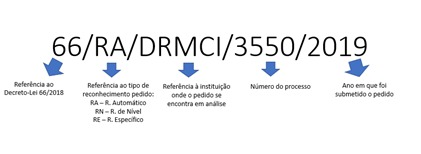
When you submit your application using the online form, the message “application successfully submitted” will appear on the screen, along with the associated number/reference. You will also have automatically received an email confirming the submission of your application with that same number/reference. If you have not received the email, please check your spam folder.

Here is an example of the order number/reference:
 

I made a mistake when submitting the application and I intend to change Higher Education Institutions, what should I do?

In this case, you should contact the institution to which you submitted your request directly and ask for its cancellation. After cancellation, you can go back to the form and submit a new request. Please note that the Higher Education Institution (IES) can only cancel requests that are assigned to it; all others will have to go through the institution that was originally chosen.


The My Superior app tells me that my order payment is still pending. What's going on?

Given that some difficulties have been experienced in using the My Superior application, we advise you to ignore the app's messages for the time being and, if you wish to obtain updated information on the status of your request, to contact the Institution indicated in the reference number directly, through their respective academic services, mentioning the reference/request number.


I spoke with the Higher Education Institution in Portugal where I want to obtain the Recognition, and they said that the IES handles everything.

The IES only provides and manages the online Recognition platform in Portugal. Both the online form and the platform are universal and shared between the IES and all Portuguese public Higher Education Institutions. Therefore, if you wish to request Recognition for an Institution, simply access the online form and choose the Institution you want.


I have a final (foreign) qualitative course grade. Can I request its conversion to the Portuguese scale?

The conversion of the final grade to the Portuguese scale (from 0 to 20) can be requested simultaneously with automatic recognition or level recognition, or, in some cases, after you have already obtained your grade.

• Recognition of Degree/Diploma, or

• Professional Recognition

With the exception of specific situations foreseen for some classifications awarded in the United Kingdom , Malta and the United States of America , the conversion of the final classification to the Portuguese scale is done by applying the following arithmetic formula:

Cfinal = {[(C-Cmin)/(Cmax-Cmin)]*10} + 10

in which:

Cfinal = final classification converted to the Portuguese scale;

C = final classification of the academic degree or foreign diploma;

Cmin = minimum grade corresponding to passing on the foreign final grading scale;

Cmax = maximum rating on the foreign final rating scale.


It is also important to note that this process of converting the final classification to the Portuguese scale does not apply to the PhD degree, but only to the Bachelor's and Master's degrees.

For the doctoral degree, as well as for situations where a final grade has not been assigned by the originating Higher Education Institution, the mechanism for assigning a final grade may be applied, which is an integral part of the Specific Recognition process.


What documents do I need to submit to apply for Recognition?

Here you can consult the required documents for each type of Recognition. However, before submitting your application using the online form, check with the Higher Education Institution where you intend to obtain the Recognition (for example, by consulting their website) what specific requirements/documents and costs are required by that institution.


Do I need to translate my documents to apply for Recognition?

If the documents were originally issued in English, French, or Spanish, no. If the documents are issued in other languages, they need to be translated into Portuguese (certified translation) if the institution you choose to evaluate your application deems it necessary. The competent authority for recognition may decide that, as an alternative to Portuguese, the translation should be done into English, Spanish, or French.

This certification should focus on the content of the translation and not just on the signatures of those involved in the acts in question.

According to current Portuguese legislation (Notary Code and Decree-Law No. 237/2001, of August 30), the following entities may perform and certify translations:

  • Portuguese Notary Office;
  • Portuguese consulate in the country where the document was issued;
  • The consulate in Portugal of the country where the document was issued and a qualified translator;
  • Conservators from any Conservatory;
  • Lawyers and Solicitors;
  • Chambers of Commerce and Industry recognized under the terms of Decree-Law No. 244/92, of October 29.

It can also be done by a qualified translator and certified by any of the services or entities previously mentioned, who must appear before the notary, registrar, registry officer, lawyer, solicitor or chamber of commerce and, under oath or commitment of honor, declare that the text has been faithfully translated by them.


I intend to have my secondary education qualifications recognized in Portugal. What should I do?

Since the IES (Institute of Higher Education) is only competent for the automatic recognition of foreign higher education degrees, if you wish to have foreign secondary education qualifications recognized, we suggest consulting the Directorate-General for Education for information on the necessary steps. More information here .

If you would like information about access to higher education in Portugal, we suggest consulting the information available here .


I intend to teach in Portugal. What type of accreditation should I choose?

Regarding the practice of teaching in Portugal, we advise you to contact the DGAE (General Directorate of School Administration), the entity that regulates teaching activity in Portugal and which can provide more information on the type of Recognition most appropriate to your situation.


I want to apply for a master's degree in Portugal. Do I need to have my undergraduate degree/bachelor's degree recognized?

Access to and admission to master's degree programs is through competitive examinations organized by each Higher Education Institution. Therefore, specific information regarding access and admission to these programs, including the requirement for prior academic qualifications to be recognized, should be obtained directly from the institution.

Updated on October 19, 2026