
Saltar para o conteúdo principal

Organization responsible for coordinating and implementing public policies in the field of higher education.

Higher Education Network

Training Offer

The Portuguese education system is regulated by the Basic Law of the Education System and is developed at three levels: basic, secondary and higher education.

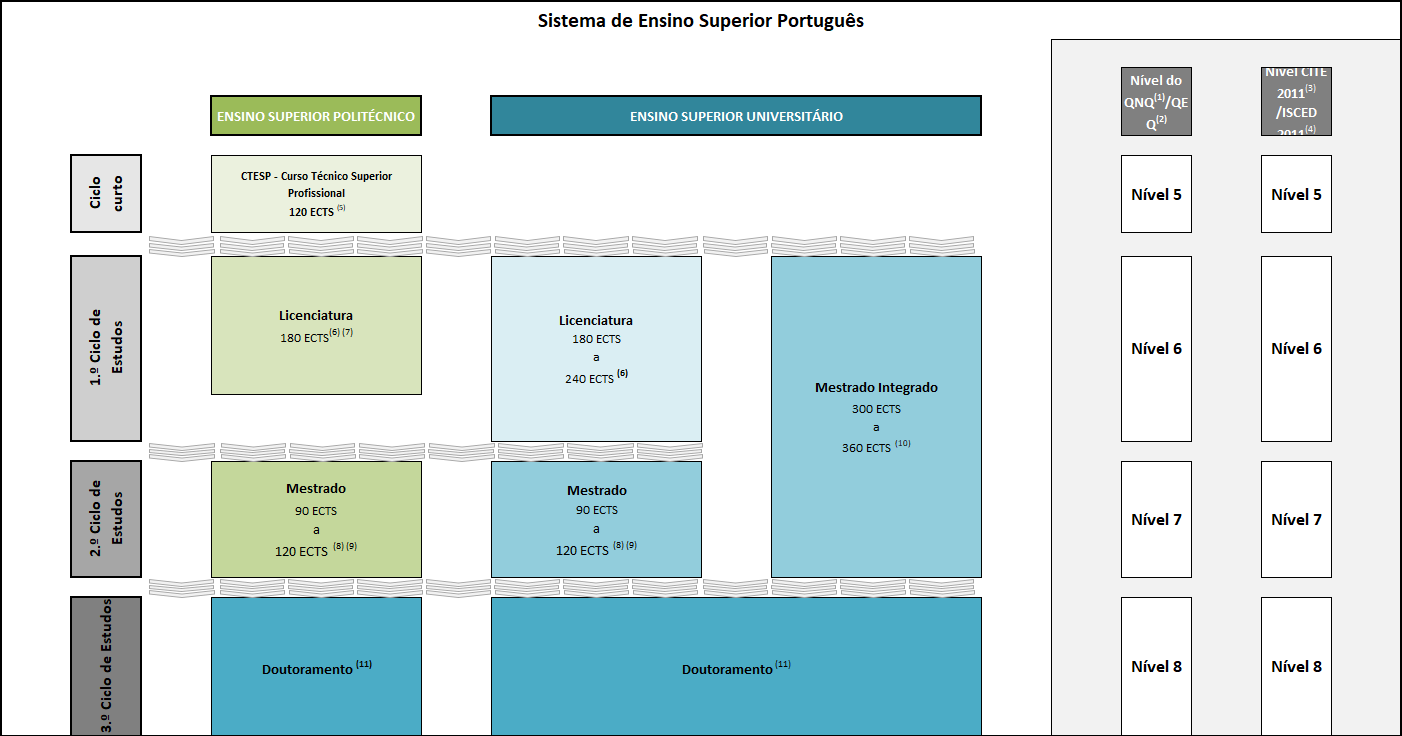
Organized in a binary system, it integrates university and polytechnic education and has a structure based on 4 cycles: a short-term study cycle, which does not confer an academic degree, and three study cycles leading to the academic degrees of bachelor, master, and doctor .

The Higher Education System

Offered in both public and private institutions, Portuguese higher education is organized in a binary system that integrates university education and polytechnic education.

Fromativa Offer

Search platform for public and private higher education courses and institutions.

Foreign Entities Not Integrated into Portuguese Higher Education

Registration procedure with the Institute for Higher Education, IP (IES, IP), applicable to entities covered by Decree-Law No. 83/2026, of April 7.

Higher Education Degrees and Diplomas

Consult information regarding all Degrees and Diplomas available in the Portuguese Higher Education System.

Portuguese Higher Education System

Organization of higher education

Portuguese higher education is organized in a binary system that integrates university and polytechnic education and is offered in both public and private institutions. Private higher education institutions obtain prior recognition of public interest from the Government.

University education includes universities, university institutes, and other university-level educational establishments. Polytechnic education comprises polytechnic institutes and other polytechnic-level educational establishments.

Binary system

University education is guided by a perspective of promoting research and knowledge creation, aiming to ensure a solid scientific and cultural preparation and provide technical training that enables the exercise of professional and cultural activities and fosters the development of design, innovation and critical analysis skills.

Polytechnic education is guided by a perspective of applied research and development, aimed at understanding and solving concrete problems, and seeks to provide a solid higher-level cultural and technical education, develop the capacity for innovation and critical analysis, and impart scientific knowledge of a theoretical and practical nature and its applications for the exercise of professional activities.

Diagram of the Higher Education System

Autonomy

Higher education institutions enjoy scientific , pedagogical , cultural , and disciplinary autonomy.

  • Scientific autonomy consists of the ability to define, plan, and execute research and other scientific activities.
  • Pedagogical autonomy encompasses the ability to develop study plans, define the subject matter of curricular units, define teaching methods, allocate resources, and choose knowledge assessment processes.
  • Cultural autonomy translates into the ability to define the training program and cultural initiatives.
  • Disciplinary autonomy confers the power to punish, in accordance with the law and statutes, disciplinary infractions committed by teachers, researchers and other employees, as well as students.

Thus, matters such as the specific conditions for admission to study cycles, the operating conditions of study cycles, study plans, prerequisites and assessment regimes, the statute of limitations, the accreditation of training, curricular transition rules, deadlines for issuing academic documentation, changes to timetables and operating regimes, or deadlines for responding to requests fall within the scope of the aforementioned autonomies.

Structure of higher education degrees and diplomas

In 2005, a process to reform the Basic Law of the Education System was initiated in order to implement the Bologna Process, which included the introduction of the European Credit Transfer System (ECTS) in study cycles, mobility mechanisms, diploma supplements, among others.

Higher education adopted a new three-cycle study structure, leading to the academic degrees of Bachelor, Master, and Doctor. This structure was introduced in 2006 and fully implemented in Portugal from the 2009/2010 academic year onwards.

Generic qualification descriptors were also established for each study cycle, based on the skills acquired, as well as the definition of ECTS credits for the first and second study cycles.

In 2014, a non-degree-granting higher education study cycle was created, called the professional higher technical course, which corresponds to the short study cycle linked to the 1st cycle foreseen in the Qualifications Framework of the European Higher Education Area.

Accreditation and quality assurance

The Agency for Assessment and Accreditation of Higher Education is the competent entity to evaluate and accredit higher education institutions and their study programs. This Agency is an independent body from the state and institutions and its objective is to promote and ensure quality in higher education.

The evaluation and accreditation criteria are those established in the legal frameworks for higher education degrees and diplomas and for higher education assessment.

In addition to the prior accreditation of newly created study programs, that Agency also carries out regular accreditation of study programs that are already in operation.

Legislation

Law No. 46/86, of October 14 – Establishes the general framework of the education system.

Modified By

Law No. 115/97, of September 19

Law, nº 49/2005, of August 30

Law, nº 85/2009, of August 27


Law No. 62/2007, of September 10 – Establishes the legal framework for higher education institutions, regulating in particular their constitution, attributions and organization, the functioning and competence of their bodies, and also the public supervision and oversight of the State over them, within the framework of their autonomy.


Decree-Law No. 74/2006, of March 24 – Approves the legal framework for academic degrees and diplomas in higher education.

Modified By

Decree-Law No. 107/2008, of June 25

Decree-Law No. 230/2009, of September 14

Decree-Law No. 115/2013, of August 7

Decree-Law No. 63/2016, of September 13

Decree-Law, nº 65/2018, of August 16

Decree-Law, No. 27/2021, of April 16


Decree-Law No. 42/2005, of February 22 – Approves the regulatory principles of instruments for the creation of the European Higher Education Area (ECTS)

Modified By

Decree-Law No. 107/2008, of June 25


Decree-Law No. 369/2007, of November 5 – Creates the Agency for Assessment and Accreditation of Higher Education and approves its statutes.


Law No. 38/2007, of August 16 – Approves the legal framework for the evaluation of the quality of higher education.

Modified By

Law No. 94/2019, of September 4

Higher Education Degrees and Diplomas

  • CTeSP

    It is a non-degree-granting higher education study cycle, with 120 ECTS credits and a duration of two years, the successful completion of which leads to the awarding of a higher professional technician diploma.

    Structure

    CTeSP integrates:

    • General and scientific training subjects;
    • Technical training subjects;
    • Work-based training. In total, considering the credits for the general and scientific training components and the technical training component, the former corresponds to approximately 30% and the latter to 70%.

    70% of the class hours for technical training subjects are dedicated to practical, laboratory, or workshop application, depending on the type of profession the course prepares students for.

    The work-based learning component is carried out through an internship, lasting at least one semester, which can be spread throughout the course.

    Bribes

    Information regarding tuition fees can be found here.

    Scholarship

    Information about scholarships and other support for higher education can be found here.

    Access

    Information regarding access and admission to this study program can be found here.

    Job openings

    The number of places available is determined annually by each institution, within the limits defined in the course registration.

    There is a priority for filling these vacancies:
    Up to 4% (and a minimum of 2 places): For students with disabilities. These students are given priority over the following.
    Up to 50%: For students who complete vocational training courses at secondary level or equivalent in schools and other entities networked with the higher education institution.

    CTeSP abroad

    Higher education institutions may partner with other foreign higher education institutions to offer courses. However, this practice is contingent upon prior registration with IES, IP.

    Creation of higher professional technical courses

    The commencement of a higher professional technical course requires prior registration with IES, IP.

  • Bachelor's degree

    The degree of Bachelor is awarded to those who demonstrate:

    a) Possess knowledge and comprehension in a field of study at a level that:

    i) Building upon your secondary-level knowledge, develop and deepen it;

    ii) Rely on and correspond to advanced-level teaching materials;

    iii) In some areas of this field, be at the cutting-edge level of knowledge in that area;

    b) To know how to apply the knowledge and understanding acquired, in order to demonstrate a professional approach to the work carried out in their vocational area;

    c) Ability to solve problems within their field of study and to construct and substantiate their own arguments;

    d) Ability to collect, select and interpret relevant information, particularly in their area of expertise, enabling them to substantiate the solutions they propose and the judgments they make, including relevant social, scientific and ethical aspects in their analysis;

    e) Skills that enable them to communicate information, ideas, problems and solutions, both to audiences made up of specialists and non-specialists;

    f) Learning skills that enable them to learn throughout their lives with a high degree of autonomy.

    In polytechnic education, it has 180 ECTS credits and a normal duration of 6 semesters, or, exceptionally, up to 240 ECTS credits and 7 or 8 semesters.

    In university education, it has 180 or 240 ECTS credits and a normal duration of between 6 and 8 semesters, and values similar to those of reference institutions in the same areas should be adopted.

    The bachelor's degree is awarded to those who, through passing all the curricular units that make up the study plan of the bachelor's degree course, have obtained the required number of credits.

    Structure

    It is the responsibility of the competent body of each higher education institution to approve, among other matters, the curriculum structure and the study plan.

    Qualification

    The bachelor's degree corresponds to level 6 of the NQF and EQF.

    Bribes

    Information regarding tuition fees can be found here.

    Scholarship

    Information on scholarships and other support for higher education can be found on the IES, IP Portal.

    Access

    Information regarding access and admission to this study program can be found on the IES, IP Portal.

    Job openings

    These places are set annually by the higher education institution or establishment, and may include specific places for evening classes, distance learning, or instruction in English.

    Creation of degree-granting study cycles

    The creation of study programs aimed at awarding academic degrees falls under the competence of higher education institutions, but their commencement requires accreditation by the Agency for Assessment and Accreditation of Higher Education and registration with the IES, IP.

  • Integrated Master's Degree

    The master's degree is awarded in a specialty, and when necessary, specialties may be further subdivided into areas of specialization, and to those who demonstrate:

    a) Possess knowledge and comprehension at a level that:

    i) Building upon the knowledge acquired at the primary school level, develop and deepen it;

    ii) They enable and form the basis for original developments and/or applications, often in a research context;

    b) To be able to apply their knowledge and their ability to understand and solve problems in new and unfamiliar situations, in broad and multidisciplinary contexts, even if related to their field of study;

    c) Ability to integrate knowledge, deal with complex issues, develop solutions or make judgments in situations of limited or incomplete information, including reflections on the ethical and social implications and responsibilities that result from or condition these solutions and judgments;

    d) To be able to communicate their conclusions, and the knowledge and reasoning underlying them, to both specialists and non-specialists, in a clear and unambiguous manner;

    e) Skills that enable them to learn throughout their lives, in a fundamentally self-directed or autonomous way.

    It is an initial training study cycle taught only at the university level, comprising 300 to 360 ECTS credits and a normal duration of between 10 and 12 semesters, in cases where this duration for access to the exercise of a specific professional activity is established by legal norms of the European Union or results from a stable and consolidated practice in the European Union.

    Structure

    The master's degree is awarded upon completion of an integrated master's degree program to those who, through passing all the curricular units that make up the study plan of the program and passing the public defense of the dissertation, project work, or internship report, have obtained the required number of credits.

    In this study program, a bachelor's degree is awarded to those who have completed the 180 ECTS credits corresponding to the first six semesters of coursework.

    Bribes

    Information regarding tuition fees can be found here.

    Scholarship

    Information on scholarships and other support for higher education can be found on the IES, IP Portal.

    Access

    Information regarding access and admission to this study program can be found on the IES, IP Portal.

    Job openings

    These places are set annually by the higher education institution or establishment, and may include specific places for evening classes, distance learning, or instruction in English.

    Training areas

    Currently, there are no restrictions on the areas of study in which integrated master's degrees can be offered. However, starting in the 2021-2022 academic year, integrated master's degrees will only be offered in the following areas of study:

    • Architecture and Urban Planning
    • Pharmaceutical Sciences
    • Medicine
    • Dentistry
    • Veterinary Medicine

    Creation of degree-granting study cycles

    The creation of study programs aimed at awarding academic degrees falls under the competence of higher education institutions, but their commencement requires accreditation by the Agency for Assessment and Accreditation of Higher Education and registration with the IES, IP.

    Job openings

    These places are set annually by the higher education institution or establishment, and may include specific places for evening classes, distance learning, or instruction in English.

  • Master's degree

    The master's degree is awarded in a specialty, and, when necessary, specialties may be further subdivided into areas of specialization, and to those who demonstrate:

    a) Possess knowledge and comprehension at a level that:

    i) Building upon the knowledge acquired at the primary school level, develop and deepen it;

    ii) They enable and form the basis for original developments and/or applications, often in a research context;

    b) To be able to apply their knowledge and their ability to understand and solve problems in new and unfamiliar situations, in broad and multidisciplinary contexts, even if related to their field of study;

    c) Ability to integrate knowledge, deal with complex issues, develop solutions or make judgments in situations of limited or incomplete information, including reflections on the ethical and social implications and responsibilities that result from or condition these solutions and judgments;

    d) To be able to communicate their conclusions, and the knowledge and reasoning underlying them, to both specialists and non-specialists, in a clear and unambiguous manner;

    e) Skills that enable them to learn throughout their lives, in a fundamentally self-directed or autonomous way.

    In university education, it must ensure the acquisition of academic specialization through research, innovation, or the development of professional skills.

    In polytechnic education, the primary goal should be to ensure the acquisition of a professional specialization.

    Duration

    It has 90 to 120 ECTS credits and a normal duration of 3 to 4 semesters.

    In exceptional cases, it may have 60 credits and a normal duration of 2 semesters, in the following situations:
    When there is a strong vocational focus, the entry requirements in these cases are suitable for the exclusive recruitment of students with a minimum of five years of prior experience, duly proven.
    This may be a consequence of a stable and internationally established practice in this specialty.

    Structure

    Integra:

    A specialization course, consisting of an organized set of curricular units, called a master's course, which corresponds to a minimum of 50% of the total credits of the study cycle.
    A scientific dissertation or project work, original and specifically carried out for this purpose, or a professional internship subject to a final report, depending on the specific objectives pursued, under the terms established by the respective regulatory norms, corresponding to a minimum of 30 credits.

    The master's degree is awarded to those who, through passing all the curricular units that make up the master's course study plan and passing the public defense of the dissertation, project work, or internship report, have obtained the required number of credits.

    It is the responsibility of the competent body of each higher education institution to approve, among other matters, the curricular structure and study plan, as well as the rules regarding the dissertation, project, or internship report component, including supervision, presentation, defense, and jury.

    Qualification

    The master's degree corresponds to level 7 of the NQF and EQF.

    Bribes

    Information regarding tuition fees can be found here.

    Scholarship

    Information on scholarships and other support for higher education can be found on the IES, IP Portal.

    Access

    Information regarding access and admission to this study program can be found on the IES, IP Portal.

    Creation of degree-granting study cycles

    The creation of study programs aimed at awarding academic degrees falls under the competence of higher education institutions, but their commencement requires accreditation by the Agency for Assessment and Accreditation of Higher Education and registration with the IES, IP.
    In university education, it must ensure the acquisition of academic specialization through research, innovation, or the development of professional skills.

  • Doctorate

    A doctoral degree is awarded in a branch of knowledge or specialty to those who demonstrate:

    a) Capacity for systematic understanding in a scientific field of study;

    b) Skills, abilities and research methods associated with a scientific field;

    c) Ability to conceive, design, adapt and carry out meaningful research while respecting the requirements imposed by academic quality and integrity standards;

    d) To have carried out a significant body of original research that has contributed to expanding the frontiers of knowledge, some of which deserves national or international dissemination in publications with a selection committee;

    e) To be able to critically analyze, evaluate, and synthesize new and complex ideas;

    f) To be able to communicate with their peers, the wider academic community, and society in general about their area of expertise;

    (g) To be able to promote technological, social, or cultural progress in a knowledge-based society, within an academic and/or professional context.

    Structure

    Integra:

    The preparation of an original thesis specifically for this purpose, suited to the nature of the field of knowledge or specialty, or the compilation of a coherent and relevant set of research papers, or, in the field of arts, a work or set of works or achievements, accompanied by written justification.
    The potential implementation of curricular units aimed at training for research, which together constitute a doctoral course, whenever the respective regulatory norms so provide.

    The duration of the doctoral degree program and the corresponding number of ECTS credits are not defined. Most frequently, it lasts 6 to 8 semesters and comprises 180 to 240 ECTS credits.

    The doctoral degree is awarded to those who have obtained approval in the public defense of their thesis.

    It is the responsibility of the competent body of each higher education institution to approve, among other matters, the curricular structure and study plan, when it exists, and the rules regarding the thesis component, including supervision, presentation, defense, and jury.

    Qualification

    The doctoral degree corresponds to level 8 of the NQF and EQF.

    Bribes

    Information regarding tuition fees can be found here.

    Access

    Information regarding access and admission to this study program can be found on the IES, IP Portal.

    Creation of degree-granting study cycles

    The creation of study programs aimed at awarding academic degrees falls under the competence of higher education institutions, but their commencement requires accreditation by the Agency for Assessment and Accreditation of Higher Education and registration with the IES, IP.
    In polytechnic education, the primary goal should be to ensure the acquisition of a professional specialization.

  • Other Courses and Diplomas

    OTHER DEGREES THAT CAN BE OBTAINED IN HIGHER EDUCATION
    In higher education, other non-degree courses may be offered and diplomas awarded, including:


    1. a) By completing part of an undergraduate degree course of no less than 120 credits;
    2. b) By completing a master's degree course of no less than 60 credits;
    3. c) By completing a doctoral course;
    4. d) Through the provision of other non-degree-granting courses, integrated into its educational project.

    Through enrollment in these programs, institutions, within the scope of their autonomy, can set the amount of tuition fees to be paid.

    Because these courses do not confer academic degrees, they are not subject to control by the supervisory authority. Therefore, only higher education institutions can provide information about the courses they offer and their respective application and operational requirements. However, they are still considered training provided within higher education.

    In either case, the diplomas in question must adopt a name that is not confused with the name of the final academic degree obtained, if one exists.


    POST-GRADUATE STUDIES
    "Postgraduate studies" is the name given to a course that is accessed after a first "graduation," usually a bachelor's degree, taught at a higher education institution, within the scope of its training vocation and educational project, but in no case conferring any degree, which is why it is not subject to authorization by the supervisory authority.

    The terms "postgraduate" and "postgraduate training" (and others that suggest higher education training) are reserved for higher education institutions and correspond, for example, to a specialization course that constitutes part of a master's degree cycle, but is not sufficient for obtaining the degree, although the concept of "postgraduate" is broader, encompassing other examples besides this.


    Postgraduate Specialization Courses in Nursing

    Postgraduate specialization courses in Nursing aim to ensure the acquisition of scientific, technical, human and cultural competence in a specific area of nursing, namely:


    • Community Nursing
    • Medical-Surgical Nursing
    • Rehabilitation Nursing
    • Child Health and Pediatric Nursing
    • Maternal and Obstetric Health Nursing
    • Mental Health and Psychiatric Nursing

    Passing all the curricular units that make up the study plan of a course confers the right to a specialization diploma in Nursing.

    Holders of a nursing degree who meet the following criteria may apply for these courses:

    • Holders of a bachelor's degree in nursing or equivalent legal qualification;
    • Holders of the professional title of nurse;
    • And they must have at least two years of professional experience as a nurse.


    Applications for enrollment and registration in postgraduate specialization courses are made through competitive examinations organized by each educational institution.

    Existing postgraduate specialization courses in Nursing can be found on the Course and Institution Search Platform.


    Advanced Training Courses in English

    Advanced training courses in English are one of the ways to obtain professional qualifications for teaching in group 120 – teaching English in the 3rd and 4th years of schooling.

    Applicants for supplementary higher education courses in English are eligible to apply if they:


    1. a) Holders of professional qualifications for teaching in recruitment group 110;
    2. b) Holders of professional qualifications for teaching in recruitment group 220;
    3. c) Holders of professional qualifications for teaching in recruitment group 330;
    4. d) Holders of a master's degree in teaching English and another foreign language in basic education, who have not completed supervised teaching practice in English in the 1st cycle.


    Applications for enrollment and registration in these courses are made through competitive examinations organized by each higher education institution, which is responsible for verifying the applicable admission requirements.


    POST-DOCTORAL
    Postdoctoral programs are specialized courses undertaken after the completion of a doctoral degree program, offered at higher education institutions.


    Offer

    Since these courses do not require registration with IES, IP, you should consult the public and private higher education institutions or their websites.


    LEGISLATION

    • Law No. 62/2007, of September 10 Establishes the legal regime for higher education institutions, regulating in particular their constitution, attributions and organization, the functioning and competence of their bodies and, also, the public tutelage and supervision of the State over them, within the framework of their autonomy, paragraph a) of No. 1 of Article 8.


    Approves the legal framework for academic degrees and diplomas in higher education.

    No. 3 of Article 4.


    Modified By

    Decree-Law No. 107/2008, of June 25

    Decree-Law No. 230/2009, of September 14

    Decree-Law No. 115/2013, of August 7

    Decree-Law No. 63/2016, of September 13

    Decree-Law, nº 65/2018, of August 16

    Decree-Law, No. 27/2021, of April 16


    • Decree No. 260-A/2014, of December 15 Regulates the acquisition of professional qualifications for teaching in recruitment groups that already hold, or will obtain, certified training in the field of English teaching in the 1st cycle of basic education, and the levels of English language proficiency from the 3rd to the 12th grade in basic and secondary education.


    Modified By

    Ordinance No. 197/2017, of June 23

  • Equivalences and recognitions of old courses

  • Legislation

CTeSP

It is a non-degree-granting higher education study cycle, with 120 ECTS credits and a duration of two years, the successful completion of which leads to the awarding of a higher professional technician diploma.

Structure

CTeSP integrates:

  • General and scientific training subjects;
  • Technical training subjects;
  • Work-based training. In total, considering the credits for the general and scientific training components and the technical training component, the former corresponds to approximately 30% and the latter to 70%.

70% of the class hours for technical training subjects are dedicated to practical, laboratory, or workshop application, depending on the type of profession the course prepares students for.

The work-based learning component is carried out through an internship, lasting at least one semester, which can be spread throughout the course.

Bribes

Information regarding tuition fees can be found here.

Scholarship

Information about scholarships and other support for higher education can be found here.

Access

Information regarding access and admission to this study program can be found here.

Job openings

The number of places available is determined annually by each institution, within the limits defined in the course registration.

There is a priority for filling these vacancies:
Up to 4% (and a minimum of 2 places): For students with disabilities. These students are given priority over the following.
Up to 50%: For students who complete vocational training courses at secondary level or equivalent in schools and other entities networked with the higher education institution.

CTeSP abroad

Higher education institutions may partner with other foreign higher education institutions to offer courses. However, this practice is contingent upon prior registration with IES, IP.

Creation of higher professional technical courses

The commencement of a higher professional technical course requires prior registration with IES, IP.

Bachelor's degree

The degree of Bachelor is awarded to those who demonstrate:

a) Possess knowledge and comprehension in a field of study at a level that:

i) Building upon your secondary-level knowledge, develop and deepen it;

ii) Rely on and correspond to advanced-level teaching materials;

iii) In some areas of this field, be at the cutting-edge level of knowledge in that area;

b) To know how to apply the knowledge and understanding acquired, in order to demonstrate a professional approach to the work carried out in their vocational area;

c) Ability to solve problems within their field of study and to construct and substantiate their own arguments;

d) Ability to collect, select and interpret relevant information, particularly in their area of expertise, enabling them to substantiate the solutions they propose and the judgments they make, including relevant social, scientific and ethical aspects in their analysis;

e) Skills that enable them to communicate information, ideas, problems and solutions, both to audiences made up of specialists and non-specialists;

f) Learning skills that enable them to learn throughout their lives with a high degree of autonomy.

In polytechnic education, it has 180 ECTS credits and a normal duration of 6 semesters, or, exceptionally, up to 240 ECTS credits and 7 or 8 semesters.

In university education, it has 180 or 240 ECTS credits and a normal duration of between 6 and 8 semesters, and values similar to those of reference institutions in the same areas should be adopted.

The bachelor's degree is awarded to those who, through passing all the curricular units that make up the study plan of the bachelor's degree course, have obtained the required number of credits.

Structure

It is the responsibility of the competent body of each higher education institution to approve, among other matters, the curriculum structure and the study plan.

Qualification

The bachelor's degree corresponds to level 6 of the NQF and EQF.

Bribes

Information regarding tuition fees can be found here.

Scholarship

Information on scholarships and other support for higher education can be found on the IES, IP Portal.

Access

Information regarding access and admission to this study program can be found on the IES, IP Portal.

Job openings

These places are set annually by the higher education institution or establishment, and may include specific places for evening classes, distance learning, or instruction in English.

Creation of degree-granting study cycles

The creation of study programs aimed at awarding academic degrees falls under the competence of higher education institutions, but their commencement requires accreditation by the Agency for Assessment and Accreditation of Higher Education and registration with the IES, IP.

Integrated Master's Degree

The master's degree is awarded in a specialty, and when necessary, specialties may be further subdivided into areas of specialization, and to those who demonstrate:

a) Possess knowledge and comprehension at a level that:

i) Building upon the knowledge acquired at the primary school level, develop and deepen it;

ii) They enable and form the basis for original developments and/or applications, often in a research context;

b) To be able to apply their knowledge and their ability to understand and solve problems in new and unfamiliar situations, in broad and multidisciplinary contexts, even if related to their field of study;

c) Ability to integrate knowledge, deal with complex issues, develop solutions or make judgments in situations of limited or incomplete information, including reflections on the ethical and social implications and responsibilities that result from or condition these solutions and judgments;

d) To be able to communicate their conclusions, and the knowledge and reasoning underlying them, to both specialists and non-specialists, in a clear and unambiguous manner;

e) Skills that enable them to learn throughout their lives, in a fundamentally self-directed or autonomous way.

It is an initial training study cycle taught only at the university level, comprising 300 to 360 ECTS credits and a normal duration of between 10 and 12 semesters, in cases where this duration for access to the exercise of a specific professional activity is established by legal norms of the European Union or results from a stable and consolidated practice in the European Union.

Structure

The master's degree is awarded upon completion of an integrated master's degree program to those who, through passing all the curricular units that make up the study plan of the program and passing the public defense of the dissertation, project work, or internship report, have obtained the required number of credits.

In this study program, a bachelor's degree is awarded to those who have completed the 180 ECTS credits corresponding to the first six semesters of coursework.

Bribes

Information regarding tuition fees can be found here.

Scholarship

Information on scholarships and other support for higher education can be found on the IES, IP Portal.

Access

Information regarding access and admission to this study program can be found on the IES, IP Portal.

Job openings

These places are set annually by the higher education institution or establishment, and may include specific places for evening classes, distance learning, or instruction in English.

Training areas

Currently, there are no restrictions on the areas of study in which integrated master's degrees can be offered. However, starting in the 2021-2022 academic year, integrated master's degrees will only be offered in the following areas of study:

  • Architecture and Urban Planning
  • Pharmaceutical Sciences
  • Medicine
  • Dentistry
  • Veterinary Medicine

Creation of degree-granting study cycles

The creation of study programs aimed at awarding academic degrees falls under the competence of higher education institutions, but their commencement requires accreditation by the Agency for Assessment and Accreditation of Higher Education and registration with the IES, IP.

Job openings

These places are set annually by the higher education institution or establishment, and may include specific places for evening classes, distance learning, or instruction in English.

Master's degree

The master's degree is awarded in a specialty, and, when necessary, specialties may be further subdivided into areas of specialization, and to those who demonstrate:

a) Possess knowledge and comprehension at a level that:

i) Building upon the knowledge acquired at the primary school level, develop and deepen it;

ii) They enable and form the basis for original developments and/or applications, often in a research context;

b) To be able to apply their knowledge and their ability to understand and solve problems in new and unfamiliar situations, in broad and multidisciplinary contexts, even if related to their field of study;

c) Ability to integrate knowledge, deal with complex issues, develop solutions or make judgments in situations of limited or incomplete information, including reflections on the ethical and social implications and responsibilities that result from or condition these solutions and judgments;

d) To be able to communicate their conclusions, and the knowledge and reasoning underlying them, to both specialists and non-specialists, in a clear and unambiguous manner;

e) Skills that enable them to learn throughout their lives, in a fundamentally self-directed or autonomous way.

In university education, it must ensure the acquisition of academic specialization through research, innovation, or the development of professional skills.

In polytechnic education, the primary goal should be to ensure the acquisition of a professional specialization.

Duration

It has 90 to 120 ECTS credits and a normal duration of 3 to 4 semesters.

In exceptional cases, it may have 60 credits and a normal duration of 2 semesters, in the following situations:
When there is a strong vocational focus, the entry requirements in these cases are suitable for the exclusive recruitment of students with a minimum of five years of prior experience, duly proven.
This may be a consequence of a stable and internationally established practice in this specialty.

Structure

Integra:

A specialization course, consisting of an organized set of curricular units, called a master's course, which corresponds to a minimum of 50% of the total credits of the study cycle.
A scientific dissertation or project work, original and specifically carried out for this purpose, or a professional internship subject to a final report, depending on the specific objectives pursued, under the terms established by the respective regulatory norms, corresponding to a minimum of 30 credits.

The master's degree is awarded to those who, through passing all the curricular units that make up the master's course study plan and passing the public defense of the dissertation, project work, or internship report, have obtained the required number of credits.

It is the responsibility of the competent body of each higher education institution to approve, among other matters, the curricular structure and study plan, as well as the rules regarding the dissertation, project, or internship report component, including supervision, presentation, defense, and jury.

Qualification

The master's degree corresponds to level 7 of the NQF and EQF.

Bribes

Information regarding tuition fees can be found here.

Scholarship

Information on scholarships and other support for higher education can be found on the IES, IP Portal.

Access

Information regarding access and admission to this study program can be found on the IES, IP Portal.

Creation of degree-granting study cycles

The creation of study programs aimed at awarding academic degrees falls under the competence of higher education institutions, but their commencement requires accreditation by the Agency for Assessment and Accreditation of Higher Education and registration with the IES, IP.
In university education, it must ensure the acquisition of academic specialization through research, innovation, or the development of professional skills.

Doctorate

A doctoral degree is awarded in a branch of knowledge or specialty to those who demonstrate:

a) Capacity for systematic understanding in a scientific field of study;

b) Skills, abilities and research methods associated with a scientific field;

c) Ability to conceive, design, adapt and carry out meaningful research while respecting the requirements imposed by academic quality and integrity standards;

d) To have carried out a significant body of original research that has contributed to expanding the frontiers of knowledge, some of which deserves national or international dissemination in publications with a selection committee;

e) To be able to critically analyze, evaluate, and synthesize new and complex ideas;

f) To be able to communicate with their peers, the wider academic community, and society in general about their area of expertise;

(g) To be able to promote technological, social, or cultural progress in a knowledge-based society, within an academic and/or professional context.

Structure

Integra:

The preparation of an original thesis specifically for this purpose, suited to the nature of the field of knowledge or specialty, or the compilation of a coherent and relevant set of research papers, or, in the field of arts, a work or set of works or achievements, accompanied by written justification.
The potential implementation of curricular units aimed at training for research, which together constitute a doctoral course, whenever the respective regulatory norms so provide.

The duration of the doctoral degree program and the corresponding number of ECTS credits are not defined. Most frequently, it lasts 6 to 8 semesters and comprises 180 to 240 ECTS credits.

The doctoral degree is awarded to those who have obtained approval in the public defense of their thesis.

It is the responsibility of the competent body of each higher education institution to approve, among other matters, the curricular structure and study plan, when it exists, and the rules regarding the thesis component, including supervision, presentation, defense, and jury.

Qualification

The doctoral degree corresponds to level 8 of the NQF and EQF.

Bribes

Information regarding tuition fees can be found here.

Access

Information regarding access and admission to this study program can be found on the IES, IP Portal.

Creation of degree-granting study cycles

The creation of study programs aimed at awarding academic degrees falls under the competence of higher education institutions, but their commencement requires accreditation by the Agency for Assessment and Accreditation of Higher Education and registration with the IES, IP.
In polytechnic education, the primary goal should be to ensure the acquisition of a professional specialization.

Other Courses and Diplomas

OTHER DEGREES THAT CAN BE OBTAINED IN HIGHER EDUCATION
In higher education, other non-degree courses may be offered and diplomas awarded, including:


  1. a) By completing part of an undergraduate degree course of no less than 120 credits;
  2. b) By completing a master's degree course of no less than 60 credits;
  3. c) By completing a doctoral course;
  4. d) Through the provision of other non-degree-granting courses, integrated into its educational project.

Through enrollment in these programs, institutions, within the scope of their autonomy, can set the amount of tuition fees to be paid.

Because these courses do not confer academic degrees, they are not subject to control by the supervisory authority. Therefore, only higher education institutions can provide information about the courses they offer and their respective application and operational requirements. However, they are still considered training provided within higher education.

In either case, the diplomas in question must adopt a name that is not confused with the name of the final academic degree obtained, if one exists.


POST-GRADUATE STUDIES
"Postgraduate studies" is the name given to a course that is accessed after a first "graduation," usually a bachelor's degree, taught at a higher education institution, within the scope of its training vocation and educational project, but in no case conferring any degree, which is why it is not subject to authorization by the supervisory authority.

The terms "postgraduate" and "postgraduate training" (and others that suggest higher education training) are reserved for higher education institutions and correspond, for example, to a specialization course that constitutes part of a master's degree cycle, but is not sufficient for obtaining the degree, although the concept of "postgraduate" is broader, encompassing other examples besides this.


Postgraduate Specialization Courses in Nursing

Postgraduate specialization courses in Nursing aim to ensure the acquisition of scientific, technical, human and cultural competence in a specific area of nursing, namely:


  • Community Nursing
  • Medical-Surgical Nursing
  • Rehabilitation Nursing
  • Child Health and Pediatric Nursing
  • Maternal and Obstetric Health Nursing
  • Mental Health and Psychiatric Nursing

Passing all the curricular units that make up the study plan of a course confers the right to a specialization diploma in Nursing.

Holders of a nursing degree who meet the following criteria may apply for these courses:

  • Holders of a bachelor's degree in nursing or equivalent legal qualification;
  • Holders of the professional title of nurse;
  • And they must have at least two years of professional experience as a nurse.


Applications for enrollment and registration in postgraduate specialization courses are made through competitive examinations organized by each educational institution.

Existing postgraduate specialization courses in Nursing can be found on the Course and Institution Search Platform.


Advanced Training Courses in English

Advanced training courses in English are one of the ways to obtain professional qualifications for teaching in group 120 – teaching English in the 3rd and 4th years of schooling.

Applicants for supplementary higher education courses in English are eligible to apply if they:


  1. a) Holders of professional qualifications for teaching in recruitment group 110;
  2. b) Holders of professional qualifications for teaching in recruitment group 220;
  3. c) Holders of professional qualifications for teaching in recruitment group 330;
  4. d) Holders of a master's degree in teaching English and another foreign language in basic education, who have not completed supervised teaching practice in English in the 1st cycle.


Applications for enrollment and registration in these courses are made through competitive examinations organized by each higher education institution, which is responsible for verifying the applicable admission requirements.


POST-DOCTORAL
Postdoctoral programs are specialized courses undertaken after the completion of a doctoral degree program, offered at higher education institutions.


Offer

Since these courses do not require registration with IES, IP, you should consult the public and private higher education institutions or their websites.


LEGISLATION

  • Law No. 62/2007, of September 10 Establishes the legal regime for higher education institutions, regulating in particular their constitution, attributions and organization, the functioning and competence of their bodies and, also, the public tutelage and supervision of the State over them, within the framework of their autonomy, paragraph a) of No. 1 of Article 8.


Approves the legal framework for academic degrees and diplomas in higher education.

No. 3 of Article 4.


Modified By

Decree-Law No. 107/2008, of June 25

Decree-Law No. 230/2009, of September 14

Decree-Law No. 115/2013, of August 7

Decree-Law No. 63/2016, of September 13

Decree-Law, nº 65/2018, of August 16

Decree-Law, No. 27/2021, of April 16


  • Decree No. 260-A/2014, of December 15 Regulates the acquisition of professional qualifications for teaching in recruitment groups that already hold, or will obtain, certified training in the field of English teaching in the 1st cycle of basic education, and the levels of English language proficiency from the 3rd to the 12th grade in basic and secondary education.


Modified By

Ordinance No. 197/2017, of June 23

Equivalences and recognitions of old courses

Legislation

Updated on September 21, 2026