Saltar para o conteúdo principal

Organization responsible for coordinating and implementing public policies in the field of higher education.

National Access Competition

General Information

  • How it Works

    Applications for public higher education are made annually through a national competition organized by the Directorate-General for Higher Education.

    The national competition takes place at the end of the school year and is organized in three phases, according to the calendar approved annually.

    The National Commission for Access to Higher Education is responsible for directing the entire process related to assessing eligibility for higher education, as well as establishing the selection and ranking criteria for candidates applying for enrollment in higher education.

    To apply, you must:

    • To hold a secondary education qualification, or a legally equivalent qualification;
    • To have taken the national exams corresponding to the entrance exams required for the different courses and institutions you are applying to;
    • Perform the prerequisites if they are required by the institution for the course you are applying for;
    • Not being covered by the international student statute regulated by Decree-Law No. 36/2014, of March 10, altered and republished by Decree-Law No. 62/2018, of 6 August.

    For each institution/course pairing, a grade equal to or higher than the minimum established grade must be obtained in each entrance exam, as well as in the application grade.
    Minimum grades are set annually by each higher education institution for each of its courses and are published in the Application Guide.
    Candidates can compete in the various stages of the competition.

    However, for students who were placed in the 1st phase and then apply to and are placed in the 2nd phase, their placement in the 1st phase will be automatically cancelled, and consequently, their registration and enrollment will also be void.
    Similarly, for students placed in the 1st or 2nd phases who apply to and are placed in the 3rd phase, that placement is automatically cancelled, and consequently, so are their registration and enrollment.

  • National Final Exams for Higher Education Applications

    In applications to higher education, national final exams can be considered in two different ways:

    • Within the context of conducting entrance exams;
    • Within the context of calculating the final secondary school grade.
  • How to apply

    Applications for higher education through the national entrance exam are made via the DGES portal, and you must have an access password for this purpose.
    To request a password, you must fill out the form. password assignment request and follow the instructions provided.
    After submitting your password request, you will receive a confirmation message at the email address you previously provided on the form.
    You must confirm the request by clicking on the link in the message you received. Confirmation will generate a password request receipt, which you must print and deliver to the location you indicated (secondary school or higher education access office) for certification.
    After certification, you will automatically receive the password at your email address.
    The password is only sent to the email address provided.
    After obtaining the password from the secondary school or GAES (Office for Access to Higher Education), Candidates may, if they so wish, start a session on online application platform with the digital mobile key.

    The Digital Mobile Key is a means of authentication and digital signature certified by the Portuguese State that allows the user to access various public or private portals and sign digital documents with a single login. This mechanism associates a mobile phone number with the civil identification number for a Portuguese citizen, and the passport number or residence permit/card for a foreign citizen.
    Activation of the digital mobile key is available at www.autenticacao.gov.pt/a-chave-movel-digital

  • Job openings

    Admission to public higher education is subject to quantitative limitations resulting from the number of places set annually by higher education institutions for each of their courses.
    The number of places available for each course at each higher education institution is published annually in the Application Guide.
    The designated positions are put up for competition right from the first phase of the process.
    Generally speaking, the remaining phases consist of vacancies that were not filled by candidates who were placed and enrolled in the previous phase(s).

  • Contingents

    In the first phase of the national competition, the places allocated for each course in each higher education institution are distributed between a general quota and priority quotas:

    • Candidates from the Azores
    • Candidates from Madeira
    • Portuguese emigrant candidates, their families, and people of Portuguese descent.
    • Military candidates on contract.
    • Candidates with disabilities
    • Candidates eligible for School Social Action benefits

    In the second phase of the national competition, the places allocated for each course in each higher education institution are distributed between a general quota and two priority quotas: candidates with disabilities and emigrant candidates, their families, and those of Portuguese descent. .
    In the 3rd phase of the national competition, the places allocated for each course in each higher education institution are distributed among a single quota.

  • Serialization

    In the national competition, up to six institution/course pairs can be submitted, that is, six different combinations of institutions and courses, indicated in order of preference.
    Placement in each institution/course is done according to the ranked lists of candidates until all available places are filled. This ranking is done in descending order of the application score for each institution/course pair.
    Thus, the placement process combines:

    • The order of preference indicated for each institution/course pair;
    • The position the candidate occupies in the ranked lists for each institution/course pair.

    In the national competition, only one placement is possible in each phase.

How it Works

Applications for public higher education are made annually through a national competition organized by the Directorate-General for Higher Education.

The national competition takes place at the end of the school year and is organized in three phases, according to the calendar approved annually.

The National Commission for Access to Higher Education is responsible for directing the entire process related to assessing eligibility for higher education, as well as establishing the selection and ranking criteria for candidates applying for enrollment in higher education.

To apply, you must:

  • To hold a secondary education qualification, or a legally equivalent qualification;
  • To have taken the national exams corresponding to the entrance exams required for the different courses and institutions you are applying to;
  • Perform the prerequisites if they are required by the institution for the course you are applying for;
  • Not being covered by the international student statute regulated by Decree-Law No. 36/2014, of March 10, altered and republished by Decree-Law No. 62/2018, of 6 August.

For each institution/course pairing, a grade equal to or higher than the minimum established grade must be obtained in each entrance exam, as well as in the application grade.
Minimum grades are set annually by each higher education institution for each of its courses and are published in the Application Guide.
Candidates can compete in the various stages of the competition.

However, for students who were placed in the 1st phase and then apply to and are placed in the 2nd phase, their placement in the 1st phase will be automatically cancelled, and consequently, their registration and enrollment will also be void.
Similarly, for students placed in the 1st or 2nd phases who apply to and are placed in the 3rd phase, that placement is automatically cancelled, and consequently, so are their registration and enrollment.

National Final Exams for Higher Education Applications

In applications to higher education, national final exams can be considered in two different ways:

  • Within the context of conducting entrance exams;
  • Within the context of calculating the final secondary school grade.

How to apply

Applications for higher education through the national entrance exam are made via the DGES portal, and you must have an access password for this purpose.
To request a password, you must fill out the form. password assignment request and follow the instructions provided.
After submitting your password request, you will receive a confirmation message at the email address you previously provided on the form.
You must confirm the request by clicking on the link in the message you received. Confirmation will generate a password request receipt, which you must print and deliver to the location you indicated (secondary school or higher education access office) for certification.
After certification, you will automatically receive the password at your email address.
The password is only sent to the email address provided.
After obtaining the password from the secondary school or GAES (Office for Access to Higher Education), Candidates may, if they so wish, start a session on online application platform with the digital mobile key.

The Digital Mobile Key is a means of authentication and digital signature certified by the Portuguese State that allows the user to access various public or private portals and sign digital documents with a single login. This mechanism associates a mobile phone number with the civil identification number for a Portuguese citizen, and the passport number or residence permit/card for a foreign citizen.
Activation of the digital mobile key is available at www.autenticacao.gov.pt/a-chave-movel-digital

Job openings

Admission to public higher education is subject to quantitative limitations resulting from the number of places set annually by higher education institutions for each of their courses.
The number of places available for each course at each higher education institution is published annually in the Application Guide.
The designated positions are put up for competition right from the first phase of the process.
Generally speaking, the remaining phases consist of vacancies that were not filled by candidates who were placed and enrolled in the previous phase(s).

Contingents

In the first phase of the national competition, the places allocated for each course in each higher education institution are distributed between a general quota and priority quotas:

  • Candidates from the Azores
  • Candidates from Madeira
  • Portuguese emigrant candidates, their families, and people of Portuguese descent.
  • Military candidates on contract.
  • Candidates with disabilities
  • Candidates eligible for School Social Action benefits

In the second phase of the national competition, the places allocated for each course in each higher education institution are distributed between a general quota and two priority quotas: candidates with disabilities and emigrant candidates, their families, and those of Portuguese descent. .
In the 3rd phase of the national competition, the places allocated for each course in each higher education institution are distributed among a single quota.

Serialization

In the national competition, up to six institution/course pairs can be submitted, that is, six different combinations of institutions and courses, indicated in order of preference.
Placement in each institution/course is done according to the ranked lists of candidates until all available places are filled. This ranking is done in descending order of the application score for each institution/course pair.
Thus, the placement process combines:

  • The order of preference indicated for each institution/course pair;
  • The position the candidate occupies in the ranked lists for each institution/course pair.

In the national competition, only one placement is possible in each phase.

CANDIDATURA ONLINE

Application

  • Calendar

    Approved by Order No. 6934/2026, of June 1st | Official Gazette No. 105/2026, Series II of 2026-06-01

    Ref.ª Action Home End
    1 Submission of applications for the 1st phase of the national competition for access to higher education – candidates for the priority quota for emigrants, family members residing with them and Portuguese descendants, and candidates requesting the substitution of entrance exams with foreign exams. July 20th July 27
    Submission of applications for the 1st phase of the national competition for access to higher education – remaining candidates July 20th August 6th
    2 Making the placement lists for the first phase of the national competition available electronically to higher education institutions. August 22
    3 Announcement of the results of the 1st phase of the national competition. August 23
    4 Registration and enrollment in higher education institutions for candidates admitted in the first phase of the national competition. August 24 August 27
    5 Submission of complaints regarding the results of the 1st phase of the national competition (1) August 24 August 28
    6 Submission of application for the 2nd phase of the national competition. August 24 September 2nd
    7 Communication, by higher education institutions to the Institute for Higher Education, IP, of the information referred to in paragraph 4 of article 44 of the national competition regulations. August 28
    8 Announcement of the vacancies referred to in paragraph 5 of article 44 of the national competition regulations. September 1st
    9 Decision on complaints relating to the 1st phase of the national competition. (1) September 28
    10 Making the placement lists for the second phase of the national competition available electronically to higher education institutions. September 13
    11 Announcement of the results of the 2nd phase of the national competition. September 13
    12 Registration and enrollment in higher education institutions for candidates admitted in the second phase of the national competition. September 14th September 16
    13 Presentation of complaints regarding the results of the 2nd phase of the national competition. (1) September 14th September 18
    14 Communication, by higher education institutions to the Institute for Higher Education, IP, of the information referred to in paragraph 2 of article 47 and paragraph 5 of article 49 of the national competition regulations. September 17th
    15 Announcement of the vacancies referred to in paragraph 3 of article 49 of the national competition regulations. September 21
    16 Submission of application for the 3rd phase of the national competition. September 22 September 24th
    17 Decision on complaints relating to the 2nd phase of the national competition. (1) October 16
    18 Making the placement lists for the 3rd phase of the national competition available electronically to higher education institutions. September 30th
    19 Announcement of the results of the 3rd phase of the national competition. September 30th
    20 Registration and enrollment in higher education institutions for candidates admitted in the 3rd phase of the national competition. September 30th October 2nd
    21 Presentation of complaints regarding the results of the 3rd phase of the national competition. (1) September 30th October 2nd
    22 Communication, by higher education institutions to the Institute for Higher Education, IP, of information about candidates placed in the 3rd phase of the national competition who have actually enrolled. October 6th
    23 Decision on complaints relating to the 3rd phase of the national competition. (1) October 30th
    (1). Complaints may still be submitted and decided upon until the end of the time limits set out in the Administrative Procedure Code.

    NOTE: The calendar is awaiting official publication in the Official Gazette by order of the President of IES, IP.

  • Priority Contingents

    In the first phase of the national competition, there are several priority quotas, in addition to the general quota, to which certain percentages of vacancies are allocated, intended for candidates who meet the conditions of each quota.
    In the second phase, in addition to the general quota, there is also a priority quota for candidates with disabilities and a priority quota for emigrants, their family members residing with them, and people of Portuguese descent.
    In the 3rd phase there is only one single contingent – the general contingent.

    See here for all quotas and application requirements.

  • Application Guide 2026

    During the application period, students have access to all information regarding access to higher education in [location]. iesuperior.pt

    They can also contact the Higher Education Access Offices (GAES), which exist in higher education institutions on the mainland and in the Autonomous Regions of the Azores and Madeira.

    This publication contains the following elements and information:

    Practical guidelines for completing the application process;

    • Higher education training offer indicating the pairs of public higher education institutions/courses and the number of places allocated for the 2026 national access competition, specifying for each:
    1. Whether prerequisites are required, as well as how to prove them;
    2. The required entrance exams;
    3. The minimum required scores for the entrance exams and the application grade, as well as the formula for calculating the application grade;
    4. Assigning different weights to entrance exams, when applicable;
    5. The existence of regional preference in access to institution/course pairs in education.
      higher polytechnic and the respective percentage of reserved places;
    6. The existence of preferential qualifications for access to institution/course pairs in polytechnic higher education and the respective percentage of places reserved.

    The following information is also attached:

    • Equivalent prerequisite groups and information on prerequisite certification (Annex I);
    • A list of public higher education courses that are subject to local admission and an indication of where students should go to obtain additional information (Annex II);
    • Contact details for the Higher Education Access Offices (Annex III).

    Students wishing to apply to private higher education should consult the publication "Guide to Applications to Private Higher Education 2026" or contact their chosen institution.

    Consult the 2026 Application Guide

  • Course Selection Assistant

    The Course Selection Assistant allows you to find institution/course pairs that meet certain conditions.

    After fulfilling the relevant conditions, you can access the results page to obtain the list of institution/course pairs that meet them (cumulatively).

    To start a new search, you should use the "Clear Selections" button, which cancels all previously entered conditions.

    Available search conditions:

    1. Course
    2. Institution
    3. Other conditions

  • CANDIDATURA ONLINE

    Online Application

    PASSWORD ASSIGNMENT REQUEST

    Instructions

    Through this page you can request the password needed to apply to public higher education.

    In the following steps you will be able to fill in your identification, the email address through which you wish to receive the password, and the indication of the school or the Higher Education Access Office (GAES) where you will certify this request.

    After submitting this information, you will receive instructions to confirm your Password Assignment Request and print the corresponding receipt at the email address you provided. If, after submitting your Password Assignment Request, you do not receive the confirmation instructions, please access [link/resource]. Check Order Status.

    You must present the Password Assignment Request receipt and your identification at the school or Higher Education Access Office (GAES) you select, in order to certify your order.

    After confirming your request, your access password will be sent to your email address.

    You can then log in using the password sent to you or by authenticating with your citizen card or digital mobile key.

    If you do not have a valid identification number (citizen card or internal number assigned by your school), you must submit one instead. Request for Password and Identification Number Assignment, which, once confirmed, must be presented at an Office for Access to Higher Education.

    ONLINE APPLICATION

    Through this page you can start a session on the online application site, authenticating yourself using your identification number and access password.

    Students who are not yet registered on this site should request registration through the page. Password Request.

  • Replacing Entrance Exams with Foreign Language Exams

    Students with foreign secondary education

    It's important to know:

    • that your foreign secondary education course must be equivalent to Portuguese secondary education (How do you obtain the equivalence?);
    • who has to take national or foreign final exams;
    • that foreign final exams must be equivalent to the Portuguese entrance exams;
    • which can only replace entrance exams with equivalent foreign final exams, according to the CNAES Deliberations in effect;
    • who can also take the Portuguese national final exams;
    • If you wish to apply for a course that requires prerequisites, please consult the information here.

    Notice: O Order No. 7714/2020, of August 6, establishes procedures for simplifying the processing of equivalencies for foreign secondary education qualifications and for registration for national final exams for citizens residing outside the national territory.

    Foreign Secondary Education Course Equivalent to Portuguese Secondary Education

    To obtain equivalence between a foreign secondary education course and a Portuguese secondary education course, you must request a certificate of equivalence.

    • The certificate of equivalence is issued by secondary schools in Portugal or by the Directorate-General for Education, where applicable. https://area.dge.mec.pt/dsdccomext/
    • The equivalency certificate must identify the foreign secondary education course and its final grade, on a scale of 0 to 200 points.
    • You can find more information about foreign equivalencies. here

    FINAL NATIONAL AND FOREIGN EXAMS

    To replace entrance exams, foreign final exams must cumulatively meet the following conditions:

    • Having a national scope – these are tests required for admission to higher education in that country that constitute exams of national scope or,
    • have national recognition. If the country does not require entrance exams for higher education, final exams in foreign secondary education subjects that constitute national exams, or local exams in the foreign country, and have national recognition are considered.
    • to be homologous exams to the entrance exams.
    • to be valid as a substitute for entrance exams.
      Exams taken since 2022 are valid for five years, that is, the year they are taken and the following four years.

    HOMOLOGOUS FOREIGN EXAMS

    The homologation of foreign exams is determined by the National Commission for Access to Higher Education (CNAES).
    CNAES publishes annually, by May 31st of the application year, a resolution with the list of equivalent foreign final exams.

    For the application, please consult the information released by CNAES.

    Exam classification

    The grading of foreign exams, when used as entrance exams, is converted to the Portuguese scale of 0 to 200 points.

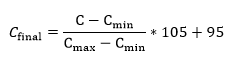
    a) For classifications expressed in whole or decimal form using numerals, the following formula applies:

    being Final The classification converted to the Portuguese scale, C; the classification obtained in the examination as stated on the diploma or certificate., Cmin the minimum foreign scale classification that allows the candidate access to higher education in that country and Cmax the highest rating on the foreign scale.

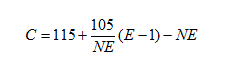
    b) In cases where the classification is presented in alphabetical order, the following formula applies:

    where C is the final classification to be assigned, on a scale of 0 to 200 points, E is the positive grade to be converted, and NE is the number of positive grades existing in the foreign classification system being converted.

    • The conversion of scales with a number of positive levels greater than 10 is subject to case-by-case assessment by the National Commission for Access to Higher Education;
    • In cases where the positive alphabetical levels include classifications expressed in decimals or hundredths, the maximum classification that can be awarded in the respective foreign secondary education system is assigned the maximum classification of 200 points;
    • In cases where an entrance exam is replaced by a combination of two exams from non-Portuguese courses that are legally equivalent to Portuguese secondary education, the verification of the minimum grade requirement for the entrance exam is done after calculating the average of the two exams;
    • In cases where an entrance exam is replaced by a combination of two exams from non-Portuguese courses legally equivalent to Portuguese secondary education, the calculation of the grade to be assigned to the entrance exam must be carried out by converting the grade of each exam to the Portuguese scale, and then calculating the average;
    • Situations not covered in the previous cases are subject to analysis and deliberation by the National Commission for Access to Higher Education, within the scope of the Higher Education Access Competitions;
    • When these distinctions exist in the respective foreign secondary education system, the National Commission for Access to Higher Education deems them justified to receive the maximum score of 200 points.

    Important to note

    • In cases where classifications are expressed to the tenths or hundredths place, conversions are performed before any rounding, which should only occur, if necessary, after the conversion process is complete.
    • The result of the calculation of the aforementioned values is rounded up to the nearest integer when the decimal part is greater than or equal to 0.5, and rounded down to the nearest integer if the decimal part is less than 0.5.
    • The result of the calculation of the aforementioned values is rounded up to the nearest tenth if it has a centesimal part greater than or equal to 0.05, and rounded down to the nearest tenth if it has a centesimal part less than 0.05.


    HOW TO SUBSTITUTE THE EVIDENCE / APPLICATION INSTRUCTIONS

    For the application:

    Access the online application platform

    • with your Portuguese identification number – citizen card or identity card. The identification number will be requested on the online application platform;
    • with an internal number – candidates who do not have a Portuguese identification number need an internal number to access the platform.

    The internal number is requested by the candidate from a Higher Education Access Office (GAES).
    When accessing the online application platform, you will be asked for your internal number.

    Request access password

    • The password request is made on the platform of online application;
    • The applicant indicates their identification number/internal number, name, the email address they wish to use, and the delivery location for the application (they can choose a secondary school or a...). GAES).

    Next, the system sends a message to the indicated email address, containing a confirmation link. By accessing this link The applicant must print the application confirmation receipt and deliver it in person to the secondary school or GAES indicated in the application for confirmation.

    If the applicant is a minor, the application receipt must be signed by their legal guardian or by someone who demonstrates parental or guardianship authority.

    After the request is validated, the password is sent to the candidate's email address.

    You should pay attention

    • The assigned access password is only valid for the year to which the application refers;
    • The access password can be used in all application phases of the same year.


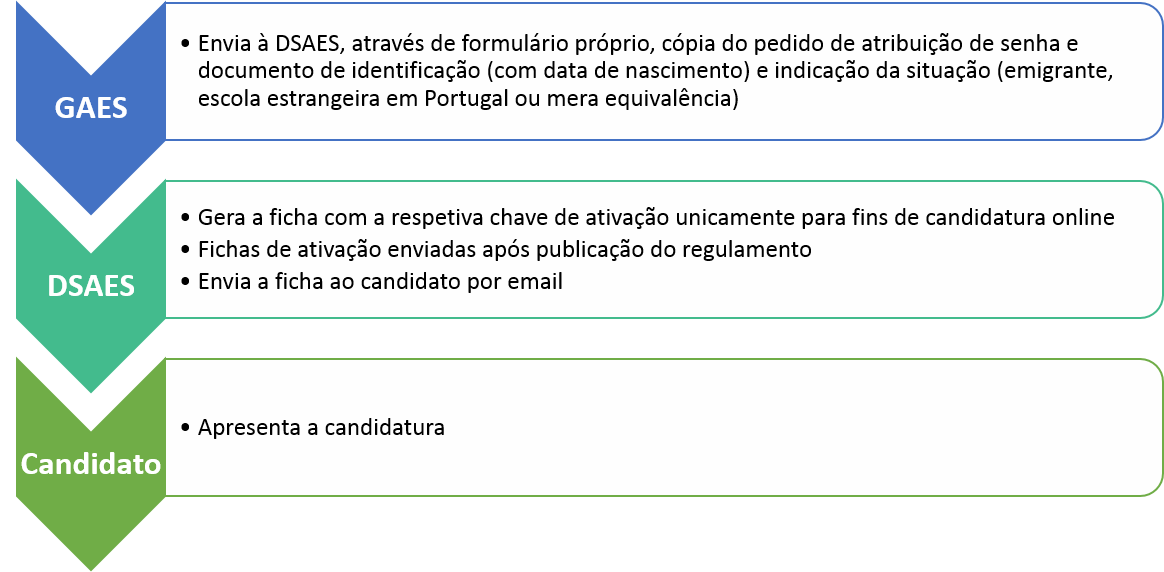
    Activation Form

    Candidates who do not take the Portuguese national final secondary school exams must request an Activation Form from a GAES (Student Support Office).
    The Activation Form contains a code that is requested in the online application and without which it is not possible to proceed with the application.

    Online form

    Once logged into the online application platform, the candidate must complete the application form. Candidates wishing to replace the entrance exams with foreign final exams must indicate this intention in the appropriate section of the online form, namely "Foreign Exam Selection Assistant".

    In case of omission or error in filling out the online form, the candidate will not benefit from the replacement of the entrance exams.

    You should pay attention

    • The online application form for substituting entrance exams with foreign exams must be completed for each phase the candidate applies to (1st phase and/or 2nd phase and/or 3rd phase).


    Upload documents

    The request to replace entrance exams with foreign final exams and the completion of the online form must include the upload of all documents required to support the request.

    Documents to upload:

    • Document proving completion of a foreign secondary education course, indicating the final grade of the course;
    • Proof of completion of foreign final exams, indicating the respective grade and the date on which they were taken;

    Note: These documents must be issued by the legally competent authority of the country to which the foreign secondary education qualification relates.

    • Certificate of equivalence of the foreign education course to Portuguese secondary education, indicating the final grade of the course, converted to a scale of 0 to 200 points;
    • other documents that candidates deem necessary.

    You should pay attention

    • Foreign documents must be authenticated by the Portuguese consular services or embassies in the country to which the qualification refers, or by the consular services or embassies of the foreign countries in Portugal, or with an Apostille of The Hague, for countries that have adhered to the Hague Convention;
    • Foreign documents in languages other than English, French, and Spanish must also be translated into Portuguese by an official translator.


    Conducting Portuguese National Final Exams

    Candidates holding a foreign secondary education qualification may choose to replace the entrance exams with foreign final exams or to take only the national final exams of Portuguese secondary education.

    If you wish to use your foreign secondary school exams and simultaneously take Portuguese national final exams, the following applies:

    • When requesting the replacement of one or more foreign exams, they cannot use the grade from the Portuguese secondary school exam, even if it is higher, when they have taken a corresponding foreign exam;
    • If they have not taken a foreign equivalent exam, they may use their Portuguese exam score to prove their eligibility for entry.

    Non-Portuguese courses equivalent to Portuguese secondary education.

    The system for granting equivalence of qualifications from foreign education systems to qualifications in the Portuguese education system at the secondary education level is defined by... Decree-Law No. 227/2005, of December 28.
    The following are defined by Decree of the Minister responsible for Education:

    • Comparative tables of the Portuguese education system and the education system of each country, and tables with the conversion of grading systems;
    • Comparative tables relating to years of schooling and courses, and conversion tables of grading systems, by educational institution, for foreign schools based in Portugal that offer courses with their own plans and programs;
    • Comparative tables relating to studies and diplomas from courses with their own programs certified by university institutions in third countries or by international non-governmental organizations;
    • Comparative tables relating to studies and diplomas from courses taught in European schools.

    With the publication of Decrees No. 224/2006, of March 8 e No. 699/2006, of July 12, Comparative tables between the Portuguese education system and certain foreign education systems, as well as conversion tables for the corresponding grading systems, have been approved for the following countries:

    • Decree No. 224/2006, of March 8 Germany, Angola, Cape Verde, Russian Federation, Greece, Mexico, Mozambique, United Kingdom, People's Republic of China, and Ukraine.
    • Decree No. 699/2006, of July 12 South Africa, Argentina, Australia, Belgium, Bolivia, Brazil, Bulgaria, Cuba, Denmark, Spain, United States of America, France, Guinea-Bissau, Indonesia, Ireland, Italy, Luxembourg, Morocco, Moldova, Netherlands, Pakistan, Romania, São Tomé and Príncipe, Senegal, Switzerland, East Timor, Tunisia, Turkey, Venezuela, and Zimbabwe.

    Under the terms of Decree-Law No. 227/2005, of December 28, The granting of equivalency is the responsibility of public and private secondary education establishments, which have pedagogical autonomy for the level of education in which equivalency is requested.
    However, requests for foreign equivalencies for which no comparative table has been defined by Order of the Minister responsible for Education must be sent to the Director-General of Education.
    Therefore, to find out if the non-Portuguese qualification held is equivalent to Portuguese secondary education, the student must submit a request for foreign equivalence to a Portuguese secondary school.
    If the institution finds that no comparative table has been defined for the foreign equivalency application submitted, as per the Ministerial Order of Education, the application must be forwarded to the Director-General of Education.
    Applications for equivalence/recognition of qualifications, studies and diplomas from foreign education systems, at the secondary education level.

    CLASSIFICATION OF THE EQUIVALENCE CERTIFICATE

    Under the terms of Article 3 of Decree-Law No. 227/2005, of December 28, In secondary education, equivalence is granted with the assignment of a grade, which may only refer to one complete academic year.

    For the purpose of calculating the classification, the following are approved by the Ministry of Education, through the Decrees No. 224/2006, of March 8 e No. 699/2006, of July 12, Comparative tables between the Portuguese education system and certain foreign education systems, as well as conversion tables for the corresponding grading systems.

    With respect to the provisions of Article 12 of Law No. 46/86, of October 14 – Basic Law of the Education System, in its updated version by Law No. 49/2005, of August 30, And in accordance with the principle of mandatory use of the final secondary school grade in the ranking process, the equivalence certificate required for access and admission to Portuguese higher education must contain a final grade corresponding to the final average of secondary education.

    Classification relating solely to one complete academic year.
    The equivalency certificate required for access and admission to Portuguese higher education must contain a final grade corresponding to the final average of the secondary education course.
    Students in Portuguese secondary education who attend a school year, or part of that schooling, as part of a foreign secondary education course, are considered integrated into the Portuguese education system, as it is their system of origin.

    Therefore, the presentation of an equivalency certificate, issued by the competent entities of the Ministry of Education, with a final grade identified as corresponding only to one academic year and not to the final average of secondary education, does not entitle students to replace entrance exams with foreign exams taken.

    Students who fall into this situation and intend to apply to Portuguese higher education must register to take the national final secondary school exams at a secondary school in order to validate the entrance exams required for access to the courses they wish to apply for.

    European Secondary School Diploma

    • Students holding qualifications from European Schools are subject to the same access rules for higher education in Portugal as students integrated into the Portuguese education system.
    • Decree No. 1/97, of January 3 Convention concerning the status of European schools

    LEGISLATION

    Decree-Law No. 64-A/2023, of July 31, 2023
    Decree-Law, No. 11/2020, of April 2, 2020
    Decree-Law No. 90/2008, of May 30
    Decree-Law No. 45/2007, of February 23
    Decree-Law No. 40/2007, of February 20
    Decree-Law No. 147-A/2006, of July 31
    Decree-Law No. 158/2004, of June 30
    Decree-Law No. 76/2004, of March 27
    Decree-Law No. 26/2003, of February 7
    Decree-Law, No. 99/99, of March 30
    Decree-Law No. 64-A/2023, of July 31, 2023
    Status: Active

  • Offices for Access to Higher Education (GAES)

    We kindly ask that you contact the Higher Education Access Office by phone or email before visiting in person to discuss matters related to your higher education application. Currently, some Higher Education Access Offices operate by appointment only.

    • Aveiro
      1. University of Aveiro. Academic Services Division, Santiago University Campus, 3810-193 Aveiro. Email: acesso@ua.pt. Telephone numbers: 234 370 200 and 234 370 347.
    • Beja
      1. Polytechnic Institute of Beja. Common Services II – IP Beja Campus, Rua Pedro Soares, 7800-295 Beja. Email: acesso@ipbeja.pt. Telephone: 284 314 400.
    • Braga
      1. University of Minho. Academic Management Service, Gualtar Campus, 4710-057 Braga. Email: acesso@usga.uminho.pt. Telephone: 253 604 593.
      2. Polytechnic Institute of Cávado and Ave. IPCA Campus, Rua do Aldão, 4750-810 Barcelos. Email: gabineteacesso@ipca.pt. Telephone: 253 802 509.
    • Bragança
      1. Polytechnic Institute of Bragança. Academic Services – Central Services, Santa Apolónia Campus, 5300-302 Bragança. Email: saipb@ipb.pt. Telephone: 273 330 850.
    • White Castle
      1. University of Beira Interior. Office for Access to Higher Education, Rua Marquês d'Ávila e Bolama, 6200-001 Covilhã. Email: acesso@ubi.pt. Telephone numbers: 275 242 014 and 275 319 700.
      2. Castelo Branco Polytechnic Institute. Avenida Pedro Álvares Cabral, No. 12, 6000-084 Castelo Branco. Email: acesso@ipcb.pt. Telephone numbers: 272 339 600 and 272 339 628.
    • Coimbra
      1. University of Coimbra. Student Hub, FMUC Building – Pólo I, Rua Larga, 3004-504 Coimbra. Email: acessoaoensinosuperior@uc.pt. Telephone: 239 247 195.
      2. Coimbra Polytechnic Institute. Rua da Misericórdia, Lagar dos Cortiços, São Martinho do Bispo, 3045-093 Coimbra. E-mail: gabinete.acesso@mail.ipc.pt. Telephone: 239 791 250.
    • Évora
      1. University of Évora. Santo Agostinho Building, Rua dos Duques de Cadaval, 7000-883 Évora. Email: gaes@uevora.pt. Telephone: 266 760 220.
    • Faro
      1. University of Algarve. Academic Services, Penha Campus, 8005-139 Faro. Email: gabineteacesso@ualg.pt. Telephone: 289 800 997.
    • Guard
      1. Polytechnic Institute of Guarda. IPG Campus, Avenida Dr. Francisco Sá Carneiro, No. 50, 6300-559 Guarda. Email: info.ipg@ipg.pt. Telephone numbers: 271 220 100 and 961 903 792.
    • Leiria
      1. Leiria Polytechnic Institute. General Norton de Matos Street, P.O. Box 4133, 2411-901 Leiria. Email: acesso@ipleiria.pt. Telephone: 244 830 013.
    • Lisbon
      1. University of Lisbon. Alameda da Universidade, Cidade Universitária, 1649-004 Lisboa. E-mail: acessoensinosuperior@ulisboa.pt. Telephone: 210 113 400.
      2. Nova University of Lisbon. Campus de Campolide, 1099-085 Lisbon. E-mail: gab-candidaturas@unl.pt. Telephone: 213 715 616.
      3. Lisbon Polytechnic Institute. Benfica Road, 529, 1549-020 Lisbon. Email: academica@sp.ipl.pt. Telephone: 217 101 200.
      4. ISCTE – University Institute of Lisbon. Sedas Nunes Building, Room 1S03, Avenida das Forças Armadas, 1649-026 Lisbon. Email: admissions@iscte-iul.pt. Telephone: 210 464 048.
    • Portalegre
      1. Polytechnic Institute of Portalegre. Municipal Square, 7300-100 Portalegre. E-mail: acesso.ipp@ipportalegre.pt. Telephone: 245 301 533.
    • Harbor
      1. University of Porto. Rectorate – Academic Training and Organization, Largo do Professor Abel Salazar, 24 (Abel Salazar Building), 4099-002 Porto. Email: acesso.es@reit.up.pt. Telephone: 220 408 237.
      2. Porto Polytechnic Institute. Dr. Roberto Frias Street, 712, 4200-465 Porto. Email: candidaturas@ipp.pt. Telephones: 225 571 039/40.
    • Santarém
      1. Polytechnic Institute of Santarém. Andaluz Complex, Moinho do Fau, P.O. Box 279, 2001-904 Santarém. Email: academicos@ipsantarem.pt. Telephone: 243 309 520.
      2. Polytechnic Institute of Tomar. Estrada da Serra, Quinta do Contador, 2300-313 Tomar. E-mail: acessoensinosuperior@ipt.pt. Telephone numbers: 249 328 107 and 249 328 216.
    • Setúbal
      1. Polytechnic Institute of Setúbal. School of Business Sciences, IPS Campus – Estefanilha, 2914-503 Setúbal. Email: divisao.academica@ips.pt. Telephone: 265 709 470.
    • Viana do Castelo
      1. Viana do Castelo Polytechnic Institute. Rua Escola Industrial e Comercial Nun'Álvares, n.º 34, 4900-347 Viana do Castelo. E-mail: gabineteacesso@ipvc.pt. Telephone: 258 819 797.
    • Vila Real
      1. University of Trás-os-Montes and Alto Douro. Student Space, Quinta dos Prados, 5001-801 Vila Real. Email: acesso@utad.pt. Telephone: 259 350 010.
    • Viseu
      1. Viseu Polytechnic Institute. Avenida Coronel José Maria Vale de Andrade, Campus Politécnico, 3504-510 Viseu. E-mail: gab.acesso.viseu@sc.ipv.pt. Telephone: 232 480 751.
    • Azores Autonomous Region
      1. Regional Secretariat of Education. Bettencourt Palace, Rua da Rosa, 49, 9700-171 Angra do Heroísmo. Email: dre.ingresso@azores.gov.pt. Telephone numbers: 295 401 100 and 295 401 186.
    • Autonomous Region of Madeira
      1. Regional Secretariat for Education, Science and Technology. Office of Higher Education, Regional Government Building, Avenida Arriaga, 9004-528 Funchal. Email: ensino.superior@madeira.gov.pt. Telephone: 291 145 515.

Calendar

Approved by Order No. 6934/2026, of June 1st | Official Gazette No. 105/2026, Series II of 2026-06-01

Ref.ª Action Home End
1 Submission of applications for the 1st phase of the national competition for access to higher education – candidates for the priority quota for emigrants, family members residing with them and Portuguese descendants, and candidates requesting the substitution of entrance exams with foreign exams. July 20th July 27
Submission of applications for the 1st phase of the national competition for access to higher education – remaining candidates July 20th August 6th
2 Making the placement lists for the first phase of the national competition available electronically to higher education institutions. August 22
3 Announcement of the results of the 1st phase of the national competition. August 23
4 Registration and enrollment in higher education institutions for candidates admitted in the first phase of the national competition. August 24 August 27
5 Submission of complaints regarding the results of the 1st phase of the national competition (1) August 24 August 28
6 Submission of application for the 2nd phase of the national competition. August 24 September 2nd
7 Communication, by higher education institutions to the Institute for Higher Education, IP, of the information referred to in paragraph 4 of article 44 of the national competition regulations. August 28
8 Announcement of the vacancies referred to in paragraph 5 of article 44 of the national competition regulations. September 1st
9 Decision on complaints relating to the 1st phase of the national competition. (1) September 28
10 Making the placement lists for the second phase of the national competition available electronically to higher education institutions. September 13
11 Announcement of the results of the 2nd phase of the national competition. September 13
12 Registration and enrollment in higher education institutions for candidates admitted in the second phase of the national competition. September 14th September 16
13 Presentation of complaints regarding the results of the 2nd phase of the national competition. (1) September 14th September 18
14 Communication, by higher education institutions to the Institute for Higher Education, IP, of the information referred to in paragraph 2 of article 47 and paragraph 5 of article 49 of the national competition regulations. September 17th
15 Announcement of the vacancies referred to in paragraph 3 of article 49 of the national competition regulations. September 21
16 Submission of application for the 3rd phase of the national competition. September 22 September 24th
17 Decision on complaints relating to the 2nd phase of the national competition. (1) October 16
18 Making the placement lists for the 3rd phase of the national competition available electronically to higher education institutions. September 30th
19 Announcement of the results of the 3rd phase of the national competition. September 30th
20 Registration and enrollment in higher education institutions for candidates admitted in the 3rd phase of the national competition. September 30th October 2nd
21 Presentation of complaints regarding the results of the 3rd phase of the national competition. (1) September 30th October 2nd
22 Communication, by higher education institutions to the Institute for Higher Education, IP, of information about candidates placed in the 3rd phase of the national competition who have actually enrolled. October 6th
23 Decision on complaints relating to the 3rd phase of the national competition. (1) October 30th
(1). Complaints may still be submitted and decided upon until the end of the time limits set out in the Administrative Procedure Code.

NOTE: The calendar is awaiting official publication in the Official Gazette by order of the President of IES, IP.

Priority Contingents

In the first phase of the national competition, there are several priority quotas, in addition to the general quota, to which certain percentages of vacancies are allocated, intended for candidates who meet the conditions of each quota.
In the second phase, in addition to the general quota, there is also a priority quota for candidates with disabilities and a priority quota for emigrants, their family members residing with them, and people of Portuguese descent.
In the 3rd phase there is only one single contingent – the general contingent.

See here for all quotas and application requirements.

Application Guide 2026

During the application period, students have access to all information regarding access to higher education in [location]. iesuperior.pt

They can also contact the Higher Education Access Offices (GAES), which exist in higher education institutions on the mainland and in the Autonomous Regions of the Azores and Madeira.

This publication contains the following elements and information:

Practical guidelines for completing the application process;

  • Higher education training offer indicating the pairs of public higher education institutions/courses and the number of places allocated for the 2026 national access competition, specifying for each:
  1. Whether prerequisites are required, as well as how to prove them;
  2. The required entrance exams;
  3. The minimum required scores for the entrance exams and the application grade, as well as the formula for calculating the application grade;
  4. Assigning different weights to entrance exams, when applicable;
  5. The existence of regional preference in access to institution/course pairs in education.
    higher polytechnic and the respective percentage of reserved places;
  6. The existence of preferential qualifications for access to institution/course pairs in polytechnic higher education and the respective percentage of places reserved.

The following information is also attached:

  • Equivalent prerequisite groups and information on prerequisite certification (Annex I);
  • A list of public higher education courses that are subject to local admission and an indication of where students should go to obtain additional information (Annex II);
  • Contact details for the Higher Education Access Offices (Annex III).

Students wishing to apply to private higher education should consult the publication "Guide to Applications to Private Higher Education 2026" or contact their chosen institution.

Consult the 2026 Application Guide

Course Selection Assistant

The Course Selection Assistant allows you to find institution/course pairs that meet certain conditions.

After fulfilling the relevant conditions, you can access the results page to obtain the list of institution/course pairs that meet them (cumulatively).

To start a new search, you should use the "Clear Selections" button, which cancels all previously entered conditions.

Available search conditions:

1. Course
2. Institution
3. Other conditions

CANDIDATURA ONLINE

Online Application

PASSWORD ASSIGNMENT REQUEST

Instructions

Through this page you can request the password needed to apply to public higher education.

In the following steps you will be able to fill in your identification, the email address through which you wish to receive the password, and the indication of the school or the Higher Education Access Office (GAES) where you will certify this request.

After submitting this information, you will receive instructions to confirm your Password Assignment Request and print the corresponding receipt at the email address you provided. If, after submitting your Password Assignment Request, you do not receive the confirmation instructions, please access [link/resource]. Check Order Status.

You must present the Password Assignment Request receipt and your identification at the school or Higher Education Access Office (GAES) you select, in order to certify your order.

After confirming your request, your access password will be sent to your email address.

You can then log in using the password sent to you or by authenticating with your citizen card or digital mobile key.

If you do not have a valid identification number (citizen card or internal number assigned by your school), you must submit one instead. Request for Password and Identification Number Assignment, which, once confirmed, must be presented at an Office for Access to Higher Education.

ONLINE APPLICATION

Through this page you can start a session on the online application site, authenticating yourself using your identification number and access password.

Students who are not yet registered on this site should request registration through the page. Password Request.

Replacing Entrance Exams with Foreign Language Exams

Students with foreign secondary education

It's important to know:

  • that your foreign secondary education course must be equivalent to Portuguese secondary education (How do you obtain the equivalence?);
  • who has to take national or foreign final exams;
  • that foreign final exams must be equivalent to the Portuguese entrance exams;
  • which can only replace entrance exams with equivalent foreign final exams, according to the CNAES Deliberations in effect;
  • who can also take the Portuguese national final exams;
  • If you wish to apply for a course that requires prerequisites, please consult the information here.

Notice: O Order No. 7714/2020, of August 6, establishes procedures for simplifying the processing of equivalencies for foreign secondary education qualifications and for registration for national final exams for citizens residing outside the national territory.

Foreign Secondary Education Course Equivalent to Portuguese Secondary Education

To obtain equivalence between a foreign secondary education course and a Portuguese secondary education course, you must request a certificate of equivalence.

  • The certificate of equivalence is issued by secondary schools in Portugal or by the Directorate-General for Education, where applicable. https://area.dge.mec.pt/dsdccomext/
  • The equivalency certificate must identify the foreign secondary education course and its final grade, on a scale of 0 to 200 points.
  • You can find more information about foreign equivalencies. here

FINAL NATIONAL AND FOREIGN EXAMS

To replace entrance exams, foreign final exams must cumulatively meet the following conditions:

  • Having a national scope – these are tests required for admission to higher education in that country that constitute exams of national scope or,
  • have national recognition. If the country does not require entrance exams for higher education, final exams in foreign secondary education subjects that constitute national exams, or local exams in the foreign country, and have national recognition are considered.
  • to be homologous exams to the entrance exams.
  • to be valid as a substitute for entrance exams.
    Exams taken since 2022 are valid for five years, that is, the year they are taken and the following four years.

HOMOLOGOUS FOREIGN EXAMS

The homologation of foreign exams is determined by the National Commission for Access to Higher Education (CNAES).
CNAES publishes annually, by May 31st of the application year, a resolution with the list of equivalent foreign final exams.

For the application, please consult the information released by CNAES.

Exam classification

The grading of foreign exams, when used as entrance exams, is converted to the Portuguese scale of 0 to 200 points.

a) For classifications expressed in whole or decimal form using numerals, the following formula applies:

being Final The classification converted to the Portuguese scale, C; the classification obtained in the examination as stated on the diploma or certificate., Cmin the minimum foreign scale classification that allows the candidate access to higher education in that country and Cmax the highest rating on the foreign scale.

b) In cases where the classification is presented in alphabetical order, the following formula applies:

where C is the final classification to be assigned, on a scale of 0 to 200 points, E is the positive grade to be converted, and NE is the number of positive grades existing in the foreign classification system being converted.

  • The conversion of scales with a number of positive levels greater than 10 is subject to case-by-case assessment by the National Commission for Access to Higher Education;
  • In cases where the positive alphabetical levels include classifications expressed in decimals or hundredths, the maximum classification that can be awarded in the respective foreign secondary education system is assigned the maximum classification of 200 points;
  • In cases where an entrance exam is replaced by a combination of two exams from non-Portuguese courses that are legally equivalent to Portuguese secondary education, the verification of the minimum grade requirement for the entrance exam is done after calculating the average of the two exams;
  • In cases where an entrance exam is replaced by a combination of two exams from non-Portuguese courses legally equivalent to Portuguese secondary education, the calculation of the grade to be assigned to the entrance exam must be carried out by converting the grade of each exam to the Portuguese scale, and then calculating the average;
  • Situations not covered in the previous cases are subject to analysis and deliberation by the National Commission for Access to Higher Education, within the scope of the Higher Education Access Competitions;
  • When these distinctions exist in the respective foreign secondary education system, the National Commission for Access to Higher Education deems them justified to receive the maximum score of 200 points.

Important to note

  • In cases where classifications are expressed to the tenths or hundredths place, conversions are performed before any rounding, which should only occur, if necessary, after the conversion process is complete.
  • The result of the calculation of the aforementioned values is rounded up to the nearest integer when the decimal part is greater than or equal to 0.5, and rounded down to the nearest integer if the decimal part is less than 0.5.
  • The result of the calculation of the aforementioned values is rounded up to the nearest tenth if it has a centesimal part greater than or equal to 0.05, and rounded down to the nearest tenth if it has a centesimal part less than 0.05.


HOW TO SUBSTITUTE THE EVIDENCE / APPLICATION INSTRUCTIONS

For the application:

Access the online application platform

  • with your Portuguese identification number – citizen card or identity card. The identification number will be requested on the online application platform;
  • with an internal number – candidates who do not have a Portuguese identification number need an internal number to access the platform.

The internal number is requested by the candidate from a Higher Education Access Office (GAES).
When accessing the online application platform, you will be asked for your internal number.

Request access password

  • The password request is made on the platform of online application;
  • The applicant indicates their identification number/internal number, name, the email address they wish to use, and the delivery location for the application (they can choose a secondary school or a...). GAES).

Next, the system sends a message to the indicated email address, containing a confirmation link. By accessing this link The applicant must print the application confirmation receipt and deliver it in person to the secondary school or GAES indicated in the application for confirmation.

If the applicant is a minor, the application receipt must be signed by their legal guardian or by someone who demonstrates parental or guardianship authority.

After the request is validated, the password is sent to the candidate's email address.

You should pay attention

  • The assigned access password is only valid for the year to which the application refers;
  • The access password can be used in all application phases of the same year.


Activation Form

Candidates who do not take the Portuguese national final secondary school exams must request an Activation Form from a GAES (Student Support Office).
The Activation Form contains a code that is requested in the online application and without which it is not possible to proceed with the application.

Online form

Once logged into the online application platform, the candidate must complete the application form. Candidates wishing to replace the entrance exams with foreign final exams must indicate this intention in the appropriate section of the online form, namely "Foreign Exam Selection Assistant".

In case of omission or error in filling out the online form, the candidate will not benefit from the replacement of the entrance exams.

You should pay attention

  • The online application form for substituting entrance exams with foreign exams must be completed for each phase the candidate applies to (1st phase and/or 2nd phase and/or 3rd phase).


Upload documents

The request to replace entrance exams with foreign final exams and the completion of the online form must include the upload of all documents required to support the request.

Documents to upload:

  • Document proving completion of a foreign secondary education course, indicating the final grade of the course;
  • Proof of completion of foreign final exams, indicating the respective grade and the date on which they were taken;

Note: These documents must be issued by the legally competent authority of the country to which the foreign secondary education qualification relates.

  • Certificate of equivalence of the foreign education course to Portuguese secondary education, indicating the final grade of the course, converted to a scale of 0 to 200 points;
  • other documents that candidates deem necessary.

You should pay attention

  • Foreign documents must be authenticated by the Portuguese consular services or embassies in the country to which the qualification refers, or by the consular services or embassies of the foreign countries in Portugal, or with an Apostille of The Hague, for countries that have adhered to the Hague Convention;
  • Foreign documents in languages other than English, French, and Spanish must also be translated into Portuguese by an official translator.


Conducting Portuguese National Final Exams

Candidates holding a foreign secondary education qualification may choose to replace the entrance exams with foreign final exams or to take only the national final exams of Portuguese secondary education.

If you wish to use your foreign secondary school exams and simultaneously take Portuguese national final exams, the following applies:

  • When requesting the replacement of one or more foreign exams, they cannot use the grade from the Portuguese secondary school exam, even if it is higher, when they have taken a corresponding foreign exam;
  • If they have not taken a foreign equivalent exam, they may use their Portuguese exam score to prove their eligibility for entry.

Non-Portuguese courses equivalent to Portuguese secondary education.

The system for granting equivalence of qualifications from foreign education systems to qualifications in the Portuguese education system at the secondary education level is defined by... Decree-Law No. 227/2005, of December 28.
The following are defined by Decree of the Minister responsible for Education:

  • Comparative tables of the Portuguese education system and the education system of each country, and tables with the conversion of grading systems;
  • Comparative tables relating to years of schooling and courses, and conversion tables of grading systems, by educational institution, for foreign schools based in Portugal that offer courses with their own plans and programs;
  • Comparative tables relating to studies and diplomas from courses with their own programs certified by university institutions in third countries or by international non-governmental organizations;
  • Comparative tables relating to studies and diplomas from courses taught in European schools.

With the publication of Decrees No. 224/2006, of March 8 e No. 699/2006, of July 12, Comparative tables between the Portuguese education system and certain foreign education systems, as well as conversion tables for the corresponding grading systems, have been approved for the following countries:

  • Decree No. 224/2006, of March 8 Germany, Angola, Cape Verde, Russian Federation, Greece, Mexico, Mozambique, United Kingdom, People's Republic of China, and Ukraine.
  • Decree No. 699/2006, of July 12 South Africa, Argentina, Australia, Belgium, Bolivia, Brazil, Bulgaria, Cuba, Denmark, Spain, United States of America, France, Guinea-Bissau, Indonesia, Ireland, Italy, Luxembourg, Morocco, Moldova, Netherlands, Pakistan, Romania, São Tomé and Príncipe, Senegal, Switzerland, East Timor, Tunisia, Turkey, Venezuela, and Zimbabwe.

Under the terms of Decree-Law No. 227/2005, of December 28, The granting of equivalency is the responsibility of public and private secondary education establishments, which have pedagogical autonomy for the level of education in which equivalency is requested.
However, requests for foreign equivalencies for which no comparative table has been defined by Order of the Minister responsible for Education must be sent to the Director-General of Education.
Therefore, to find out if the non-Portuguese qualification held is equivalent to Portuguese secondary education, the student must submit a request for foreign equivalence to a Portuguese secondary school.
If the institution finds that no comparative table has been defined for the foreign equivalency application submitted, as per the Ministerial Order of Education, the application must be forwarded to the Director-General of Education.
Applications for equivalence/recognition of qualifications, studies and diplomas from foreign education systems, at the secondary education level.

CLASSIFICATION OF THE EQUIVALENCE CERTIFICATE

Under the terms of Article 3 of Decree-Law No. 227/2005, of December 28, In secondary education, equivalence is granted with the assignment of a grade, which may only refer to one complete academic year.

For the purpose of calculating the classification, the following are approved by the Ministry of Education, through the Decrees No. 224/2006, of March 8 e No. 699/2006, of July 12, Comparative tables between the Portuguese education system and certain foreign education systems, as well as conversion tables for the corresponding grading systems.

With respect to the provisions of Article 12 of Law No. 46/86, of October 14 – Basic Law of the Education System, in its updated version by Law No. 49/2005, of August 30, And in accordance with the principle of mandatory use of the final secondary school grade in the ranking process, the equivalence certificate required for access and admission to Portuguese higher education must contain a final grade corresponding to the final average of secondary education.

Classification relating solely to one complete academic year.
The equivalency certificate required for access and admission to Portuguese higher education must contain a final grade corresponding to the final average of the secondary education course.
Students in Portuguese secondary education who attend a school year, or part of that schooling, as part of a foreign secondary education course, are considered integrated into the Portuguese education system, as it is their system of origin.

Therefore, the presentation of an equivalency certificate, issued by the competent entities of the Ministry of Education, with a final grade identified as corresponding only to one academic year and not to the final average of secondary education, does not entitle students to replace entrance exams with foreign exams taken.

Students who fall into this situation and intend to apply to Portuguese higher education must register to take the national final secondary school exams at a secondary school in order to validate the entrance exams required for access to the courses they wish to apply for.

European Secondary School Diploma

  • Students holding qualifications from European Schools are subject to the same access rules for higher education in Portugal as students integrated into the Portuguese education system.
  • Decree No. 1/97, of January 3 Convention concerning the status of European schools

LEGISLATION

Decree-Law No. 64-A/2023, of July 31, 2023
Decree-Law, No. 11/2020, of April 2, 2020
Decree-Law No. 90/2008, of May 30
Decree-Law No. 45/2007, of February 23
Decree-Law No. 40/2007, of February 20
Decree-Law No. 147-A/2006, of July 31
Decree-Law No. 158/2004, of June 30
Decree-Law No. 76/2004, of March 27
Decree-Law No. 26/2003, of February 7
Decree-Law, No. 99/99, of March 30
Decree-Law No. 64-A/2023, of July 31, 2023
Status: Active

Offices for Access to Higher Education (GAES)

We kindly ask that you contact the Higher Education Access Office by phone or email before visiting in person to discuss matters related to your higher education application. Currently, some Higher Education Access Offices operate by appointment only.

  • Aveiro
    1. University of Aveiro. Academic Services Division, Santiago University Campus, 3810-193 Aveiro. Email: acesso@ua.pt. Telephone numbers: 234 370 200 and 234 370 347.
  • Beja
    1. Polytechnic Institute of Beja. Common Services II – IP Beja Campus, Rua Pedro Soares, 7800-295 Beja. Email: acesso@ipbeja.pt. Telephone: 284 314 400.
  • Braga
    1. University of Minho. Academic Management Service, Gualtar Campus, 4710-057 Braga. Email: acesso@usga.uminho.pt. Telephone: 253 604 593.
    2. Polytechnic Institute of Cávado and Ave. IPCA Campus, Rua do Aldão, 4750-810 Barcelos. Email: gabineteacesso@ipca.pt. Telephone: 253 802 509.
  • Bragança
    1. Polytechnic Institute of Bragança. Academic Services – Central Services, Santa Apolónia Campus, 5300-302 Bragança. Email: saipb@ipb.pt. Telephone: 273 330 850.
  • White Castle
    1. University of Beira Interior. Office for Access to Higher Education, Rua Marquês d'Ávila e Bolama, 6200-001 Covilhã. Email: acesso@ubi.pt. Telephone numbers: 275 242 014 and 275 319 700.
    2. Castelo Branco Polytechnic Institute. Avenida Pedro Álvares Cabral, No. 12, 6000-084 Castelo Branco. Email: acesso@ipcb.pt. Telephone numbers: 272 339 600 and 272 339 628.
  • Coimbra
    1. University of Coimbra. Student Hub, FMUC Building – Pólo I, Rua Larga, 3004-504 Coimbra. Email: acessoaoensinosuperior@uc.pt. Telephone: 239 247 195.
    2. Coimbra Polytechnic Institute. Rua da Misericórdia, Lagar dos Cortiços, São Martinho do Bispo, 3045-093 Coimbra. E-mail: gabinete.acesso@mail.ipc.pt. Telephone: 239 791 250.
  • Évora
    1. University of Évora. Santo Agostinho Building, Rua dos Duques de Cadaval, 7000-883 Évora. Email: gaes@uevora.pt. Telephone: 266 760 220.
  • Faro
    1. University of Algarve. Academic Services, Penha Campus, 8005-139 Faro. Email: gabineteacesso@ualg.pt. Telephone: 289 800 997.
  • Guard
    1. Polytechnic Institute of Guarda. IPG Campus, Avenida Dr. Francisco Sá Carneiro, No. 50, 6300-559 Guarda. Email: info.ipg@ipg.pt. Telephone numbers: 271 220 100 and 961 903 792.
  • Leiria
    1. Leiria Polytechnic Institute. General Norton de Matos Street, P.O. Box 4133, 2411-901 Leiria. Email: acesso@ipleiria.pt. Telephone: 244 830 013.
  • Lisbon
    1. University of Lisbon. Alameda da Universidade, Cidade Universitária, 1649-004 Lisboa. E-mail: acessoensinosuperior@ulisboa.pt. Telephone: 210 113 400.
    2. Nova University of Lisbon. Campus de Campolide, 1099-085 Lisbon. E-mail: gab-candidaturas@unl.pt. Telephone: 213 715 616.
    3. Lisbon Polytechnic Institute. Benfica Road, 529, 1549-020 Lisbon. Email: academica@sp.ipl.pt. Telephone: 217 101 200.
    4. ISCTE – University Institute of Lisbon. Sedas Nunes Building, Room 1S03, Avenida das Forças Armadas, 1649-026 Lisbon. Email: admissions@iscte-iul.pt. Telephone: 210 464 048.
  • Portalegre
    1. Polytechnic Institute of Portalegre. Municipal Square, 7300-100 Portalegre. E-mail: acesso.ipp@ipportalegre.pt. Telephone: 245 301 533.
  • Harbor
    1. University of Porto. Rectorate – Academic Training and Organization, Largo do Professor Abel Salazar, 24 (Abel Salazar Building), 4099-002 Porto. Email: acesso.es@reit.up.pt. Telephone: 220 408 237.
    2. Porto Polytechnic Institute. Dr. Roberto Frias Street, 712, 4200-465 Porto. Email: candidaturas@ipp.pt. Telephones: 225 571 039/40.
  • Santarém
    1. Polytechnic Institute of Santarém. Andaluz Complex, Moinho do Fau, P.O. Box 279, 2001-904 Santarém. Email: academicos@ipsantarem.pt. Telephone: 243 309 520.
    2. Polytechnic Institute of Tomar. Estrada da Serra, Quinta do Contador, 2300-313 Tomar. E-mail: acessoensinosuperior@ipt.pt. Telephone numbers: 249 328 107 and 249 328 216.
  • Setúbal
    1. Polytechnic Institute of Setúbal. School of Business Sciences, IPS Campus – Estefanilha, 2914-503 Setúbal. Email: divisao.academica@ips.pt. Telephone: 265 709 470.
  • Viana do Castelo
    1. Viana do Castelo Polytechnic Institute. Rua Escola Industrial e Comercial Nun'Álvares, n.º 34, 4900-347 Viana do Castelo. E-mail: gabineteacesso@ipvc.pt. Telephone: 258 819 797.
  • Vila Real
    1. University of Trás-os-Montes and Alto Douro. Student Space, Quinta dos Prados, 5001-801 Vila Real. Email: acesso@utad.pt. Telephone: 259 350 010.
  • Viseu
    1. Viseu Polytechnic Institute. Avenida Coronel José Maria Vale de Andrade, Campus Politécnico, 3504-510 Viseu. E-mail: gab.acesso.viseu@sc.ipv.pt. Telephone: 232 480 751.
  • Azores Autonomous Region
    1. Regional Secretariat of Education. Bettencourt Palace, Rua da Rosa, 49, 9700-171 Angra do Heroísmo. Email: dre.ingresso@azores.gov.pt. Telephone numbers: 295 401 100 and 295 401 186.
  • Autonomous Region of Madeira
    1. Regional Secretariat for Education, Science and Technology. Office of Higher Education, Regional Government Building, Avenida Arriaga, 9004-528 Funchal. Email: ensino.superior@madeira.gov.pt. Telephone: 291 145 515.

FAQs

Atualizado em July 14, 2026